

The Indivisible Thread: Medicine's Progress Woven with the Fabric of Knowledge
Summary: The relentless progress of medicine is not merely a chronicle of scientific breakthroughs; it is a profound philosophical journey, inextricably linked to humanity's evolving understanding of the world and itself. From ancient empirical observations to modern genetic engineering, each advancement in healing has been predicated on the expansion of knowledge, fundamentally altering our perceptions of life and death, and challenging us to confront the ethical frontiers of our capabilities. This article explores how our quest to alleviate suffering and prolong existence has mirrored, and often driven, the very development of human inquiry.
The story of medicine is, at its heart, the story of knowledge. It is an ongoing narrative of observation, hypothesis, experimentation, and refinement, pushing the boundaries of what we understand about the human body, disease, and the very processes of life and death. When we speak of progress in medicine, we are not just celebrating new drugs or surgical techniques; we are acknowledging a deeper philosophical shift in how humanity apprehends its own physical existence and its place within the natural order.
From Speculation to System: The Ancient Foundations of Medical Knowledge
For millennia, the attempt to heal was intertwined with myth, religion, and nascent philosophy. The "Great Books of the Western World" reveal this early, holistic approach. Thinkers like Hippocrates, often called the "Father of Medicine," moved beyond divine intervention to advocate for empirical observation and logical deduction. His humoral theory, though later superseded, represented a monumental step: an attempt to systematize knowledge about the body based on observable phenomena, rather than supernatural causes.
- Early Philosophical Contributions to Medicine:
- Pre-Socratics: Sought natural explanations for cosmic and bodily phenomena, laying groundwork for scientific inquiry.
- Aristotle: His detailed biological observations and classifications, while not strictly medical, profoundly influenced the understanding of anatomy and physiology for centuries. His emphasis on teleology – the purpose of parts – shaped how functions were perceived.
- Galen: Built upon Hippocrates and Aristotle, creating a comprehensive, albeit flawed, medical system that dominated Western thought for over a thousand years. His extensive anatomical work, often based on animal dissection, was a testament to the pursuit of detailed physical knowledge.
This era established the crucial precedent: progress in medicine required a systematic approach to knowledge gathering, even if that knowledge was limited by the tools and philosophical frameworks of the time. The shift from attributing illness to divine displeasure to seeking natural causes was a fundamental leap in human intellectual development.
The Renaissance and Enlightenment: Accelerating Medical Progress Through Scientific Knowledge
The Renaissance, with its renewed interest in classical texts and human anatomy, sparked a revolution. Figures like Andreas Vesalius, through meticulous human dissection, corrected centuries of Galenic errors, demonstrating the power of direct observation over inherited dogma. This was not just a medical advancement; it was a philosophical declaration: knowledge must be verifiable.
The subsequent Scientific Revolution and Enlightenment cemented this trajectory. The development of the microscope unveiled an unseen world of microbes, leading to germ theory. The concept of controlled experimentation, championed by thinkers like Francis Bacon, provided a robust methodology for acquiring reliable knowledge.
- Key Shifts Driving Medical Progress:
- Empiricism: Reliance on observation and experiment as the primary source of knowledge.
- Rationalism: Application of reason and logic to understand disease processes.
- Mechanistic View: The body increasingly seen as a complex machine, amenable to repair and intervention, influenced by Descartes' philosophy.
This era saw unprecedented progress in understanding disease causation, developing vaccines, and improving surgical techniques. The average human lifespan began to extend, directly challenging historical norms of life and death.
The Philosophical Crossroads: Life, Death, and the Burden of Knowledge
Today, medicine stands at a pinnacle of progress, capable of feats unimaginable even a century ago. Organ transplantation, genetic therapies, advanced imaging – these are testaments to our ever-expanding knowledge. Yet, this immense capability brings profound philosophical challenges, particularly concerning life and death.
| Aspect of Medical Progress | Philosophical Implication |
|---|---|
| Life Prolongation | Redefining what constitutes a "good life" versus mere existence. |
| Genetic Intervention | Ethical debates on human enhancement, designer babies, and identity. |
| End-of-Life Care | The right to choose one's death, palliative care, and dignity. |
| Artificial Intelligence | The role of human judgment and empathy in diagnosis and treatment. |
The very definition of death has become more complex, shifting from a clear, singular event to a spectrum of states, particularly with advancements in life support. Our knowledge allows us to prolong life, but it also forces us to ask: should we? This is the essential philosophical dilemma embedded within medical progress. We are no longer just passive recipients of fate; we are active agents, shaping the boundaries of our own mortality.
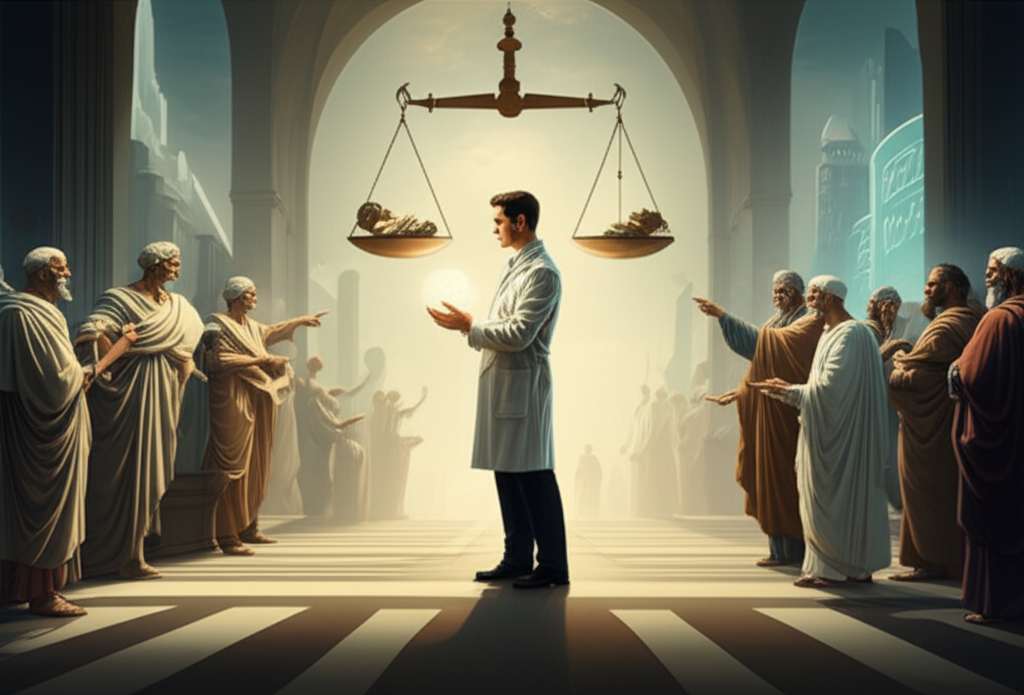
The Great Books remind us that humanity has always grappled with suffering and mortality. From the epic struggles of Achilles to the Socratic examination of the soul, the philosophical tradition has sought meaning in the face of inevitable death. Modern medicine, powered by knowledge, offers unprecedented tools, but it does not absolve us of the need for wisdom in their application. The progress of medicine is thus a mirror reflecting our deepest values, our understanding of human dignity, and our ongoing dialogue with the ultimate mysteries of life and death.
YouTube Suggestions:
-
📹 Related Video: ARISTOTLE ON: The Nicomachean Ethics
Video by: The School of Life
💡 Want different videos? Search YouTube for: "Philosophy of Medical Ethics History"
-
📹 Related Video: What is Philosophy?
Video by: The School of Life
💡 Want different videos? Search YouTube for: "What is Life Philosophy Death"