

The Unfolding Enigma: Grappling with the Problem of Time and Space
"The Problem of Time and Space" is a foundational philosophical inquiry, challenging us to understand the very fabric of existence. Are these concepts fundamental realities or mere constructs of our minds? From ancient Greek musings to modern scientific theories, thinkers have wrestled with their nature, their quantity, and how they shape our perception of the world. This article delves into the enduring philosophical problem of these elusive dimensions, drawing insights from the rich tapestry of Western thought.
Hello, fellow wanderers in the realm of ideas! Chloe here, ready to tackle one of philosophy's most persistent and mind-bending challenges: The Problem of Time and Space. It’s a question that truly gets to the heart of what it means to exist, to perceive, and to understand the universe around us. We use these words every day – "in time," "in space" – but when we pause to truly dissect them, they unravel into a dizzying array of paradoxes and profound mysteries. Are they containers for reality, or are they woven from reality itself? Let's take a journey through the ages, guided by some of the greatest minds, to explore this captivating enigma.
Historical Echoes: The Enduring Problem Through the Ages
The problem of time and space isn't new; it's a venerable old friend in philosophical discourse, extensively explored in the Great Books of the Western World.
- Ancient Roots: Thinkers like Plato, in his Timaeus, explored the creation of the cosmos and with it, the nature of time as a "moving image of eternity." Aristotle, in his Physics, saw time as the number of motion with respect to "before" and "after," and space (or "place") as the innermost motionless boundary of what contains a body. For them, these weren't abstract vacuums but intimately tied to change and existence.
- Medieval Meditations: St. Augustine, in his Confessions, famously pondered, "What then is time? If no one asks me, I know; if I wish to explain it to one who asks, I know not." He saw time as subjective, existing in the mind through memory, present attention, and expectation, rather than an objective external quantity.
- The Dawn of Modernity: The scientific revolution brought new perspectives. Isaac Newton posited absolute time and absolute space – independent, unchanging frameworks that existed whether anything was in them or not. They were like a grand, invisible stage upon which the cosmic drama unfolded.
- Leibniz's Relational View: But Gottfried Leibniz challenged Newton. He argued that space and time are not absolute entities but relational. Space is merely the order of co-existing things, and time is the order of successive events. Without objects or events, there is no space or time. This was a direct confrontation about the fundamental quantity and nature of these concepts.
- Kant's Synthesis: Immanuel Kant, a titan of philosophy, offered a revolutionary perspective in his Critique of Pure Reason. He argued that space and time are not properties of things-in-themselves, nor are they empirical concepts derived from experience. Instead, they are a priori forms of intuition – necessary structures of the human mind through which we experience the world. We can't perceive anything outside of space and time because our minds are hardwired to process reality through these lenses.
Time: The Elusive Flow
What is time? Is it a flowing river, carrying us inevitably from past to future? Or is it a series of discrete moments, like frames in a film? The problem of time is multifaceted:
- The Arrow of Time: Why does time only move forward? The fundamental laws of physics are largely time-symmetric, yet our experience is unequivocally unidirectional. This irreversibility is a profound problem.
- Subjectivity vs. Objectivity: Augustine's lament resonates. We feel time pass, but does it pass independently of our consciousness? Is the past truly gone, the future not yet real, and only the present truly exists?
- The Problem of "Now": Where is the "now"? Is it a point without duration, constantly slipping away? If it has duration, then it contains a past and a future, which contradicts its nature as "now."
- Time's Quantity: Can we truly quantify time? We measure it in seconds, minutes, years, but these are human constructs. What is the fundamental unit, if any? Is it infinitely divisible, or are there discrete "quanta" of time?
Space: The Boundless Mystery
And what about space? Is it an empty void, waiting to be filled, or is it fundamentally intertwined with matter and energy? The problem of space is equally perplexing:
- Infinite or Finite? Is space boundless, stretching on forever, or does it curve back on itself, like the surface of a sphere, having no edge but a finite quantity?
- Discrete or Continuous? Can space be divided infinitely into smaller and smaller points, or is there a fundamental, indivisible unit of space? The concept of a "Planck length" in physics hints at a lower limit, but philosophically, the problem of infinite divisibility persists.
- Absolute vs. Relational (Revisited): The Newton-Leibniz debate continues to echo. Is space a container that exists independently of objects, or is it merely the relationship between objects? If the universe were empty, would space still exist?
- Space's Quantity: How do we quantify something that can appear empty? We measure distance, area, volume – but these are measures of objects in space, or the extent of space. What is the intrinsic quantity of space itself, if it's not simply "nothingness" or "extension"?
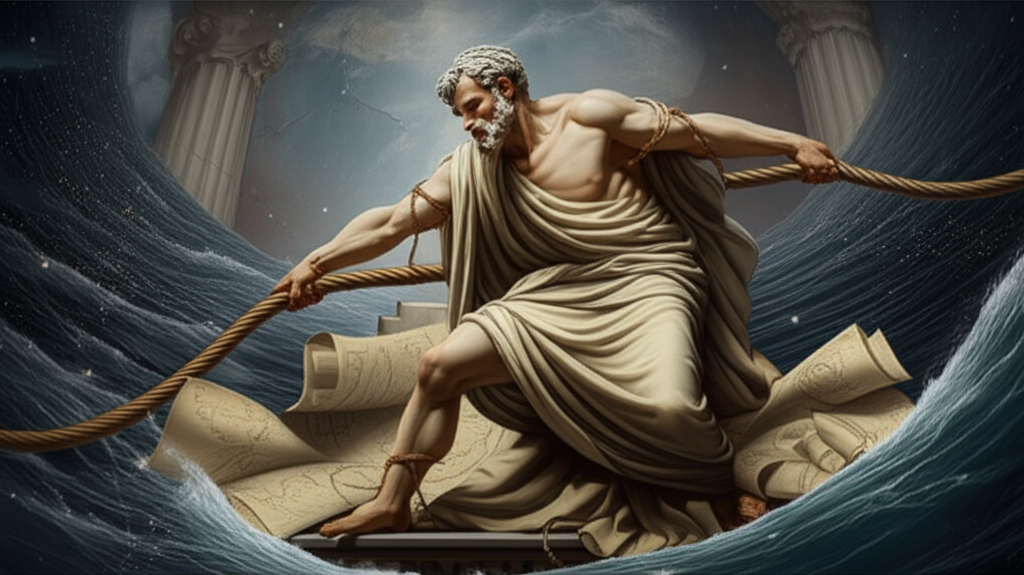
The Intertwined Problem: Space-Time and the Challenge of Quantity
Modern physics, particularly Einstein's theories of relativity, has shown us that time and space are not separate entities but are interwoven into a single fabric called spacetime. This revolutionary idea has profound philosophical implications. The "Problem" shifts from two distinct entities to a unified, dynamic whole.
- Relativity and Perception: If time can dilate and space can contract based on relative motion and gravity, then our intuitive understanding of their absolute nature is shattered. This makes the quantity of time and space not fixed, but relative to an observer.
- Gravity as Spacetime Curvature: Gravity isn't a force pulling objects together; it's the curvature of spacetime caused by mass and energy. Objects simply follow the shortest path through this curved geometry. This redefines what "space" is.
This brings us squarely to the Problem of Quantity. How do we measure and understand something so fundamental yet so elusive?
| Aspect | Philosophical Problem of Quantity |
|---|---|
| Time | Is it infinitely divisible? Are its "units" objective or subjective? |
| Space | Is it infinitely divisible? Does it have a fundamental "grain"? |
| Spacetime | How do we quantify its curvature, its dynamic nature? Is its "size" finite? |
The very tools we use to quantify – numbers, measurements – are themselves conceptual. Are we trying to measure something that is fundamentally beyond discrete quantification in an absolute sense?
Modern Implications and Continuing Relevance
Why does this problem still captivate us? Because our understanding of time and space shapes everything:
- Cosmology: The origin and fate of the universe depend on the nature of spacetime.
- Consciousness: Is our perception of time a product of our brain structure?
- Free Will: If all events are predetermined within a fixed spacetime, what of agency?
- Quantum Gravity: Reconciling general relativity with quantum mechanics often involves radical rethinking of the nature of space and time at the most fundamental levels, questioning their very existence as continuous entities.
The problem of time and space, far from being resolved, continues to be a fertile ground for philosophical and scientific inquiry, pushing the boundaries of human knowledge.
Conclusion
So, there you have it – a whirlwind tour through "The Problem of Time and Space." It's a journey that takes us from ancient Greek contemplation to the cutting edge of theoretical physics, always returning to those core questions: What are they? How do they work? And how do we, as conscious beings, fit into their grand, mysterious design? The beauty of philosophy, as showcased in the Great Books of the Western World, is that it encourages us not just to find answers, but to keep asking the most profound questions, even when the quantity of our understanding feels infinitesimally small against the backdrop of the cosmos. Keep pondering, friends!
YouTube Video Suggestions:
-
📹 Related Video: ARISTOTLE ON: The Nicomachean Ethics
Video by: The School of Life
💡 Want different videos? Search YouTube for: ""Leibniz-Newton debate on space and time""
-
📹 Related Video: KANT ON: What is Enlightenment?
Video by: The School of Life
💡 Want different videos? Search YouTube for: ""Kant's philosophy of space and time explained""