

The Enduring Riddle: Confronting the Problem of Time and Infinity
A Glimpse into the Abyss: The Problem Defined
The nature of Time and Infinity stands as one of the most profound and persistent problems in Metaphysics. From the earliest philosophical inquiries to contemporary physics, thinkers have grappled with the elusive essence of these concepts, often finding them inextricably linked. This article delves into the historical and conceptual challenges posed by time and infinity, exploring how their inherent complexities continue to baffle and inspire, forcing us to confront the very limits of human understanding. We will see that what appears simple on the surface unravels into a tapestry of paradoxes, demanding a rigorous re-evaluation of our most fundamental assumptions about existence.
The Metaphysical Quagmire: Why Time and Infinity are Problems
At its core, the problem of Time and Infinity is a metaphysical one, probing the fundamental structure of reality. Is time real or merely a construct of our minds? Does it flow, or is it a static dimension? And what of infinity? Can something truly be infinite, or is it always a potentiality, forever beyond full realization? These aren't just academic curiosities; they shape our perception of causality, free will, and even the universe itself.
Consider these initial challenges:
- The Elusiveness of Time: We experience time as a relentless progression, yet we cannot grasp it. The "now" is fleeting, the past gone, the future not yet here. As St. Augustine famously pondered in his Confessions (a cornerstone of the Great Books of the Western World): "What then is time? If no one asks me, I know what it is. If I wish to explain it to him who asks, I do not know."
- The Paradoxes of Infinity: The concept of infinity, whether in terms of endless duration or unbounded magnitude, quickly leads to logical contradictions. Zeno's paradoxes, for instance, demonstrate how an infinite number of steps can prevent motion from ever beginning or ending, challenging our intuitive understanding of space and time.
Historical Echoes: Philosophers on Time and Infinity
The Great Books of the Western World provide a rich lineage of thought on this intertwined problem.
Plato's Eternal Forms and Cyclical Time
For Plato, the true reality lies in the eternal, unchanging Forms. Time, in contrast, is merely a "moving image of eternity." In Timaeus, he describes the cosmos as having a beginning, created by a divine craftsman, and moving through cycles. While the Forms themselves are timeless, the physical universe exists in time, reflecting an ordered, yet bounded, existence. The notion of an infinite regress or an infinite universe was less central than the idea of a perfect, timeless archetype.
Aristotle's Potential vs. Actual Infinity
Aristotle, in his Physics, grappled directly with the concept of infinity. He argued against the existence of actual infinity in the physical world. For Aristotle, infinity is always potential – we can always add one more number, or divide a line further, but we never reach an actual, completed infinity. This distinction is crucial for understanding motion and change without falling into Zeno's paradoxes. A journey, for example, can be infinitely divisible, but it is not composed of an infinite number of discrete, actualized points. Aristotle's stance provided a powerful framework for discussing the boundaries of the cosmos and the nature of continuous magnitudes.
Augustine's Subjective Time and Divine Eternity
As mentioned, St. Augustine's reflections on time are profoundly influential. He posits that time is not an objective, external container, but rather a distension of the soul – a mental construct of memory (past), attention (present), and expectation (future). God, however, exists outside of time, in an eternal present. This theological perspective offers a solution to the problem of time's beginning by placing it within creation, while positing an infinite, timeless divine existence.
Kant's Antinomies: The Limits of Reason
Immanuel Kant, in his Critique of Pure Reason, presented the problem of infinity in relation to the universe as one of his famous "antinomies." He argued that reason can equally well prove that the world has a beginning in time and is spatially bounded, as it can prove that the world is infinite in time and space. For Kant, this demonstrated that such metaphysical questions about the universe's ultimate extent transcend the limits of human experience and pure reason, leading to unavoidable contradictions when applied beyond their proper domain.
The Intertwined Nature: Why Time and Infinity Are Inseparable
The problem with Time often becomes acute when considered in the context of Infinity.
- Infinite Regress: If time had no beginning, it implies an infinite past. But can an infinite past actually be traversed? If so, how did we arrive at the present? This leads to the philosophical problem of infinite regress, which many thinkers find logically incoherent.
- Eternal Recurrence: The idea that time is infinite and cyclical suggests that all events must eventually repeat, an idea explored by Nietzsche. Does this imply a lack of genuine novelty or meaning?
- The Bounded vs. Unbounded Universe: Modern cosmology grapples with whether the universe is finite or infinite in space and time. Each possibility presents its own set of philosophical and scientific challenges, touching on the very nature of existence and the potential for other realities.
The Modern Dilemma: Physics, Philosophy, and the Future
Even with the advancements of modern physics, the problem of Time and Infinity remains. Theories like general relativity describe spacetime as a dynamic entity, while quantum mechanics introduces a probabilistic, non-classical view of events. The concept of a multiverse, an infinite collection of universes, further complicates our understanding.
The philosophical implications are vast:
- Is time emergent? Some theories suggest time isn't fundamental but emerges from more basic interactions.
- The arrow of time: Why does time only move forward? Is this related to the universe's expansion or the increase of entropy?
- The nature of the beginning: If the universe began with the Big Bang, what was "before" that? Does it imply a boundary to time, or simply a state beyond our current comprehension?
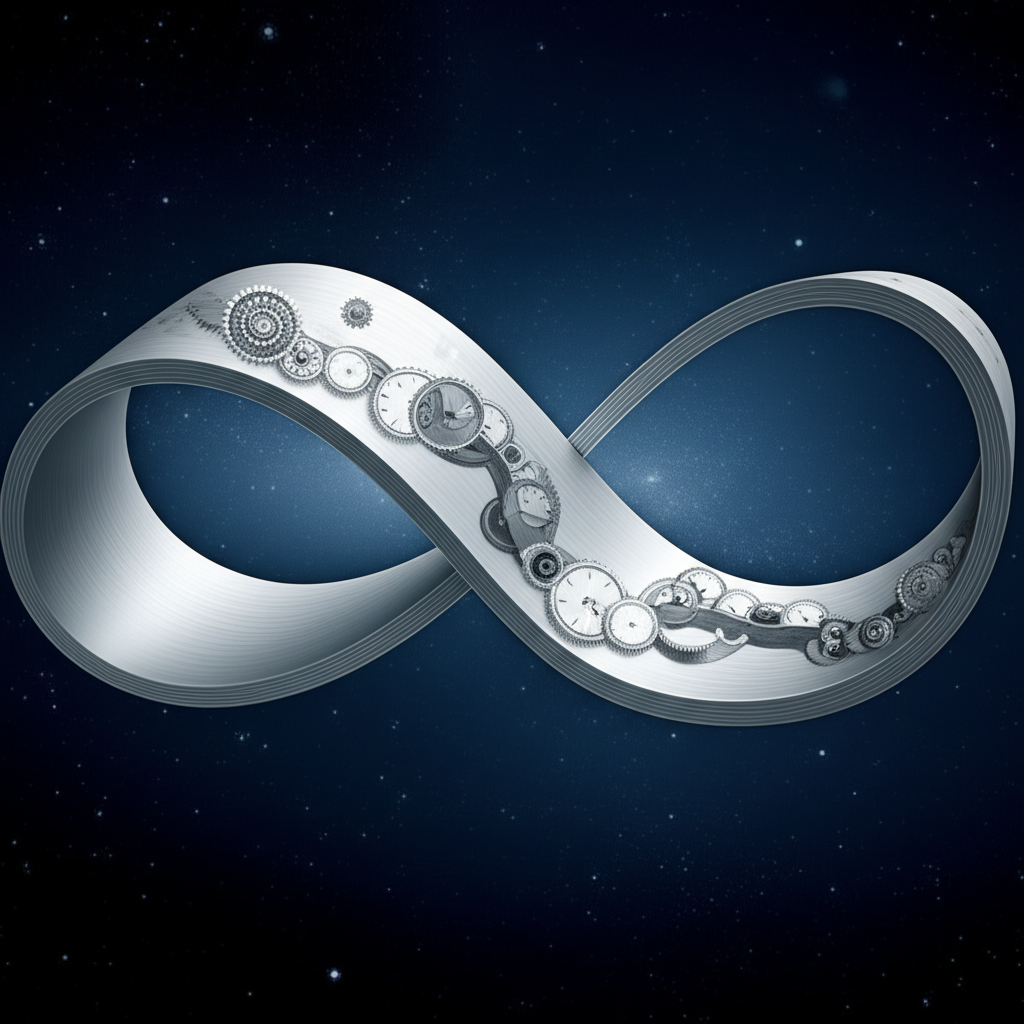
The problem of Time and Infinity is not a solved riddle; it is a continuously evolving frontier of thought, pushing the boundaries of our metaphysical understanding.
Conclusion: An Endless Inquiry
The problem of Time and Infinity remains one of the most compelling and confounding aspects of Metaphysics. From the ancient Greeks to contemporary cosmologists, humanity has struggled to reconcile our intuitive experience with the logical paradoxes these concepts present. Whether we consider Aristotle's potential infinity, Augustine's subjective time, or Kant's antinomies, the journey through the Great Books of the Western World reveals a persistent inquiry into the very fabric of reality. This is not a problem to be "solved" in a definitive sense, but rather a profound invitation to continue exploring the depths of existence, reminding us that the most fundamental questions often lead to the most enduring mysteries.
Further Exploration
-
📹 Related Video: What is Philosophy?
Video by: The School of Life
💡 Want different videos? Search YouTube for: ""The Philosophy of Time Explained" - search for videos that cover A-theory vs. B-theory, presentism, eternalism, and their implications."
-
📹 Related Video: PLATO ON: The Allegory of the Cave
Video by: The School of Life
💡 Want different videos? Search YouTube for: ""Zeno's Paradoxes and the Problem of Infinity" - look for animated explanations and philosophical discussions on how these ancient puzzles relate to modern concepts of space, time, and calculus."