

The Enduring Conundrum: Navigating the Problem of Time and Infinity
The very fabric of our existence, the canvas upon which all events unfold, is underpinned by two of the most elusive and profound concepts known to human thought: Time and Infinity. For millennia, philosophers, theologians, and scientists alike have wrestled with their nature, often finding themselves trapped in a labyrinth of paradoxes and unanswerable questions. This article delves into the enduring problem that arises when we attempt to truly comprehend time and infinity, exploring how their intertwined mysteries continue to challenge our understanding of reality and metaphysics.
The Unsettling Dance of Time and Infinity: A Summary
At its core, the problem of time and infinity stems from our inability to fully grasp either concept, let alone their intricate relationship. Is time an endless river, flowing from an infinite past into an infinite future? Or does it have a beginning, perhaps even an end? What does it mean for something to be infinite, and how does that infinitude manifest in the temporal dimension? These questions are not merely academic curiosities; they strike at the heart of our being, shaping our worldview, our understanding of causality, and our place in the cosmos. We find ourselves constantly asking: How can something finite exist within something potentially infinite, or vice versa? This article will unpack this profound philosophical challenge, drawing on historical insights and contemporary thought to illuminate its depths.
Unpacking the Problem: Why Are Time and Infinity So Troublesome?
The difficulty in defining time and infinity isn't for lack of trying. From ancient Greek philosophers to modern physicists, the brightest minds have grappled with these concepts, often arriving at more questions than answers.
The Elusiveness of Time
Time feels undeniably real. We experience its passage, measure its intervals, and organize our lives around its flow. Yet, when we try to pin it down, it slips through our fingers like sand. Is time a fundamental property of the universe, an independent dimension through which events progress? Or is it merely an emergent property, a consequence of change and our perception of it?
Key Philosophical Questions Regarding Time:
- Is Time Real? Is it an objective feature of reality, or a subjective construct of the human mind?
- The Arrow of Time: Why does time appear to move only forward? Is a reversal possible, even theoretically?
- The Nature of the Present: Does only the present exist, with the past gone and the future yet to be? Or do past, present, and future all exist simultaneously?
- Time's Beginning and End: Did time have a beginning (e.g., the Big Bang), and will it have an end? What was "before" time, or what would be "after" it?
The Paradoxes of Infinity
Infinity is equally, if not more, perplexing. We use it in mathematics to describe endless sets and unbounded quantities, but its application to reality leads to profound conceptual difficulties. Can actual infinities exist in the physical world, or are all physical infinities merely potential?
Challenges Posed by Infinity:
- Actual vs. Potential Infinity: As articulated by Aristotle in his Physics, is infinity ever truly actual (a completed, endless quantity), or is it always potential (the possibility of always adding more)? This distinction is crucial when considering an infinite past or future.
- Zeno's Paradoxes: These ancient paradoxes, such as Achilles and the Tortoise, highlight the difficulties arising from dividing continuous quantities (like space and time) into an infinite number of smaller parts.
- The Problem of "Too Many": If the universe were infinitely old, would every possible event have already occurred an infinite number of times? What does that imply for novelty and free will?
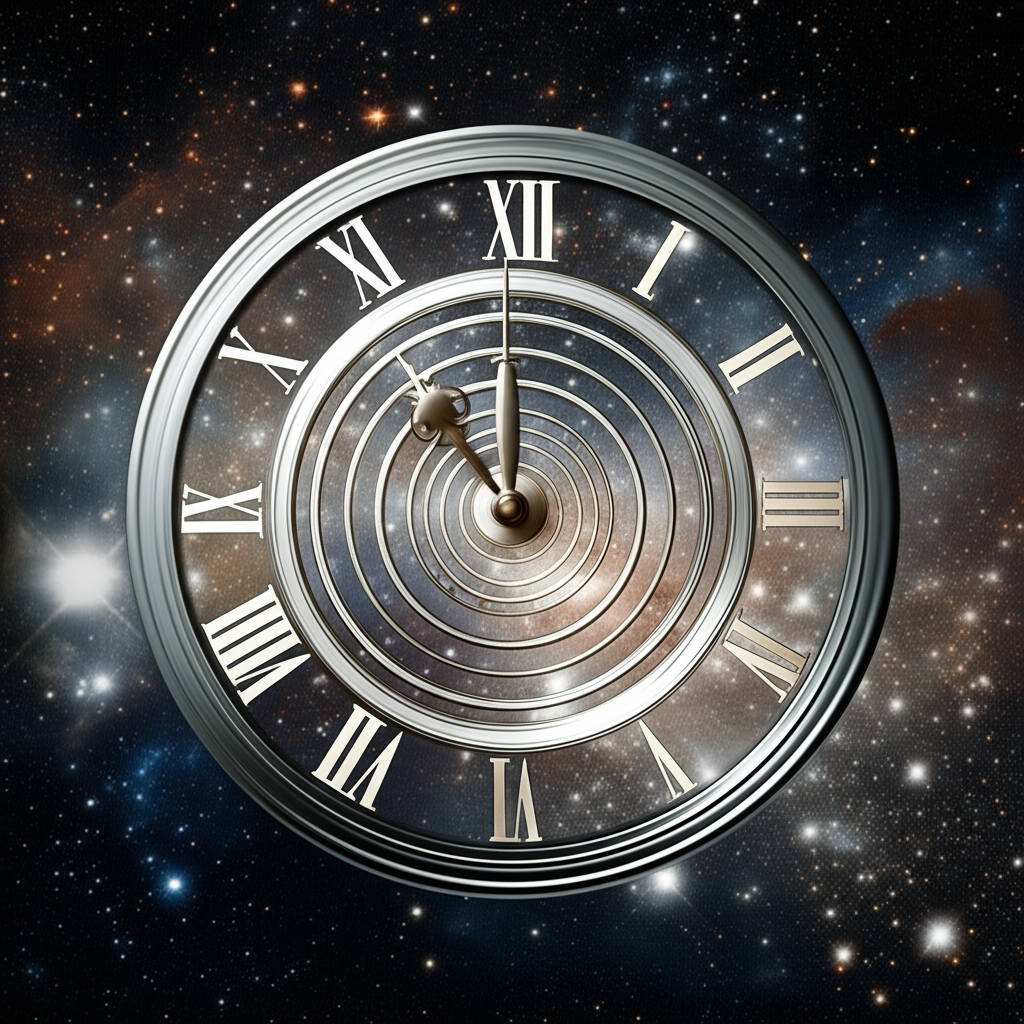
Historical Perspectives: Voices from the Great Books
The problem of time and infinity has preoccupied thinkers for millennia, with many of the foundational arguments originating in the Great Books of the Western World.
-
Aristotle: In his Physics and Metaphysics, Aristotle rigorously explored the concept of infinity, arguing primarily for potential infinity. He maintained that while we can always conceive of adding more to a number or extending a line, there is no such thing as a completed, actual infinite magnitude in the physical world. This perspective profoundly influenced Western thought on the limits of what can exist. He also posited that the universe itself was eternal, implying an infinite past and future, but without actual infinite magnitudes within it in a way that would lead to paradoxes.
-
St. Augustine of Hippo: In his Confessions, Augustine famously grappled with the nature of time, particularly in Book XI. He asks, "What then is time? If no one asks me, I know; if I wish to explain it to one who asks, I know not." Augustine concludes that time is a "distention of the soul," a subjective experience tied to memory (for the past), attention (for the present), and expectation (for the future). He also pondered what God was doing before creation, ultimately asserting that time itself was created with the universe, meaning there was no "before" in a temporal sense.
-
Immanuel Kant: In his Critique of Pure Reason, Kant presented the Antinomies of Pure Reason, two of which directly address time and infinity. He argued that reason, when attempting to comprehend the unconditioned (like the universe as a whole), inevitably falls into contradictory conclusions. For instance, he demonstrated that one could rationally argue both that the world has a beginning in time and is limited in space, and that it is infinite in both. For Kant, this revealed the limits of human reason when applied beyond the realm of possible experience, suggesting that time and space are forms of our intuition rather than properties of things-in-themselves.
The Interplay: When Time Meets Infinity
The true problem emerges when these two enigmatic concepts converge.
- Infinite Regress: If every event is caused by a prior event, and time extends infinitely into the past, do we face an infinite regress of causes, or must there be an uncaused first cause? This question deeply impacts cosmological arguments for the existence of God.
- The Heat Death of the Universe: If the universe is infinite and time extends infinitely into the future, does it guarantee an eventual "heat death" where all energy is evenly distributed, leading to a state of ultimate stagnation? What does this imply for meaning and purpose?
- Eternal Recurrence: Some philosophers, like Nietzsche, considered the idea of eternal recurrence – that all events in an infinite time and space will eventually repeat themselves exactly. This concept forces us to confront the weight of our actions and the nature of uniqueness.
The Enduring Metaphysical Challenge
Ultimately, the problem of time and infinity remains a cornerstone of metaphysics. Our attempts to resolve these issues often lead us to fundamental questions about the nature of reality itself:
- Is the universe fundamentally rational and understandable, or are there aspects that transcend human comprehension?
- What are the limits of human knowledge and experience?
- How do our conceptual frameworks (like mathematics and logic) relate to the actual structure of the cosmos?
These aren't just abstract musings; they influence our scientific theories, our theological doctrines, and even our personal philosophies of life. The journey into the depths of time and infinity is a journey into the deepest mysteries of existence, a testament to the insatiable human desire to understand the universe and our place within it.
YouTube Video Suggestions:
- YouTube: "Augustine on Time Confessions Book 11"
- YouTube: "Aristotle on Potential and Actual Infinity Philosophy"
📹 Related Video: What is Philosophy?
Video by: The School of Life
💡 Want different videos? Search YouTube for: "The Problem of Time and Infinity philosophy"