

The Problem of Time and Consciousness: An Intimate Dance with Reality
The relationship between time and consciousness presents one of philosophy's most enduring and perplexing challenges. At its core, the problem is this: Is time an objective feature of the universe, independent of our minds, or is it fundamentally a construct of our subjective experience? Our very experience of the world, our sense of self, and our understanding of existence are inextricably linked to how we perceive and process time. This article will delve into this profound problem, exploring how the human mind grapples with the fleeting and persistent nature of time, drawing insights from the rich tapestry of thought found within the Great Books of the Western World.
The Elusive Nature of Time
Time feels undeniably real. We mark its passage with clocks, calendars, and the undeniable march of aging. Yet, when we try to grasp it, to define it, it slips through our fingers like sand. What is time? Is it a flowing river, a dimension like space, or merely a measure of change? Philosophers have wrestled with this fundamental problem for millennia. Is there a "now" that exists universally, or is each "now" unique to an individual mind? This question forms the bedrock of our inquiry, leading us to consider how our subjective awareness shapes, or is shaped by, temporal reality.
Consciousness as the Crucible of Time
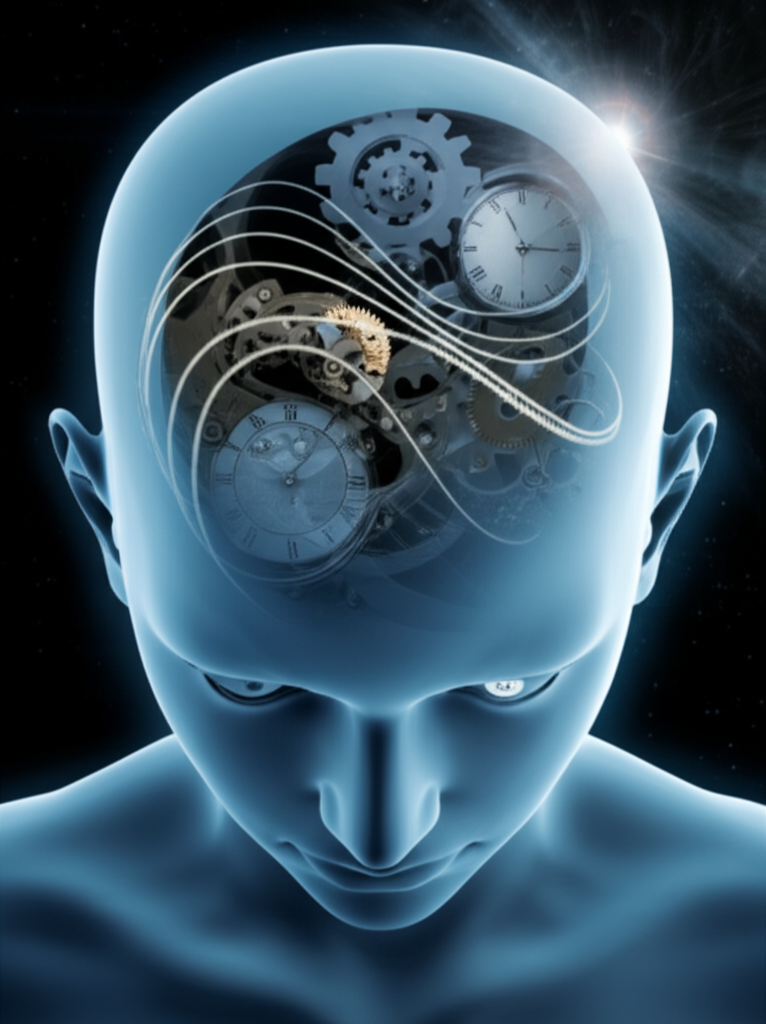
It is within our mind, our consciousness, that the experience of time truly takes shape. We don't just observe time; we live it. We remember the past, anticipate the future, and dwell (however briefly) in the present. This internal, subjective experience of duration, sequence, and simultaneity is what often makes the philosophical problem of time so personal. Without a conscious observer, would time, as we know it, even exist? This profound question forces us to consider the possibility that our mind isn't just a passive recipient of temporal data but an active participant in its construction.
Historical Perspectives from the Great Books
The Great Books of the Western World offer a profound lineage of thought on the intricate connection between time and the mind. From ancient reflections on change to modern phenomenological analyses, the problem has been approached from myriad angles.
- Augustine's Inner Time: In his Confessions (Book XI), St. Augustine famously declared, "What then is time? If no one asks me, I know; if I wish to explain it to one who asks, I know not." He concluded that time is a "distention of the soul," existing primarily in the mind as memory of the past, attention to the present, and expectation of the future. For Augustine, the experience of time is deeply personal and subjective, a measure of the mind's own activity.
- Aristotle's Time as Measure of Motion: In Physics, Aristotle defines time as "a number of motion in respect of 'before' and 'after'." While seemingly objective, this definition still implicitly relies on a perceiving mind to 'number' or measure. Without change, and without a consciousness to apprehend that change, would time as a measurable entity exist? This highlights an early facet of the problem.
- Kant's Subjective Form of Intuition: Immanuel Kant, in his Critique of Pure Reason, posited that time is not an external reality but an a priori form of intuition, inherent in our mind. It is a necessary framework through which we experience phenomena. We cannot conceive of events outside of time, not because time is an objective container, but because our mind imposes this structure on all our perceptions. This makes the experience of time fundamentally subjective, a product of our cognitive apparatus.
- Hume's Stream of Impressions: David Hume, in A Treatise of Human Nature, argued that we have no direct impression of time itself, only a succession of distinct impressions. Our idea of duration arises from the experience of these successive perceptions in our mind. This empiricist view further underscores the reliance of our understanding of time on our subjective experience.
The Enduring Problem: Why Does It Matter?
Understanding the problem of time and consciousness is not merely an academic exercise; it touches the very core of our existence. If time is a mental construct, what does that imply for free will, destiny, and the objective reality of the universe? Our experience of causality, of moral responsibility, and of our own identity is deeply intertwined with our conception of past, present, and future. The philosophical inquiry into this relationship helps us to:
- Deconstruct our assumptions: Challenging the intuitive notion of time as an external, flowing entity.
- Appreciate the role of consciousness: Recognizing the active, rather than passive, role of the mind in shaping reality.
- Re-evaluate scientific models: Considering how physics, which often treats time as a dimension, might integrate or reconcile with subjective experience.
Exploring the Intersections
The problem of time and consciousness opens up several critical areas for further philosophical exploration:
- The Arrow of Time: Why does time appear to move only forward? Is this an objective feature of the universe (e.g., entropy) or a subjective experience of our mind?
- Memory and Anticipation: How do our cognitive faculties of memory (past) and anticipation (future) shape our experience of the present moment? Are these purely mental constructs, or do they connect us to a deeper temporal reality?
- Timelessness and Eternity: What does it mean to conceive of eternity, or a state beyond time? Is this a concept accessible to the human mind, or does our temporal experience limit our understanding?
- The "Now" Problem: What defines the present moment? How can a "now" exist if it is constantly becoming the past?
Conclusion: A Timeless Inquiry
The problem of time and consciousness remains one of philosophy's most profound and persistent enigmas. From Augustine's soul-searching to Kant's critical analysis, the Great Books of the Western World provide a testament to humanity's relentless pursuit of understanding our place within, and perhaps our role in shaping, temporal reality. As Daniel Fletcher, I find myself continually drawn to this intricate dance between the objective and the subjective, the universal and the intensely personal. Our experience of time is, after all, our experience of life itself, and to understand one is to begin to grasp the other.
📹 Related Video: What is Philosophy?
Video by: The School of Life
💡 Want different videos? Search YouTube for: ""Augustine Confessions Book 11 Time Philosophy""
📹 Related Video: KANT ON: What is Enlightenment?
Video by: The School of Life
💡 Want different videos? Search YouTube for: ""Kant Time as a Form of Intuition Explained""