

The Problem of Time and Consciousness: A Deep Dive into Our Temporal Experience
The relationship between time, that relentless march of moments, and consciousness, our subjective awareness of being, presents one of philosophy's most enduring and perplexing challenges. At its heart lies a fundamental problem: how does an objective, seemingly independent dimension like time interact with and become apprehended by the subjective, inner world of the mind? This article delves into this intricate dance, exploring how our experience of time is shaped by consciousness, and conversely, how time itself might be a precondition for the very existence of a conscious mind.
The Elusive Nature of Time: Objective Reality vs. Subjective Apprehension
Time, for many, appears to be an unyielding, external force—a universal constant against which all events unfold. Yet, the moment we attempt to grasp it, to define it, it slips through our fingers like sand. St. Augustine, in his Confessions, famously articulated this conundrum: "What then is time? If no one asks me, I know; if I wish to explain it to one who asks, I do not know." This profound statement from a foundational text within the Great Books of the Western World captures the essence of the problem. Is time a measurable continuum, a fourth dimension as physics suggests, or is it fundamentally a construct of our perception?
On one hand, we have the scientific understanding of time: a linear progression, a dimension measurable by clocks, integral to the fabric of spacetime. On the other, we have our lived experience: time that drags or flies, time infused with memory and anticipation, time that feels intensely personal. This duality is where the problem truly begins.
Consciousness: The Crucible of Temporal Experience
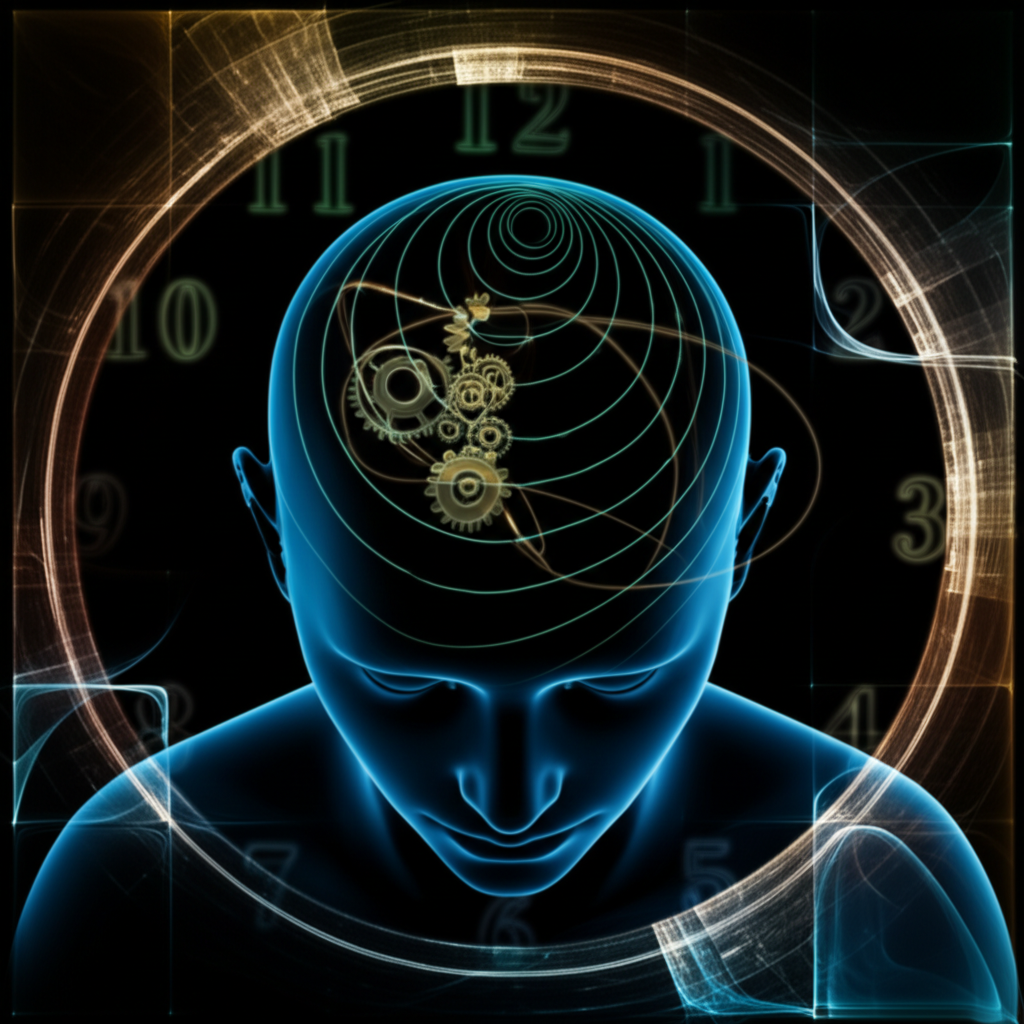
Our mind is not a passive receiver of time; it actively engages with it, shapes it, and is, perhaps, even constituted by it. Consciousness is inherently temporal. We remember the past, perceive the present, and anticipate the future. Without this temporal structure, our experience would be a chaotic, disconnected stream of sensations.
Immanuel Kant, another titan of the Great Books, argued in his Critique of Pure Reason that time is not an empirical concept derived from experience, but rather an a priori intuition. It is a necessary form of our sensibility, a fundamental structure of the mind that allows us to perceive anything at all. For Kant, time is not a property of things-in-themselves but a condition under which objects can appear to us. This means our experience of time is not merely observing an external reality, but rather, time is a lens through which our mind constructs reality.
The Intertwined Problem: Why We Can't Separate Them
The core problem lies in the inseparability of time and consciousness. We cannot conceive of consciousness without a temporal dimension – a succession of thoughts, memories, and intentions. Similarly, we struggle to conceive of time outside of a conscious observer to measure, perceive, and experience it.
Consider the following facets of this intricate relationship:
- Memory and Anticipation: Our ability to recall the past and project into the future is a hallmark of consciousness and utterly dependent on a temporal framework. These are not just events in time, but ways our mind actively engages with time.
- The "Now": The elusive present moment is constantly slipping away. Our mind seems to stitch together an immediate past and an immediate future to create the illusion of a stable "now." This subjective duration, or specious present, is central to our experience.
- The Flow of Time: We experience time as flowing, moving from future to past. Yet, physics offers no inherent directionality to time at a fundamental level. Is the arrow of time a product of entropy, or is it a deep-seated feature of our conscious mind?
Philosophical Perspectives on Time and Consciousness
Over centuries, philosophers have grappled with this problem, offering diverse insights. Here’s a brief overview of some key perspectives:
| Philosopher/Tradition | Core Idea Regarding Time and Consciousness |
|---|---|
| Introduction | The problem of time and consciousness explores the fundamental philosophical conundrum of how our subjective, inner experience of time (its flow, duration, past/present/future) relates to objective, physical time. It questions whether time is a feature of reality independent of the mind, or if consciousness itself is constitutive of our temporal experience. |
| I. The Dual Nature of Time: Objective vs. Subjective | Time appears to possess two distinct faces: an objective, measurable dimension and a profoundly subjective, lived experience. This section will elaborate on this duality, setting the stage for the core philosophical problem. |
| A. Time as an Objective Datum | From classical Newtonian mechanics to Einstein's theory of relativity, physics presents time as a fundamental dimension, independent of any observer. It's a parameter in equations, a measurable quantity, and an integral part of the universe's fabric. |
| B. Time as a Subjective Experience | Our lived experience of time is fluid and highly personal. It can stretch during moments of boredom or danger, and race during periods of joy. Memories anchor us to the past, while anticipation pulls us toward the future. This internal clock, distinct from any external chronometer, is where consciousness truly interacts with temporality. |
| II. Consciousness: The Site of Temporal Awareness | How does the mind apprehend, structure, and even create its sense of time? This section explores the active role of consciousness in our temporal experience. |
| A. The Mind's Temporal Architecture | Consciousness is inherently temporal. It's not a static state but a dynamic process unfolding through successive moments. Our thoughts, perceptions, and emotions are structured by an awareness of before and after. |
| B. Memory, Anticipation, and the "Specious Present" | The mind constructs a sense of continuity through memory (retaining the past) and anticipation (projecting into the future). The "present" we experience is not an infinitesimal point but a brief duration, often called the "specious present," where immediate past and immediate future coalesce. This psychological present is crucial to our sense of experience. |
| III. Philosophical Explorations from the Great Books | Major thinkers throughout history have wrestled with this problem. We turn to some foundational texts to understand their contributions. |
| A. Augustine's Psychological Time | St. Augustine, in his Confessions, famously pondered the nature of time, concluding that it exists primarily in the mind as "distention of the soul." He argued that we measure not external time, but the impression that passing things make upon us—a psychological present of things past (memory), a present of things present (attention), and a present of things future (expectation). This highlights the profound subjectivity of our temporal experience. |
| B. Kant's A Priori Intuition of Time | Immanuel Kant, in his Critique of Pure Reason, posits that time is not an empirical concept but an a priori form of intuition. It is a necessary condition for us to experience anything at all, a fundamental structure of the mind through which all phenomena are ordered. For Kant, time is not a property of objects themselves but a framework imposed by our consciousness. This provides a powerful explanation for why we universally experience time in a particular way. |
| C. Aristotle and the Measure of Motion | Aristotle, in his Physics, defined time as "the number of motion with respect to before and after." While linking time to change and motion in the world, he also implicitly ties it to a mind capable of numbering or measuring this motion. Without a conscious entity, would there be "numbering," and thus "time" in this sense? This raises the problem of whether time requires an observer to be fully realized. |
| IV. The Enduring Problem: Why it Matters | The continuous grappling with the problem of time and consciousness is not merely an academic exercise; it touches upon the very essence of what it means to be a conscious being in a temporal universe. |
| A. The Reality of Free Will | If time is a fixed, block universe where all moments exist eternally, does free will become an illusion? Our experience of making choices and influencing the future seems to contradict a purely deterministic, timeless reality. |
| B. The Nature of Existence | Is our existence fundamentally temporal, or does consciousness offer a glimpse into a more timeless reality? The problem pushes us to question the very fabric of our being and the cosmos. |
| Conclusion: A Timeless Query for the Mind | The problem of time and consciousness remains one of philosophy's most fertile grounds for inquiry. From Augustine's introspective struggles to Kant's transcendental insights, the Great Books of the Western World consistently demonstrate that the deeper we probe the nature of time, the more inextricably linked it becomes to the inner workings of the mind and the richness of our experience. It |
📹 Related Video: What is Philosophy?
Video by: The School of Life
💡 Want different videos? Search YouTube for: "The Problem of Time and Consciousness philosophy"