

The Enduring Problem of Space in Astronomy: A Philosophical Inquiry
Summary: The seemingly straightforward concept of "space"—that vast expanse separating celestial bodies—has, throughout history, presented one of the most profound and persistent philosophical and scientific problems. Far from being a mere container, the nature of space in Astronomy challenges our very understanding of reality, the World, and our place within it. From ancient Greek philosophers grappling with the void to modern cosmologists contending with an expanding universe and curved spacetime, the philosophical problem of space remains a cornerstone of inquiry, constantly pushing the boundaries of human thought.
Unveiling the Enigma: Space Beyond the Void
For many, space is simply "out there"—an empty canvas upon which the cosmic drama of stars and galaxies unfolds. Yet, delve deeper, and this intuitive understanding quickly dissolves into a labyrinth of conceptual difficulties. The problem of space is not just about its vastness or the objects within it; it's about its very essence, its properties, its relationship to matter, and indeed, its existence. How we define and perceive space fundamentally shapes our World view and our scientific endeavors in Astronomy.
Historical Contemplations: From Place to Absolute
The problem of space has a rich intellectual lineage, deeply embedded in the Great Books of the Western World. Philosophers and scientists have wrestled with its implications for millennia.
-
Ancient Greece: The Finite Cosmos and the Question of Void
- Aristotle, in his Physics, famously argued against the existence of a void, asserting that space is merely the "place" occupied by bodies. For Aristotle, the cosmos was a finite, plenum World with no space beyond its outermost sphere. The idea of space as an empty container was anathema, as it implied something that is but is nothing.
- Plato, particularly in Timaeus, offered a more abstract concept of a "receptacle" or "chora"—a kind of amorphous, formless medium that receives all forms, hinting at a primordial space that precedes material existence.
- The very notion of a finite World meant that the problem wasn't "what is beyond," but rather "what is space if there is no 'beyond'?"
-
The Medieval Synthesis: God and Infinite Space
- Medieval scholastic thinkers largely followed Aristotle, yet the concept of God's omnipresence introduced new complexities. If God is everywhere, does that imply an infinite space? The theological problem of defining God's relationship to space laid groundwork for later debates.
-
The Dawn of Modern Science: Absolute vs. Relational Space
- René Descartes equated space with extension, arguing that wherever there is extension, there is matter. For him, a true vacuum was impossible, and space was merely the property of extended substance.
- Isaac Newton, however, posited the existence of absolute space—an infinite, immovable, and independent arena in which all events occur. This absolute space was unmoving and unaffected by objects within it, serving as a divine sensorium. This concept provided a stable framework for his laws of motion and universal gravitation, becoming foundational for classical Astronomy.
- Gottfried Wilhelm Leibniz vehemently opposed Newton's absolute space. For Leibniz, space was not an independent entity but a system of relations between objects. Remove all objects, and space ceases to exist. This relational space presented a profound philosophical problem for understanding the World without an independent spatial backdrop.
| Philosophical View | Key Proponent(s) | Conception of Space | Implications for Astronomy |
|---|---|---|---|
| Place/No Void | Aristotle | Defined by occupied bodies; finite cosmos | Universe has a boundary; no empty "beyond" |
| Receptacle | Plato | Formless medium for forms | Space as a primordial condition for existence |
| Extension | Descartes | Identical with matter; no vacuum | Universe is a plenum; no empty regions |
| Absolute | Newton | Independent, infinite, unmoving container | Provides a fixed reference frame for motion |
| Relational | Leibniz | Relations between objects; no independent existence | Space emerges from the arrangement of matter |
The Problem Deepens: Space in Modern Astronomy
The advent of modern Astronomy and physics, particularly in the 20th century, did not resolve the problem of space; it amplified its complexity, transforming it from a static philosophical debate into a dynamic scientific frontier.
-
Olbers' Paradox: The Infinite Universe Problem
- If the universe is infinite, static, and uniformly filled with stars, then every line of sight should eventually end on the surface of a star. This implies the night sky should be blindingly bright, not dark. This problem forced astronomers to reconsider the assumptions about the infinite nature of space and the age of the World. Solutions often involve an expanding universe, a finite age, or a non-uniform distribution of matter.
-
Einstein's Revolution: Space as a Fabric
- Albert Einstein's General Theory of Relativity delivered a seismic shift, fundamentally altering our understanding of space. No longer a passive arena, space (and time) became a dynamic entity, spacetime, that can be curved and distorted by mass and energy. Gravity, in this view, is not a force pulling objects together but a manifestation of the curvature of spacetime.
- This concept introduces a new philosophical problem: If space is curved, what is it curved in? The analogy of a stretched rubber sheet helps visualize this, but the underlying reality remains profoundly abstract, challenging our Euclidean intuitions about the World.
-
The Expanding Universe: What is it Expanding Into?
- Observations by Edwin Hubble confirmed that the universe is expanding. Galaxies are moving away from each other, and the farther they are, the faster they recede. This cosmic expansion presents a significant problem: If the universe is expanding, what is it expanding into? The prevailing cosmological view is that space itself is expanding, rather than galaxies moving through a pre-existing, static space. This implies there is no "outside" for the universe to expand into, a concept that strains our everyday understanding of three-dimensional space and the boundaries of our World.
-
Cosmological Horizons: Limits to Our Spatial World
- The finite speed of light, combined with the expansion of the universe, means that there are regions of space from which light has not yet had time to reach us. This creates a cosmological horizon, a boundary beyond which we cannot observe, effectively limiting our empirical World within the vastness of space.
Philosophical Ramifications: Our Place in the World
The problem of space in Astronomy is not merely an academic exercise; it profoundly impacts our philosophical outlook:
- The Nature of Reality: Is space a fundamental constituent of reality, or is it an emergent property of matter and energy?
- Human Perception: Our intuitive grasp of space is based on our terrestrial experience. How do we reconcile this with the non-Euclidean, dynamic space of the cosmos?
- The Infinite and the Finite: The problem of whether space is infinite or finite continues to challenge our conceptual limits. If it's finite, what defines its boundary? If infinite, how can we comprehend such an unbounded World?
- Our Existential Context: Understanding space reshapes our understanding of the World and our place within it, from being at the center of a finite cosmos to being a tiny speck within an incomprehensibly vast and dynamic universe.
Conclusion: The Unending Inquiry
The problem of space in Astronomy is an enduring testament to the human capacity for inquiry. From the ancient Greeks questioning the void to modern cosmologists mapping the curvature of spacetime, the journey to comprehend space is far from over. It forces us to confront the limits of our intuition, to embrace abstract concepts, and to continually redefine our understanding of the World. The problem of space is, at its heart, a problem of existence itself, reminding us that the deepest mysteries often lie in the most fundamental assumptions we make about reality.
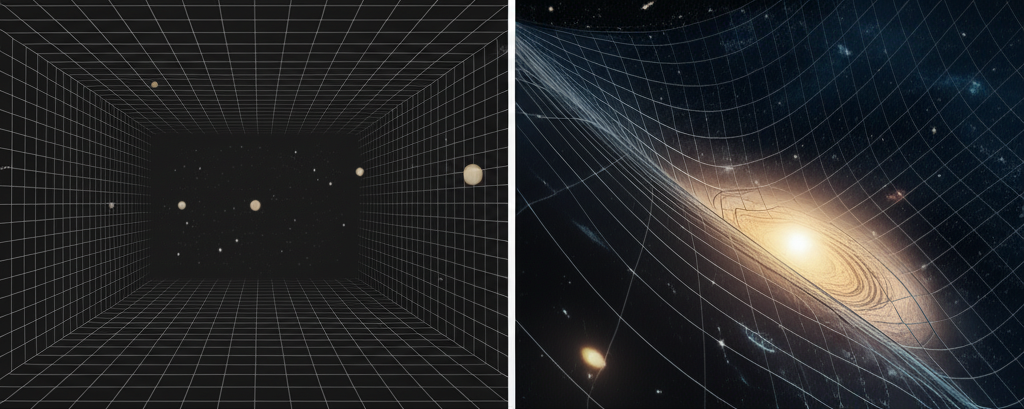 creating indentations and ripples, illustrating how space itself is affected by matter and energy. The transition between the two sides highlights the conceptual shift, with subtle philosophical symbols like an ancient Greek scroll on the left and a complex mathematical equation on the right.)
📹 Related Video: What is Philosophy?
Video by: The School of Life
💡 Want different videos? Search YouTube for: ""Leibniz vs Newton on Space and Time Philosophy""
📹 Related Video: PLATO ON: The Allegory of the Cave
Video by: The School of Life
💡 Want different videos? Search YouTube for: ""General Relativity Explained: Curvature of Spacetime Philosophical Implications""