

The Problem of Sin and Will: An Enduring Philosophical Conundrum
The intricate dance between human will and the concept of sin stands as one of philosophy's most enduring and perplexing challenges. For millennia, thinkers have grappled with fundamental questions: What is sin? Are we truly free to choose good and evil, or are our actions predetermined? How does moral responsibility arise if our will is constrained? This pillar page delves into the historical and philosophical landscape of this profound problem, exploring its roots, its evolution through the ages, and the myriad ways some of the greatest minds have attempted to untangle its complexities, drawing heavily from the rich tapestry of the Great Books of the Western World.
Unpacking the Core Problem: Sin, Will, and Moral Agency
At its heart, the Problem of Sin and Will is a profound inquiry into human nature, responsibility, and the very foundation of ethics. It asks whether our capacity for wrongdoing (sin) stems from a defect in our will, an inherent flaw, or simply a misuse of our freedom. Conversely, it probes the nature of that freedom itself: is the will truly autonomous, or is it subject to external forces, internal drives, or even divine decree?
Understanding this problem requires a nuanced look at several interconnected concepts:
- Sin: Often understood as a transgression against divine law, moral principle, or the natural order. But is it merely an act, or a state of being? Is it solely religious, or does it have secular equivalents in moral failing?
- Will: The faculty by which we make choices, initiate actions, and determine our conduct. Is it free, bound, or something in between?
- Good and Evil: The moral framework within which sin is defined. What constitutes good, and how do we distinguish it from evil? Are these objective truths or subjective constructions?
- Moral Responsibility: The ability to be held accountable for one's actions. If the will is not free, can one truly be responsible for sin?
This complex interplay has fueled debates across theological, ethical, and metaphysical domains, shaping our understanding of justice, redemption, and human dignity.
Ancient Echoes: Precursors to the Problem of Sin and Will
While the term "sin" often carries Abrahamic connotations, the underlying philosophical problem of voluntary wrongdoing and moral responsibility has ancient roots.
The Hellenic Perspective: Ignorance and Virtue
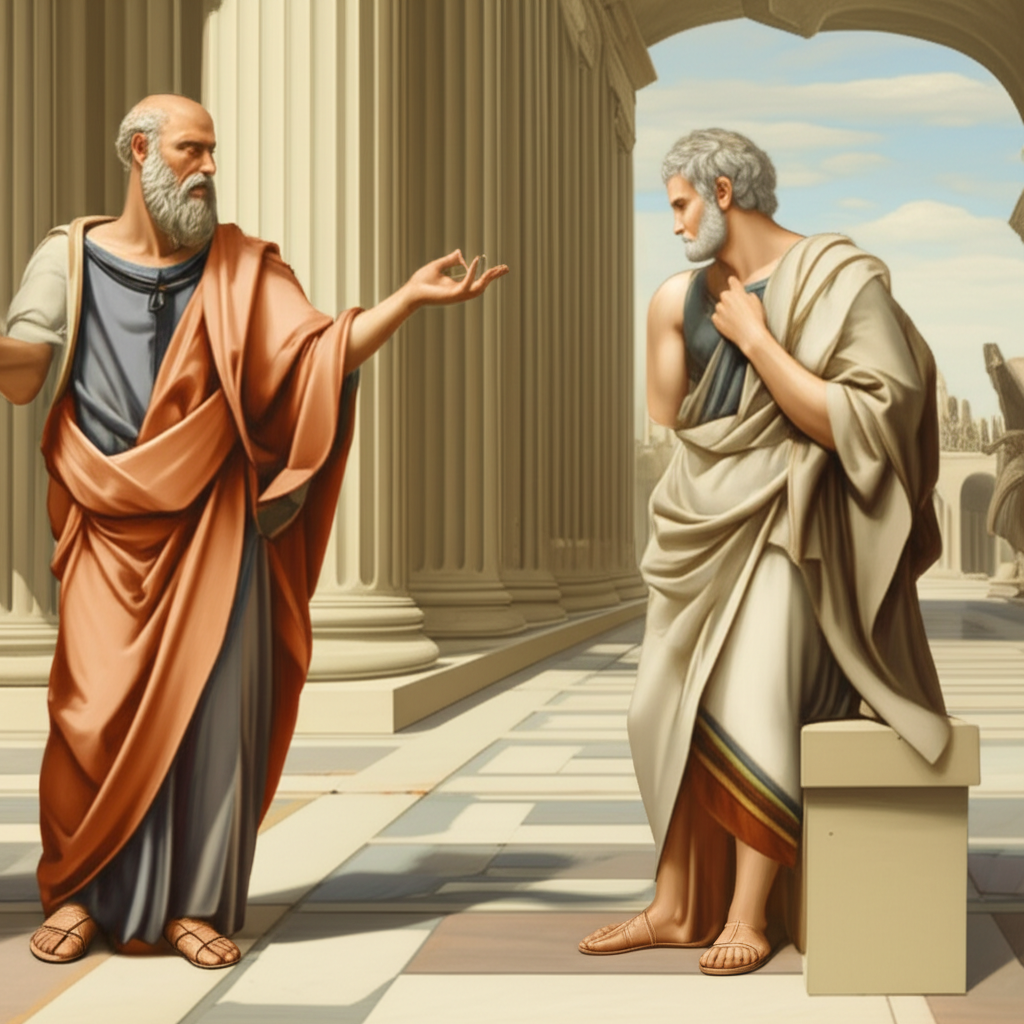
Ancient Greek philosophy, particularly the Socratic tradition, approached wrongdoing not primarily as "sin" in a theological sense, but as a failure of reason or knowledge.
- Socrates & Plato: For Socrates, no one does evil willingly. Wrongdoing stemmed from ignorance of the good. If one truly knew what was good, one would inevitably pursue it. This perspective minimizes the role of a perverse will and places the onus on intellectual understanding. Plato, in works like the Republic, expands on this, suggesting that a well-ordered soul, guided by reason, naturally inclines towards virtue.
- Aristotle: In his Nicomachean Ethics, Aristotle delves into voluntary and involuntary actions, crucial for assigning moral praise or blame. He distinguishes between actions done under compulsion or through ignorance (involuntary), and those chosen deliberately (voluntary). While acknowledging that people can choose wrongly, he still emphasizes the role of habituation and practical wisdom (phronesis) in shaping one's character and inclination towards good. He doesn't posit a "sinful nature" but rather a character that can be corrupted by bad habits and choices.
The Augustinian Revolution: Sin as a Disease of the Will
The Christian tradition, profoundly shaped by St. Augustine of Hippo (354-430 CE), dramatically reconfigured the problem of sin and will. Augustine's personal struggles, articulated powerfully in his Confessions, led him to a radical understanding.
Original Sin and the Enslaved Will
Augustine posited that humanity inherited Original Sin from Adam's transgression. This was not merely an individual act but a corruption of human nature itself, particularly the will.
- Before the Fall: Adam possessed a truly free will, capable of choosing not to sin (posse non peccare).
- After the Fall: Human will became profoundly weakened, inclined towards evil, and enslaved by concupiscence. It lost the ability not to sin (non posse non peccare) without divine grace.
- The Lure of Evil: Augustine famously grappled with why he stole pears as a youth, not out of hunger, but purely "for the mischief's sake." This highlighted sin as an attraction to evil for its own sake, a perversion of the will, rather than a mere misunderstanding of the good.
- Grace and Redemption: For Augustine, true freedom of the will, the capacity to choose the good and overcome sin, could only be restored through God's unmerited grace. This shifted the focus from human intellectual capacity (as in Greek thought) to divine intervention.
Augustine's ideas, particularly his arguments against Pelagianism (which emphasized human capacity for good without divine grace), became foundational for much of Western Christian theology and philosophy, introducing the profound tension between divine omnipotence, human freedom, and the pervasive reality of sin.
Medieval Scholasticism: Reconciling Faith and Reason
Following Augustine, medieval thinkers, most notably Thomas Aquinas (1225-1274 CE), sought to integrate classical philosophy, especially Aristotle, with Christian doctrine to provide a systematic understanding of sin and will.
Aquinas: Intellect, Will, and Natural Law
Aquinas, in his Summa Theologica, presented a nuanced view that acknowledged both the intellect's role and the will's freedom, even within a divinely ordered universe.
- Intellect Precedes Will: For Aquinas, the intellect presents objects to the will, apprehending them as good or evil. The will then chooses among these apprehended goods.
- The Will's Freedom: While the will is naturally drawn to the universal good (God), it is free to choose among particular goods. Sin occurs when the will chooses an apparent, lesser good over the true, ultimate good.
- Ignorance and Malice: Aquinas distinguished between sins committed out of ignorance (which can mitigate culpability) and sins committed out of malice or deliberate choice against a known good.
- Natural Law: Aquinas integrated the concept of Natural Law – innate moral principles discoverable by human reason – as a guide for the will, reflecting God's eternal law. Sin is a deviation from this natural order.
| Philosopher | View on Sin's Origin | Role of Will | Path to Good |
|---|---|---|---|
| Socrates | Ignorance of the Good | Not inherently perverse | Knowledge & Reason |
| Augustine | Original Sin, corrupted nature | Enslaved, needs grace | Divine Grace |
| Aquinas | Choosing lesser good over true good | Free within limits, guided by intellect | Reason, Natural Law, Grace |
Modern Perspectives: Autonomy, Determinism, and the Will to Power
The Enlightenment and subsequent philosophical movements challenged traditional notions of sin and will, often emphasizing human autonomy or questioning the very foundations of morality.
Descartes and the Infinite Will
René Descartes (1596-1650 CE), in his Meditations, famously distinguished between the finite understanding and the infinite will.
- Infinite Will, Finite Intellect: Descartes argued that our errors (a form of intellectual "sin") arise because our will, being infinite, can assent to propositions that our finite intellect has not fully comprehended. This places the source of error, and by extension, moral failing, in the misuse of the will.
Kant: Autonomy and Duty
Immanuel Kant (1724-1804 CE) revolutionized the understanding of the will by grounding morality in its autonomy and rationality.
- Autonomy of the Will: For Kant, a truly moral act stems from a will that legislates for itself, acting out of duty and respect for the moral law, not from external commands or inclinations. The will is free precisely because it is self-governing.
- Categorical Imperative: Sin (or immorality) arises when the will acts on maxims that cannot be universalized without contradiction, or when it treats humanity merely as a means to an end, rather than an end in itself. The problem of evil here is a failure of the will to act according to its own rational, universalizable principles.
Nietzsche: Revaluation of Values and the Will to Power
Friedrich Nietzsche (1844-1900 CE) launched a scathing critique of traditional morality, particularly the concepts of sin and good and evil as understood in Christian contexts.
- Master vs. Slave Morality: Nietzsche argued that "sin" and the associated values of humility, pity, and self-denial were products of a "slave morality," invented by the weak to control the strong.
- Will to Power: He proposed that the fundamental drive of all life is the "will to power," a drive for growth, overcoming, and self-assertion. From this perspective, traditional notions of sin are life-denying. He called for a "revaluation of all values," urging individuals to create their own good and evil based on strength and vitality, rather than inherited dogma.
Contemporary Challenges: Neuroscience, Existentialism, and Responsibility
The problem of sin and will continues to evolve in contemporary thought, grappling with new scientific insights and philosophical frameworks.
- Existentialism (Sartre): Jean-Paul Sartre emphasized radical freedom and responsibility. For Sartre, existence precedes essence, meaning we are condemned to be free. There is no predetermined nature or divine law to dictate our choices. Sin, if it exists, is a form of bad faith – a refusal to acknowledge our absolute freedom and the responsibility that comes with it. We are entirely responsible for defining our own good and evil.
- Neuroscience and Determinism: Modern brain science poses a challenge to traditional notions of free will. If our choices are ultimately the product of neuronal firings and chemical reactions, determined by our genetic makeup and environment, how much freedom does the will truly possess? This reopens the ancient debate between free will and determinism, directly impacting our understanding of moral responsibility and the very possibility of "sin."
- Secular Ethics: In increasingly secular societies, the concept of "sin" often gives way to terms like "moral failing," "unethical behavior," or "harm." The problem then becomes how to ground moral responsibility and motivate ethical conduct without appealing to divine judgment or an inherited "sinful" nature.
The Enduring Relevance of the Problem
The Problem of Sin and Will is far from resolved. It continues to inform our understanding of:
- Justice Systems: How do we assign blame and punishment if free will is debated?
- Personal Responsibility: How much control do we truly have over our actions and character?
- Ethical Frameworks: What is the basis for distinguishing good and evil in a diverse, globalized world?
- Human Nature: Are we inherently flawed, or capable of infinite self-improvement?
From the ancient Greek emphasis on knowledge to Augustine's enslaved will, Kant's autonomous reason, and Nietzsche's will to power, the inquiry into sin and will forces us to confront the very essence of what it means to be human, to choose, and to be accountable. This profound philosophical journey, documented across the Great Books, remains as vital and challenging today as it has ever been.
📹 Related Video: What is Philosophy?
Video by: The School of Life
💡 Want different videos? Search YouTube for: ""Free Will vs Determinism Philosophy Debate""
📹 Related Video: KANT ON: What is Enlightenment?
Video by: The School of Life
💡 Want different videos? Search YouTube for: ""Augustine Original Sin Explained""