

The Enduring Riddle: Unpacking the Problem of One and Many
Summary
The "Problem of One and Many" is a foundational question in Metaphysics that has puzzled philosophers for millennia. At its core, it asks how diverse, individual things (the Many) can exist and yet collectively form a unified, coherent reality (the One). How do we reconcile the apparent multiplicity of our experience with the underlying unity we intuitively seek in understanding Being? This article explores the historical roots and enduring significance of this question, examining how thinkers from the ancient Greeks to modern philosophers have grappled with the intricate Relation between unity and plurality, and why it remains central to our understanding of existence itself.
Introduction: A Philosophical Paradox at the Heart of Reality
Have you ever looked at a forest and seen both countless individual trees and a single, unified ecosystem? Or considered your own identity – a collection of experiences, thoughts, and physical parts, yet undeniably you? This seemingly simple observation points to one of philosophy's most profound and persistent challenges: the Problem of One and Many.
This isn't just an abstract academic exercise; it's a fundamental inquiry into the very fabric of reality. How can the world be made up of distinct, individual entities (the Many) while simultaneously possessing an overarching coherence and unity (the One)? How do these seemingly contradictory aspects of existence relate to each other? This question, deeply embedded in Metaphysics, forces us to confront the nature of Being itself.
The Ancient Roots of a Timeless Question
The intellectual journey into the Problem of One and Many begins, as so many philosophical quests do, with the ancient Greeks. Their insights, preserved in the Great Books of the Western World, laid the groundwork for centuries of debate.
Parmenides' Unwavering One: The Absolute Unity of Being
One of the earliest and most radical stances came from Parmenides of Elea. For Parmenides, reality was fundamentally one, unchanging, indivisible, and eternal. Any appearance of multiplicity, change, or motion was merely an illusion of the senses, a deceptive path of "opinion." True Being, according to Parmenides, simply is – a perfect, spherical unity. His philosophy offered a stark, uncompromising vision of the One, essentially denying the reality of the Many.
Heraclitus' Fluxing Many: The Primacy of Change
In stark contrast, Heraclitus of Ephesus championed the reality of constant change and multiplicity. His famous dictum, "You cannot step into the same river twice," epitomizes his view that everything is in a state of flux. For Heraclitus, the world was characterized by dynamic opposition and perpetual becoming. While he saw an underlying logos (reason or order) guiding this change, the immediate reality was one of constant differentiation and interaction – a celebration of the Many, with unity found only in the pattern of change itself.
Plato's Forms: A Bridge Between Worlds?
Plato, deeply influenced by both Parmenides and Heraclitus, sought a way to reconcile these opposing views. His theory of Forms attempted to bridge the gap. For Plato, the changing, sensible world we perceive (the Many) is merely an imperfect reflection of a higher, eternal, and unchanging realm of Forms (the One). Individual beautiful things (many beautiful things) participate in the Form of Beauty (the one Beauty). This allowed for the reality of both multiplicity in the phenomenal world and unity in the intelligible realm, with Relation being key: the many participate in the one.
Aristotle's Substance and Relation: Grounding Unity in Multiplicity
Aristotle, Plato's student, offered a different approach, moving away from a separate realm of Forms. For Aristotle, reality is made up of individual substances – concrete, particular things (like a specific tree or a particular human). These individual substances are the primary bearers of Being.
However, Aristotle also recognized that these many individual substances share common characteristics and can be grouped into species and genera. He introduced the concept of universals (like "tree-ness" or "humanity") which exist in the particular things, not apart from them. The unity (the universal) is found within the multiplicity (the individual substances).
Aristotle's categories, particularly that of Relation, become crucial here. How does a specific tree relate to the universal concept of "tree"? How do individual parts of an organism relate to the whole organism? For Aristotle, understanding these relations was essential to understanding how the Many cohere into the One, without denying the reality of either.
Beyond the Ancients: Modern Echoes and Elaborations
The Problem of One and Many didn't vanish with the classical era. Later philosophers continued to grapple with it, often rephrasing it in new contexts:
- Spinoza's Monism: Baruch Spinoza proposed that there is only one substance – God or Nature – of which everything else is merely an attribute or mode. This is a powerful, albeit controversial, affirmation of the One.
- Leibniz's Monads: Gottfried Wilhelm Leibniz posited an infinite number of simple, indivisible substances called monads, each a "mirror of the universe." His challenge was then to explain how these independent "many" could form a coherent "one" without direct interaction, leading to his theory of pre-established harmony.
- Kant's Synthesis: Immanuel Kant tackled the problem through the lens of human cognition. He argued that our minds actively synthesize the raw sensory data (the Many) into a unified, coherent experience of the world (the One) through innate categories of understanding. The unity we perceive is, in part, a product of our own mental faculties.
- Hegel's Dialectic: G.W.F. Hegel viewed reality as a dynamic process of becoming, where the One (the Absolute Spirit) unfolds through a dialectical process of differentiation and integration, constantly moving from thesis to antithesis to synthesis, thus embracing both unity and multiplicity as essential to its development.
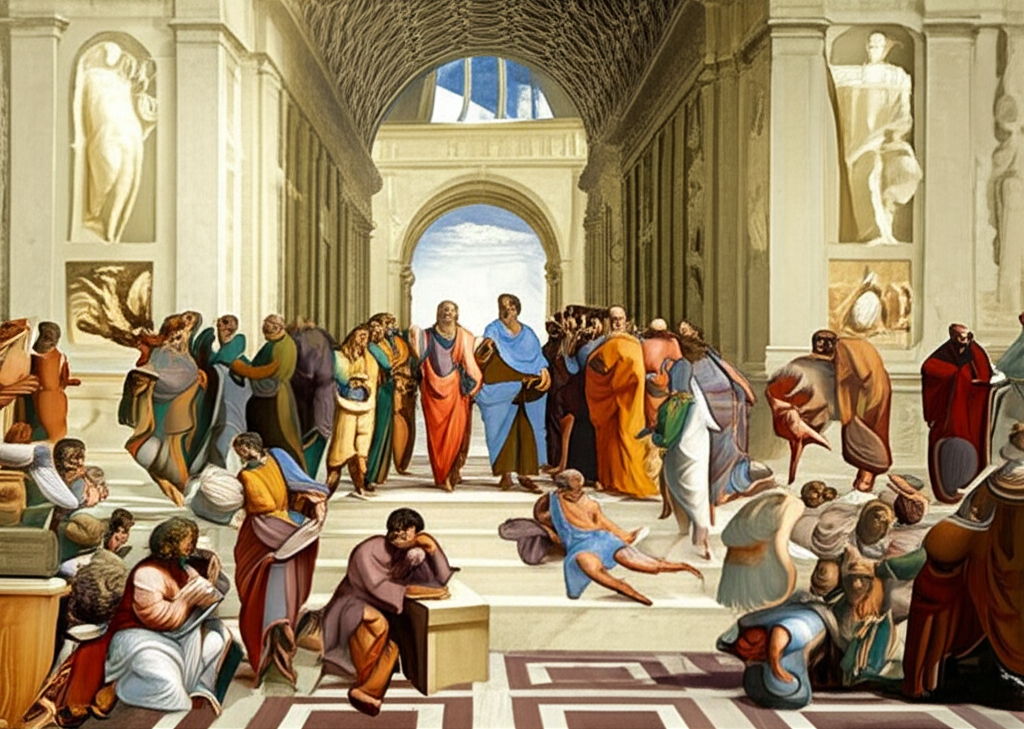 and the Many (Particulars, empirical reality). The background shows a bustling marketplace, further emphasizing the multiplicity of everyday existence.)
Why Does This Matter? The Metaphysics of Being
The Problem of One and Many is not just a historical curiosity; it sits at the very heart of Metaphysics because it directly concerns the nature of Being itself. Our answers to this problem shape our understanding of:
- Reality: Is the world fundamentally unified or diverse? Is change real or illusory?
- Knowledge: How can we have universal knowledge if reality is purely particular? How can we understand particulars if they are merely fragments of a greater whole?
- Identity: What makes an individual one and distinct, while also being part of larger groups and systems?
- Ethics: If all beings are fundamentally one, what are our obligations to others? If we are truly many, how do we justify universal moral principles?
Key Philosophical Approaches to the One and Many
| Approach | Core Idea | Key Thinkers | Emphasis |
|---|---|---|---|
| Radical Monism | Only the One is real; multiplicity is illusory. | Parmenides | Unity, permanence |
| Radical Pluralism | Only the Many are real; unity is an emergent property or an illusion. | Heraclitus (in some interpretations), Atomists | Multiplicity, change |
| Dualism | Two fundamental, distinct kinds of Being (e.g., mind and body). | Plato (Forms and particulars), Descartes | Distinction, interaction (or lack thereof) |
| Moderate Realism | Universals (the One) exist in particulars (the Many). | Aristotle | Relation, substance, immanent universals |
| Idealism/Constructivism | Unity is imposed or constructed by the mind or consciousness. | Kant, Hegel | Subjectivity, synthesis |
| Process Philosophy | Reality is fundamentally dynamic; unity and multiplicity are moments in a continuous flow. | Heraclitus, Whitehead | Becoming, change, interconnectedness |
Conclusion: An Enduring Quest for Coherence
The Problem of One and Many remains a vibrant area of philosophical inquiry because it forces us to confront the very foundations of our understanding. Whether we lean towards a unified cosmos or a fragmented reality, our attempts to reconcile the One with the Many reveal the deep human desire to find coherence and meaning in the vastness of existence. It reminds us that Metaphysics isn't just about what is, but how everything relates to everything else, forming the intricate tapestry of Being.
YouTube: "Parmenides vs Heraclitus problem of one and many"
YouTube: "Plato's Theory of Forms and the Problem of Universals"
📹 Related Video: What is Philosophy?
Video by: The School of Life
💡 Want different videos? Search YouTube for: "The Problem of One and Many philosophy"