

Unraveling Reality: The Enduring Puzzle of the One and Many
Hey everyone, Chloe here, diving into one of philosophy's most persistent and fascinating riddles: The Problem of One and Many. At its heart, this isn't just an abstract intellectual exercise; it's a fundamental quest to understand the very fabric of reality. How can the diverse, ever-changing world we experience – the "Many" – ultimately be unified or derive from a single, underlying essence or principle – the "One"? This question lies at the bedrock of Metaphysics, challenging us to define Being itself and the Relation between its seemingly contradictory manifestations. It’s a puzzle that has captivated thinkers from ancient Greece right up to our contemporary philosophical landscape, shaping our understanding of existence, knowledge, and even ourselves.
The Ancient Origins: A Clash of Perspectives
The Great Books of the Western World are absolutely brimming with attempts to grapple with this conundrum. The earliest Western philosophers, the Pre-Socratics, were already wrestling with it, setting the stage for millennia of debate.
- Parmenides of Elea: Argued vehemently for the One. For Parmenides, Being is singular, eternal, unchanging, and indivisible. Change and multiplicity are mere illusions of the senses. To speak of "non-being" is impossible, therefore, everything that is must be fundamentally a single, unified reality. This radical monism presented a profound challenge: how do we account for the world we perceive?
- Heraclitus of Ephesus: Stood in stark contrast, championing the Many. "No man ever steps in the same river twice, for it's not the same river and he's not the same man." For Heraclitus, everything is in a state of flux, constant change is the only constant. Being is a dynamic process, an eternal becoming, not a static entity. The unity he found was in the logos, the underlying principle of change and opposition, rather than a static substance.
These two foundational views established the core tension: permanence vs. change, unity vs. multiplicity.
Plato's Solution: Forms and Particulars
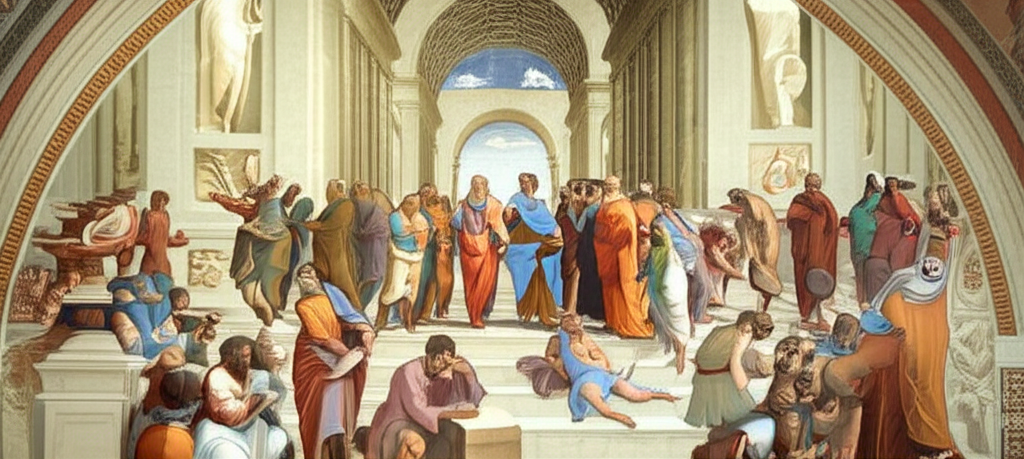
Plato, deeply influenced by both Parmenides and Heraclitus, sought to reconcile these extremes. He proposed his famous Theory of Forms.
- The Forms (The One): For Plato, true Being resides in the transcendent, perfect, and unchanging Forms (e.g., the Form of Beauty, the Form of Justice, the Form of Horseness). These Forms are universal archetypes, representing the "One" in its purest sense. They are eternal, non-physical, and serve as the ideal models for everything that exists in the sensible world.
- The Particulars (The Many): The objects we encounter in our everyday experience – beautiful things, just acts, individual horses – are mere imperfect copies or participants in these Forms. They are the "Many" – diverse, changing, and ephemeral.
The crucial aspect here is the Relation between the Forms and the particulars. How do individual things "participate" in a universal Form? This Relation is where the problem of One and Many truly becomes intricate for Plato, leading to questions like the "Third Man Argument" in his later dialogues, where he himself critically examined the difficulties of this connection.
Aristotle's Grounded Approach: Substance and Accident
Aristotle, Plato's most famous student, offered a different path. While acknowledging the need for both universals and particulars, he brought the Forms down to earth, integrating them into the very fabric of existence.
| Aspect | Plato's View | Aristotle's View |
|---|---|---|
| Universals | Separate, transcendent Forms | Immanent in particulars, essences of things |
| Particulars | Imperfect copies, participate in Forms | Primary substances, combinations of form and matter |
| Relation | Participation (often problematic) | Form in matter, substance is its form/matter |
| Being | Primarily the Forms | Primarily individual substances |
For Aristotle, the "One" is not a separate realm but the form or essence inherent within each individual thing, which he called a substance. A substance (like a specific human being or a particular tree) is a composite of form (the universal, defining essence) and matter (the particular stuff it's made of). The "Many" are these individual substances, each embodying a universal form in a unique way. The Relation here is one of inherence: the universal form exists in the particular matter. This approach attempts to solve the problem by showing how the universal (the "One") is actualized and made concrete in the particular (the "Many").
Beyond Antiquity: The Persistence of the Problem
The Problem of One and Many didn't end with the Greeks. It continued to shape medieval philosophy, particularly in the Problem of Universals: do universals (like "humanity" or "redness") exist independently of individual things (realism), only as concepts in the mind (conceptualism), or merely as names or labels (nominalism)? This debate is a direct continuation of the One and Many.
In modern philosophy, while the language might change, the core tension remains.
- How do we reconcile the unity of a scientific law with the vast diversity of phenomena it explains?
- How can a single consciousness experience a multitude of sensations and thoughts?
- What is the Relation between the individual person and the collective society?
The Problem of One and Many forces us to confront fundamental questions about unity, diversity, identity, and change. It's about how we structure our understanding of the world – whether we privilege the overarching principles or the granular details, and critically, how we connect them. It’s a constant reminder that reality, in all its perplexing glory, is rarely simple.
YouTube: "Parmenides vs Heraclitus - The Problem of Change"
YouTube: "Plato's Theory of Forms Explained"
📹 Related Video: What is Philosophy?
Video by: The School of Life
💡 Want different videos? Search YouTube for: "The Problem of One and Many philosophy"