

The Enduring Quandary: Unpacking The Problem of Labor in the State
Summary: The problem of labor within the state is a foundational and persistent philosophical dilemma, exploring how human effort shapes society, generates wealth, and defines individual freedom and collective obligation. From ancient Greece to modern industrial societies, philosophers have grappled with labor's role in creating wealth, its relationship to citizenship, and the state's responsibility in managing its inherent tensions, often revealing deep-seated problems of justice, alienation, and power.
The Genesis of a Philosophical Problem
From the earliest city-states to the most complex global economies, human labor has been the engine of civilization. Yet, its nature, purpose, and proper place within the political order have consistently posed profound problems for philosophers. Is labor a curse or a blessing? A means to an end or an end in itself? How does the state reconcile the individual's need to work with the collective's need for order and prosperity? And perhaps most critically, how is the wealth generated by this labor to be justly distributed and managed?
This inquiry, deeply rooted in the "Great Books of the Western World," reveals a dynamic tension between the individual, their productive capacity, and the overarching structure of the state.
Ancient Perspectives: Labor as Necessity and Subordination
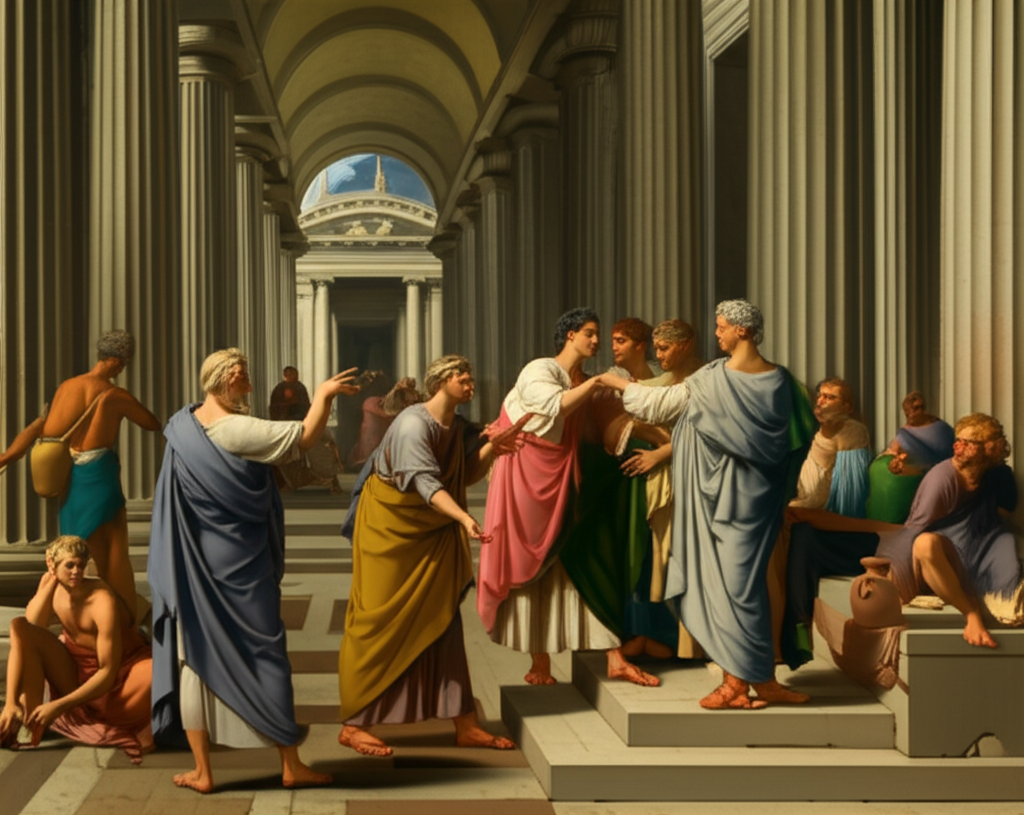
In the classical world, the problem of labor was often framed in terms of social hierarchy and the pursuit of the "good life."
- Plato's Republic: Envisioned a state where labor was compartmentalized. The artisans and farmers performed essential tasks, producing the wealth necessary for the community, but were distinct from the guardian class and the philosopher-kings who governed. Manual labor, while necessary, was generally seen as a lower pursuit, diverting one from the intellectual and civic duties required for true citizenship. The problem here was how to integrate essential labor without compromising the intellectual and moral development of the ruling class.
- Aristotle's Politics: Similarly distinguished between "necessary" activities, like crafting and farming, and "noble" activities, like politics and philosophy. For Aristotle, the ideal citizen had leisure, freed from the drudgery of labor, to participate fully in the polis. Slaves and foreigners often performed the bulk of the physical labor, allowing citizens to pursue virtue. The state's role was to maintain this order, which, from a modern perspective, highlights the problem of an economy built on forced labor and exclusion.
These ancient views established a lasting problem: how can a society value and depend upon labor for its very existence, yet simultaneously devalue those who perform it?
The Enlightenment and the Rise of Labor as Property
With the advent of the Enlightenment, the philosophical understanding of labor underwent a significant transformation, moving from a mere necessity to a fundamental aspect of human identity and the source of legitimate property.
- John Locke's Second Treatise of Government: Proposed that labor is the origin of property. When an individual "mixes" their labor with something from nature, they make it their own. This concept profoundly shifted the understanding of wealth creation and individual rights. The state's role, in Locke's view, was to protect these natural rights, including the right to one's labor and its fruits. However, this also introduced a new problem: if labor creates property, what happens when some individuals accumulate vast amounts of wealth through the labor of others?
- Jean-Jacques Rousseau's Discourse on Inequality: While acknowledging labor's role in property, Rousseau critically examined the problem of private property leading to inequality. He argued that the establishment of property, initially secured by labor, ultimately led to the formation of the state not to protect natural rights universally, but to protect the interests of the wealthy few, thus perpetuating the problem of social stratification.
The Enlightenment thinkers thus laid the groundwork for understanding labor as a source of individual agency and wealth, but also exposed its potential to create profound social problems if not properly managed or regulated by the state.
Industrialization, Alienation, and the Modern State
The Industrial Revolution dramatically intensified the problem of labor within the state, bringing forth new challenges related to scale, mechanization, and the nature of work itself.
- Karl Marx's Das Kapital: Offered a searing critique of industrial labor under capitalism. For Marx, labor became a commodity, bought and sold in the market. Workers, alienated from the products of their labor, the process of labor itself, their fellow workers, and their own species-being, became mere cogs in a machine designed to generate wealth for the capitalist class. The state, in Marx's analysis, served as an instrument of the ruling class, perpetuating this exploitative system. The fundamental problem here was the dehumanizing nature of labor and the unjust distribution of the wealth it created, leading to class struggle.
| Philosophical Era | View of Labor | State's Role | Key Problem Identified |
|---|---|---|---|
| Ancient (Plato, Aristotle) | Necessary but subordinate; for non-citizens/slaves | Maintain social hierarchy, ensure stability | Integrating essential labor without compromising civic virtue/leisure |
| Enlightenment (Locke, Rousseau) | Source of property, individual right; potential for inequality | Protect property/rights; potentially perpetuate inequality | Justification of property; rise of social inequality |
| Industrial (Marx) | Commodity, source of surplus value; alienating | Instrument of the ruling class; perpetuating exploitation | Alienation, exploitation, unjust distribution of wealth |
The modern state is thus faced with the complex problem of balancing economic growth, often driven by intense labor, with social justice, worker rights, and the equitable distribution of wealth.
The Enduring Philosophical Dilemma
The problem of labor in the state remains one of philosophy's most urgent and multifaceted inquiries. It touches upon fundamental questions of human dignity, economic justice, and the very purpose of political organization. As societies evolve, new forms of labor emerge, and the mechanisms of wealth creation shift, the state's role in mediating the relationship between individuals and their work continues to be a battleground of ideas.
Whether it is the demand for fair wages, the debate over automation, or the quest for meaningful work, the echoes of Plato, Locke, and Marx resonate, reminding us that the problem of labor is not merely economic or political, but profoundly philosophical.
YouTube: "Marxist concept of alienation explained"
YouTube: "John Locke's theory of property and labor"
📹 Related Video: What is Philosophy?
Video by: The School of Life
💡 Want different videos? Search YouTube for: "The Problem of Labor in the State philosophy"