

The Enduring Quandary: The Problem of Labor in the State
At the heart of political philosophy lies a fundamental tension: the relationship between individual human labor and the overarching structure of the State. This article will explore the persistent problem of how societies organize, value, and distribute the fruits of labor, and how the State's intervention invariably shapes the accumulation and distribution of wealth. From ancient divisions of tasks to modern economic systems, the question of who labors, for whom, and under what conditions remains a crucial philosophical battleground, directly impacting individual freedom, social justice, and the very nature of political power.
The Genesis of the Problem: Labor as the Foundation
From the earliest philosophical inquiries, it was understood that human existence is inextricably linked to labor. Whether tilling the soil, crafting tools, or building cities, labor is the transformative act that sustains life and builds civilization. Thinkers throughout the Great Books of the Western World – from Plato's division of labor in the Republic to Locke's theory of property derived from labor – grappled with its significance.
- Plato's Ideal State: Envisioned a society where individuals perform tasks best suited to their nature, ensuring the efficient functioning of the State. Labor here is a civic duty, a contribution to the collective good.
- Aristotle's Household Economy: Distinguished between natural acquisition (labor for sustenance) and unnatural acquisition (commerce for profit), questioning the moral implications of different forms of labor and wealth accumulation.
- Locke's Natural Rights: Argued that an individual's labor, when mixed with nature, creates property, thereby establishing a fundamental right that the State should protect, not infringe upon.
The initial problem emerges when individual effort, inherently personal, becomes subject to collective organization and control. How does the State balance the need for collective prosperity with the individual's right to the fruits of their own toil?
The State's Embrace and Its Iron Grip
The State, by its very definition, is an organizing principle. It establishes laws, defines property rights, and often dictates the terms under which labor is performed. This intervention, while necessary for order and large-scale projects, introduces complex philosophical dilemmas.
The State's Multifaceted Relationship with Labor:
- Regulator: The State sets minimum wages, working conditions, and safety standards, aiming to protect laborers and ensure fair practices.
- Employer: In many societies, the State is a significant employer, directly organizing labor for public services, infrastructure, and defense.
- Taxer: The State extracts a portion of the wealth generated by labor through taxation, ostensibly to fund public goods and redistribute resources.
- Enforcer: It enforces contracts, protects private property, and maintains the legal framework within which labor operates, often using coercive power.
- Beneficiary: The State itself benefits immensely from the collective labor of its citizens, deriving its power and resources from the productivity of its populace.
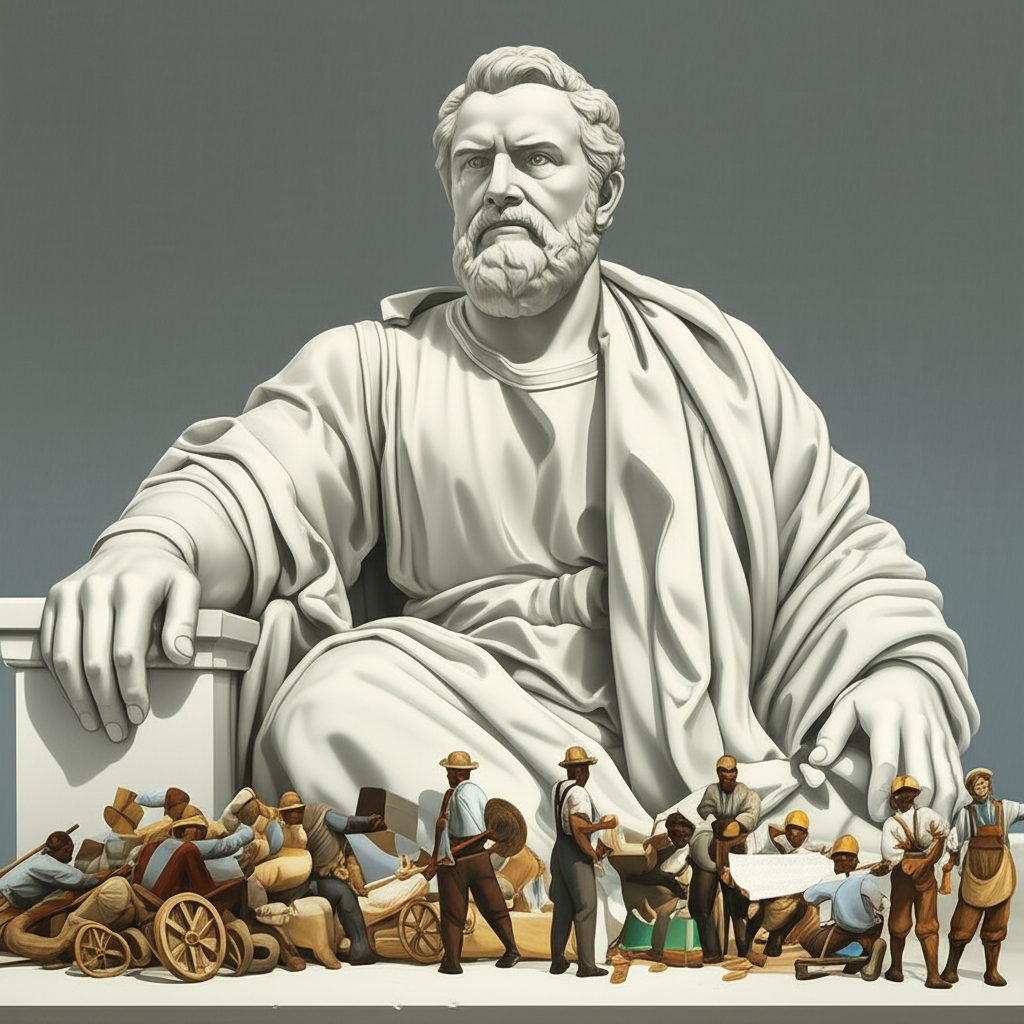 diligently working, and the other hand holding scales of justice or a scroll of laws. In the background, there are various structures like granaries and public buildings, symbolizing the wealth generated and managed. The laborers show a mix of determination and subtle weariness, illustrating the inherent tension in their relationship with the governing power.)
Wealth, Justice, and the Problem of Distribution
The central problem intensifies when we consider the distribution of wealth. If labor creates wealth, how should that wealth be shared? The State's role here is highly contentious, leading to vastly different political and economic ideologies.
- Laissez-faire Approaches: Advocate for minimal State intervention, believing that the free market, driven by individual labor and exchange, will naturally lead to optimal wealth distribution, albeit with inevitable inequalities.
- Socialist Theories: Propose greater State control over the means of production and distribution, arguing that collective labor should yield collective wealth, shared more equitably to prevent exploitation and alleviate poverty.
- Welfare States: Seek a middle ground, where the State intervenes to redistribute wealth through social programs, progressive taxation, and regulations, aiming to mitigate the harshness of unchecked capitalism while preserving individual initiative.
The philosophical debate revolves around what constitutes a just distribution. Is it based on individual effort, need, or contribution to the collective? And to what extent is the State justified in compelling individuals to contribute their labor or a portion of their wealth for the common good? This often leads to the problem of individual liberty versus collective security, a recurring theme in political thought.
The Persistent Quandary
The problem of labor in the State is not static; it evolves with economic systems, technological advancements, and changing social values. From the challenges of industrialization to the complexities of the digital economy, the fundamental questions persist:
- How can the State ensure dignified and meaningful labor for all its citizens?
- What is the proper balance between individual autonomy in labor and the collective needs of society?
- How should the wealth generated by labor be allocated to foster both prosperity and justice?
These are not mere economic questions; they are profound philosophical inquiries into the nature of human freedom, societal organization, and the moral responsibilities of power. The answers we devise, or fail to devise, shape the very fabric of our lives and the future of our civilizations.
YouTube Video Suggestions:
-
📹 Related Video: KANT ON: What is Enlightenment?
Video by: The School of Life
💡 Want different videos? Search YouTube for: ""Marx's Theory of Alienation Explained - The Problem of Labor""
2. ## 📹 Related Video: What is Philosophy?
Video by: The School of Life
💡 Want different videos? Search YouTube for: ""John Locke Labor Theory of Property - Political Philosophy""