

The Unbounded Question: Grappling with the Problem of Infinity in Space
The idea of infinity often captivates and confounds us, nowhere more so than when we turn our gaze to the cosmos. Is space, the very fabric within which all existence unfolds, truly infinite? Or does it possess a boundary, a final frontier beyond which nothing lies? This is the Problem of Infinity in Space, a profound philosophical conundrum that has puzzled thinkers from antiquity to the present day, challenging our very capacity to conceive of ultimate quantity and extent. It's a problem that forces us to confront the limits of human reason and the boundless mysteries of existence itself.
The Ancient Roots of an Endless Debate
Philosophers throughout history, many of whom are captured within the pages of the Great Books of the Western World, have grappled with the nature of space. The ancient Greeks, for instance, were deeply divided. Parmenides, with his emphasis on an unchanging, unified reality, might lean towards a finite, perfect sphere. Yet, the atomists, like Leucippus and Democritus, posited an infinite void in which an infinite number of atoms could move, creating an infinite number of worlds.
Aristotle, ever the meticulous categorizer, introduced a crucial distinction between actual infinity and potential infinity. For him, actual infinity (an infinitely completed quantity) could not exist in the physical world. While a line could be divided infinitely (potential infinity), there could not be an actually infinite number of points on that line. Applied to space, this meant that while space might be potentially extendable without end, it couldn't be an actually infinite, completed totality. This distinction provided a powerful framework, influencing centuries of thought on the problem.
The Paradoxes of an Infinite or Finite Space
Whether we posit an infinite or finite Space, we inevitably encounter profound paradoxes that stretch our understanding:
If Space is Truly Infinite:
- The Problem of Comprehension: How can the finite human mind grasp something truly boundless? Our experience is always within limits, making the concept of an endless expanse almost unintelligible.
- The Absence of a Center: In an infinite universe, every point could be considered a center, or no point could be. This challenges our intuitive sense of orientation and location.
- The Return of All Possibilities: If Space is infinite, and matter is distributed throughout it (even sparsely), then given enough time and quantity of matter, every possible event, every possible configuration, and indeed, infinite versions of ourselves and our lives, must exist somewhere within that infinite expanse. This concept, while fascinating, undermines the uniqueness of individual existence.
If Space is Finite:
- The Boundary Question: If space has a boundary, what lies beyond it? This is perhaps the most immediate and perplexing question. Does it simply "end"? What would that "end" look like?
- The Container Paradox: If space is finite, it implies that it must be contained within something else. But what is that "something else" if not more space? This leads to an infinite regress, pushing the problem back rather than resolving it.
- The Edge of Reality: Imagining an edge to reality itself is deeply unsettling. Would we simply fall off? Would we hit an invisible wall? The very notion seems to contradict the continuous, unbounded nature of our experience.
Philosophical Implications and the Limits of Reason
The Problem of Infinity in Space isn't merely a cosmological curiosity; it strikes at the heart of our philosophical understanding of reality, knowledge, and even our place within the cosmos.
Key Philosophical Impacts:
- Epistemology (Theory of Knowledge): It highlights the limitations of human perception and conceptualization when faced with ultimate questions. Can we truly know the nature of space, or is it fundamentally beyond our grasp?
- Metaphysics (Nature of Reality): It forces us to reconsider fundamental categories like "existence," "location," and "quantity." What does it mean for something to exist if it has no ultimate boundary or, conversely, if it is confined within an inexplicable limit?
- Cosmology and Theology: Historically, the nature of space has been deeply intertwined with conceptions of God and the universe's origin. An infinite universe might suggest an infinite creator, or it might challenge the idea of a singular act of creation.
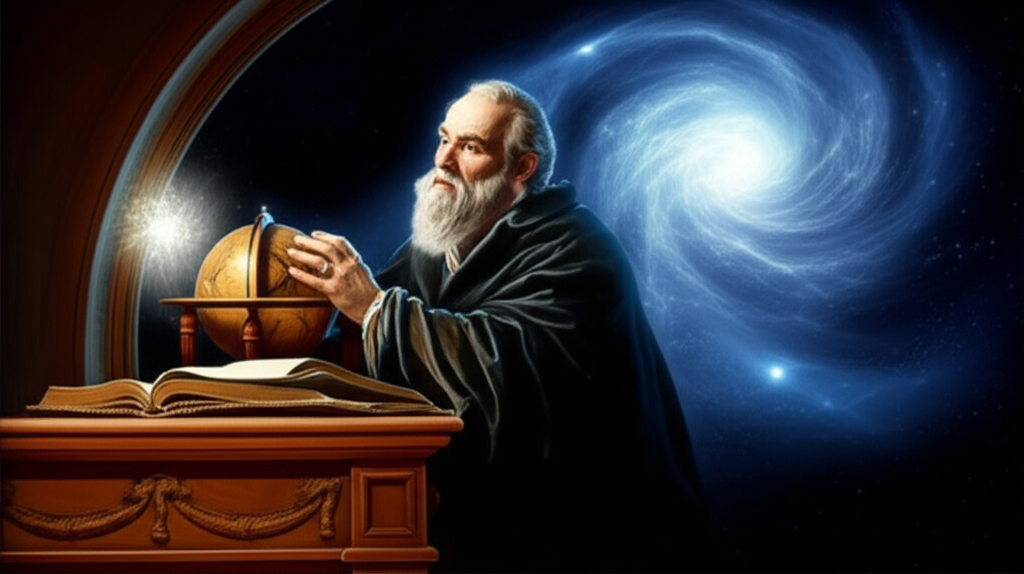
Enduring Mystery and Modern Echoes
While modern physics offers theories about the universe's expansion and curvature, these often describe the observable universe or the geometry within space, rather than definitively resolving the philosophical problem of space's ultimate quantity and extent. The question of whether space itself is infinite or finite remains a profound philosophical challenge.
Ultimately, grappling with the Problem of Infinity in Space is less about finding a definitive answer and more about the journey of inquiry itself. It's about pushing the boundaries of our thought, acknowledging the grand scale of the universe, and embracing the profound mysteries that lie at the core of our existence.
YouTube Suggestions:
-
📹 Related Video: KANT ON: What is Enlightenment?
Video by: The School of Life
💡 Want different videos? Search YouTube for: ""Philosophical problem of infinite space""
2. ## 📹 Related Video: ARISTOTLE ON: The Nicomachean Ethics
Video by: The School of Life
💡 Want different videos? Search YouTube for: ""Aristotle actual vs potential infinity explained""