

The Unbounded Question: Grappling with the Problem of Infinity in Space
Have you ever looked up at the night sky and felt that dizzying sensation, that profound problem of scale? It's not just the vastness we perceive; it's the unsettling quantity of it all, the nagging philosophical question of whether space truly stretches on forever. This isn't just a scientific query; it's one of humanity's oldest philosophical conundrums, a relentless intellectual pursuit that challenges our very capacity for comprehension: the problem of infinity in space.
This article delves into the philosophical journey of grappling with an infinite cosmos, tracing how thinkers from antiquity to the Enlightenment have wrestled with the implications of an unbounded universe. We’ll explore why the concept of infinite space presents such a profound problem for our understanding, our perception of quantity, and ultimately, our place within existence.
Gazing into the Void: The Philosophical Weight of Infinite Space
Let's be honest, the idea of infinity is a mind-bender. We can count, we can measure, we can conceptualize "very, very large," but "without end"? That's a different beast entirely. When we apply this concept to space itself, we confront a fundamental problem that has baffled the greatest minds in history. Is the universe boundless, stretching out in every direction without limit? Or does it have an edge, and if so, what lies beyond that edge? These aren't idle musings; they strike at the heart of our understanding of reality, causality, and even the nature of being. The sheer quantity implied by infinite space seems to defy our finite minds.
The Ancient Quandary: Aristotle and the Potential vs. Actual Infinite
Our journey into this problem begins, as so many philosophical journeys do, with the ancient Greeks. Aristotle, a titan among the thinkers featured in the Great Books of the Western World, meticulously dissected the concept of infinity, particularly in his Physics. For Aristotle, the idea of an actual infinite – a completed, existing infinite quantity – was problematic and ultimately rejected.
Aristotle argued that while we can always conceive of adding more to a number, or dividing a line further, this process is one of potential infinity. We can always potentially extend space, or divide a segment of it, but we never arrive at a point where an infinite quantity of space or parts of space is actually present and complete.
- Aristotle's Argument Against Actual Infinity in Space:
- Impossibility of Completion: An actual infinite implies a completion of an unending process, which is a contradiction.
- No "Whole" for an Infinite: How can you have a "whole" or "sum" of something that is infinite? It defies definition and measurement.
- Relativity to Movement: Space, for Aristotle, was tied to bodies and their movement. An infinite body or infinite movement was incoherent.
This distinction is crucial. It allowed for the idea of space being indefinitely extendable, but not actually infinite in its present state. The problem of quantity was thus sidestepped by shifting from a static, completed infinite to a dynamic, ever-unfolding one.
Zeno's Paradoxes: The Infinite Within the Finite
While not directly about the infinity of space as a whole, Zeno of Elea's paradoxes (also found in the Great Books, often discussed in relation to Aristotle) brilliantly illustrate the conceptual problem of quantity and infinity within space. Consider the paradox of Achilles and the Tortoise, or the Dichotomy paradox (before reaching a destination, you must first reach the halfway point, and before that, the halfway point of that, and so on, infinitely).
These paradoxes highlight the absurdity that can arise when we assume that space (or time) is infinitely divisible into an actual infinite number of points or moments. If every segment of space contains an infinite quantity of points, how can movement ever begin or end? Zeno's challenges, though designed to support Parmenides' view of unchanging reality, underscore how deeply unsettling the concept of infinity – even within a finite region of space – can be for our logical frameworks.
The Cartesian Challenge and Kant's Antinomies
Centuries later, the problem of infinite space re-emerged with renewed vigor. René Descartes, another luminary from the Great Books, posited that the essence of matter was extension, meaning that where there is space, there is matter. This implied a potentially infinite, homogeneous universe.
However, it was Immanuel Kant, in his Critique of Pure Reason, who most famously articulated the problem of infinite space as one of his Antinomies of Pure Reason. Kant argued that reason, left to its own devices, falls into unavoidable contradictions when contemplating the nature of the cosmos.
| Antinomy (First, regarding Space) | Thesis (World is Finite) | Antithesis (World is Infinite) |
|---|---|---|
| Regarding Space | The world has a beginning in time, and is also limited in space. | The world has no beginning in time, and no limits in space; it is infinite as regards both time and space. |
Kant demonstrated that one could construct equally compelling rational arguments for both the finitude and the infinitude of space. This isn't just a failure of reason; it's a profound insight into the problem itself: our empirical experience can never verify infinity, and our pure reason, when applied to concepts beyond possible experience, leads to irresolvable contradictions. The quantity of the universe, whether finite or infinite, remains a conceptual stumbling block.
The Modern Conundrum: Is Space Truly Infinite?
Even with the advent of modern cosmology, which offers models of an expanding universe, the philosophical problem of infinity in space persists. While science can describe the observable universe and its geometry, the question of whether space itself is truly infinite remains largely beyond empirical verification. Is the universe spatially infinite, a boundless expanse? Or is it finite but unbounded, like the surface of a sphere, where you can travel forever without hitting an edge, but the quantity of its surface area is finite?
These are not just scientific questions; they are deeply philosophical, touching upon the problem of what it means for something to be truly without end, without limit, and how such a quantity can exist or be conceived.
The Unquantifiable Expanse: Why Infinity Troubles Our Minds
The core problem with infinity in space is that it fundamentally resists our attempts to quantify and categorize. Our minds are built to process finite quantities, to measure, to compare. When faced with something that has no measure, no end, no boundary, our cognitive tools falter.
- Conceptual Difficulty: We can't truly imagine an infinite space. We can only imagine more space, and then more again.
- Lack of Reference Points: In an infinite universe, every point is, in a sense, a center, and no point is truly unique. How do we establish a frame of reference for quantity?
- Implications for Existence: Does an infinite quantity of space imply an infinite quantity of matter? An infinite quantity of possibilities? The philosophical ripple effects are immense.
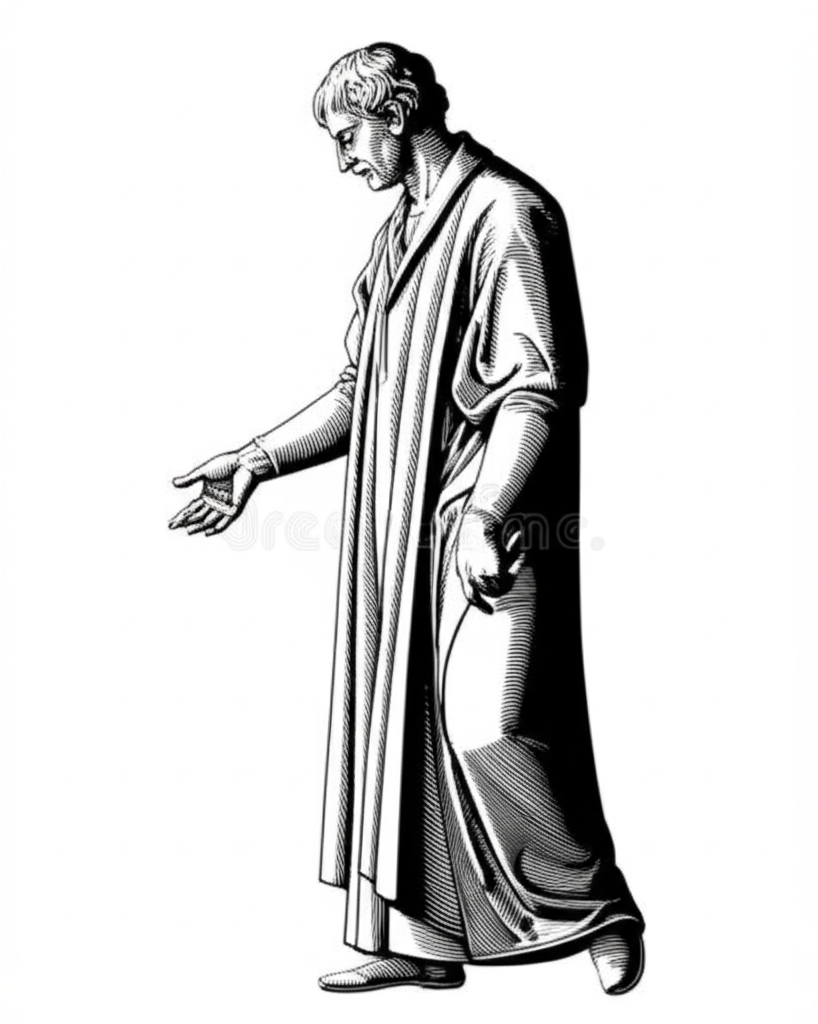 peering through a telescope or simply gazing upwards into a stylized, abstract sky. The sky is not simply stars but features swirling patterns or an endless, repeating geometric motif that visually suggests boundlessness and the overwhelming nature of infinite space, with subtle classical architectural elements in the foreground.)
Conclusion: Living with the Infinite Question
The problem of infinity in space is not one that has been definitively "solved" by philosophy or science. Instead, it stands as a testament to the limits of human reason and the boundless nature of the cosmos itself. From Aristotle's careful distinctions to Kant's antinomies, the Great Books of the Western World reveal a sustained struggle to reconcile our finite understanding with an potentially infinite reality.
Perhaps the greatest lesson is not in finding an answer, but in appreciating the problem itself. It forces us to confront the limitations of our conceptual frameworks, to question our assumptions about quantity and existence, and to cultivate a profound sense of wonder at the universe's ultimate mysteries. The question of infinite space remains, an open invitation to continuous philosophical inquiry.
YouTube Video Suggestions:
-
📹 Related Video: ARISTOTLE ON: The Nicomachean Ethics
Video by: The School of Life
💡 Want different videos? Search YouTube for: ""Aristotle Infinity Physics Philosophy""
2. ## 📹 Related Video: KANT ON: What is Enlightenment?
Video by: The School of Life
💡 Want different videos? Search YouTube for: ""Kant First Antinomy Space Time""