

The concept of infinity, a boundless expanse that dwarfs our finite comprehension, has long been a source of profound fascination and exasperating problem within both philosophy and mathematics. It challenges our most fundamental notions of quantity, order, and completeness, leading to paradoxes that have perplexed the greatest minds across millennia. This pillar page delves into "The Problem of Infinity in Mathematics," exploring its historical roots, its revolutionary mathematical developments, and the deep philosophical questions it continues to provoke about the very nature of reality and thought. From ancient Greek dilemmas to modern set theory, the infinite remains an elusive, yet central, frontier of human inquiry.
Defining the Infinite Problem
At its core, the problem of infinity in mathematics isn't merely about understanding a very large number; it's about grappling with a concept that defies conventional numerical operations and intuitions. How can we manipulate, count, or even conceive of something that has no end? This question gives rise to a series of paradoxes and foundational crises that force us to re-evaluate what we mean by "number," "set," and even "existence." Is infinity a concrete entity, an actual quantity that can be measured or contained, or merely a potential process, an endless journey that can never be completed? This distinction lies at the heart of the mathematical and philosophical struggle with the infinite.
A Historical Glimpse: From Ancient Greece to Modern Set Theory
The problem of infinity is not a modern invention; its roots stretch back to antiquity, profoundly influencing early philosophical and mathematical thought.
Zeno's Paradoxes: Early Encounters with Infinite Division
The Eleatic philosopher Zeno of Elea, whose work is chronicled in the Great Books of the Western World, presented a series of paradoxes that highlighted the perplexing nature of infinite divisibility. His most famous, "Achilles and the Tortoise" and "The Dichotomy," argue that motion is impossible because to reach any destination, one must first traverse an infinite number of smaller distances. These paradoxes didn't deny the existence of motion, but rather exposed the deep conceptual difficulties in reconciling continuous space and time with discrete units of measurement and the problem of summing an infinite series.
Aristotle's Distinction: Potential vs. Actual Infinity
Aristotle, another towering figure from the Great Books, offered a crucial distinction that shaped Western thought on infinity for centuries: potential infinity versus actual infinity.
- Potential Infinity: For Aristotle, infinity was always "potential." It represented a process that could be continued indefinitely, such as the endless division of a line segment or the unending sequence of natural numbers. We can always add one more, or divide a segment further, but we never reach an end or complete the entire infinite process. This type of infinity is always "in the making" and never fully "made."
- Actual Infinity: Aristotle generally rejected the notion of actual infinity in the physical world, seeing it as contradictory. He believed that a completed, bounded totality of infinitely many things could not exist. This view profoundly influenced medieval scholasticism and largely restricted mathematical inquiry into infinity to its potential form.
Cantor's Revolution: Quantifying the Infinite
The Aristotelian consensus was dramatically challenged in the late 19th century by the German mathematician Georg Cantor. His groundbreaking work on set theory, though initially met with skepticism and even hostility, revolutionized our understanding of infinity. Cantor dared to treat infinite sets as completed, actual totalities, and in doing so, he made an astonishing discovery: infinities come in different sizes.
Cantor demonstrated that the set of natural numbers (1, 2, 3, ...) is infinite, but it is a "countable" infinity. He then proved, using his famous diagonal argument, that the set of real numbers (all numbers on the number line) is a "larger" or "uncountable" infinity. This meant that there are more real numbers than natural numbers, even though both sets are infinite. Cantor's work profoundly shifted the problem of infinity from a purely philosophical debate about its existence to a mathematical inquiry into its various forms and properties, fundamentally altering our concept of quantity.
Navigating the Landscape of Mathematical Infinities
Cantor's insights opened up a new landscape, requiring new definitions and approaches to truly grasp the nuances of infinity.
The Two Faces: Potential and Actual
The distinction inherited from Aristotle remains vital, even as modern mathematics embraces actual infinity.
| Type of Infinity | Description | Example |
|---|---|---|
| Potential Infinity | A process that can be continued indefinitely, but never reaches a final, complete state. | The sequence of natural numbers (always adding one) |
| Actual Infinity | A completed totality of infinitely many elements, treated as a single, existing mathematical object. | The set of all natural numbers {1, 2, 3, ...} |
Modern set theory largely operates with actual infinity, allowing mathematicians to study properties of infinite sets as if they were finite, albeit with counter-intuitive results.
Orders of Infinity: Countable and Uncountable
Cantor's most revolutionary contribution was demonstrating that not all infinite sets are equivalent in "size."
- Countable Infinity: A set is countably infinite if its elements can be put into a one-to-one correspondence with the natural numbers. This means we could, in principle, list all its elements, even if the list never ends.
- Examples: The set of natural numbers (N), the set of integers (Z), the set of rational numbers (Q).
- Uncountable Infinity: A set is uncountably infinite if its elements cannot be put into a one-to-one correspondence with the natural numbers. There are simply "too many" elements to list, even in an infinite list.
- Examples: The set of real numbers (R), the set of points on any line segment, the power set of the natural numbers (the set of all subsets of N).
This hierarchy of infinities, often denoted by aleph numbers ($\aleph_0$, $\aleph_1$, etc.), reveals a startling complexity to the concept of quantity beyond our everyday experience.
Paradoxes of the Infinite: Hilbert's Hotel
The acceptance of actual infinity in mathematics often leads to scenarios that defy common sense, best illustrated by David Hilbert's "Hilbert's Hotel."
Imagine a hotel with an infinite number of rooms, all occupied.
- Scenario 1: One new guest arrives. The manager simply moves the guest in room 1 to room 2, guest in room 2 to room 3, and so on ($n \to n+1$). Room 1 becomes vacant, and the new guest is accommodated.
- Scenario 2: An infinite number of new guests arrive. The manager moves the guest in room 1 to room 2, guest in room 2 to room 4, guest in room 3 to room 6 ($n \to 2n$). All the odd-numbered rooms become vacant, and the infinite number of new guests can be accommodated.
This thought experiment demonstrates how actual infinity behaves differently from finite numbers, where adding to an already full system would be impossible. It highlights the problem of applying finite intuitions to infinite quantities.
The Philosophical Echoes of Infinity
The mathematical developments surrounding infinity have profound implications for philosophy, particularly regarding the nature of mathematical objects and reality itself.
Mathematical Reality: Platonism, Formalism, Intuitionism
The problem of infinity is a battleground for different philosophies of mathematics:
- Platonism (or Realism): Adherents believe that mathematical objects, including infinite sets and transfinite numbers, exist independently of human thought, in a sort of abstract realm. For Platonists, Cantor's discoveries were descriptions of an objective mathematical reality, not mere human constructs.
- Formalism: Formalists view mathematics as a system of formal axioms and rules for manipulating symbols. The problem of infinity is handled by ensuring consistency within these formal systems. Whether infinite sets "exist" in any real sense is less important than whether their manipulation leads to contradictions.
- Intuitionism: This school of thought, championed by L.E.J. Brouwer, is highly skeptical of actual infinity. Intuitionists argue that mathematical objects must be constructible or provable by finite means. They reject the notion of completed infinite sets as meaningful, viewing them as beyond human intuition and potentially leading to logical inconsistencies. For an intuitionist, only potential infinity is truly valid.
The Limits of Quantity and Comprehension
The very existence and nature of infinity force us to confront the limits of human understanding. Can we truly comprehend an uncountable quantity? Does the mathematical validity of infinite sets imply their physical possibility or existence? The universe, for instance, might be spatially infinite, but can it contain an actual infinity of stars or particles? These questions bridge the gap between pure mathematics and metaphysics, making the problem of infinity a perennial source of philosophical debate.
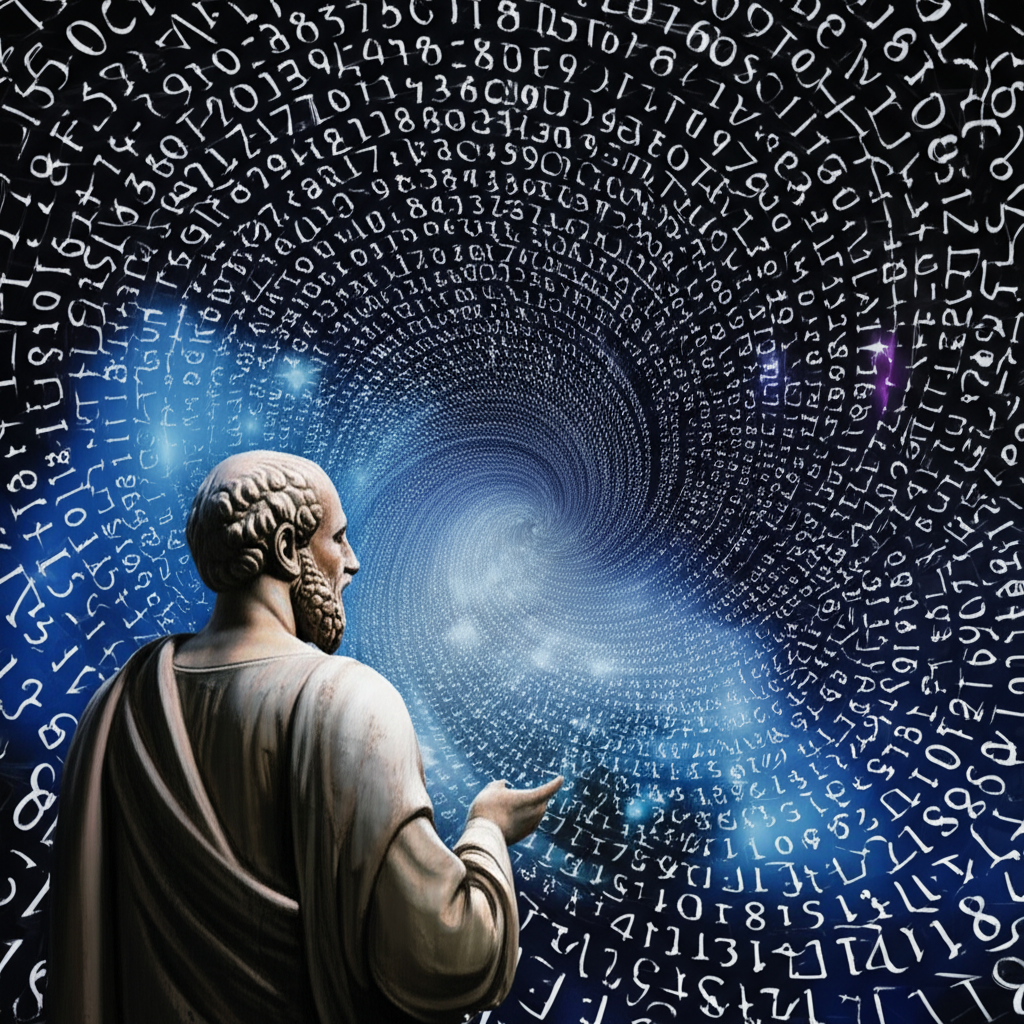 gazes pensively at a scroll, while in the background, a modern mathematician (like Cantor) stands before a chalkboard filled with set theory notation, both figures seemingly contemplating the same boundless concept from different eras.)
Conclusion: An Unending Inquiry
The problem of infinity in mathematics is not a solved puzzle but an ongoing exploration. From the ancient Greeks grappling with endless division to Cantor's revolutionary hierarchy of infinities, this concept continues to challenge our intuitions about quantity, space, and existence. It forces us to question the very foundations of our logical systems and the relationship between abstract mathematical constructs and the concrete world we inhabit. As we continue to push the boundaries of mathematical thought, infinity remains a testament to the boundless capacity of the human mind, even as it reveals the profound limits of our comprehension. It is an eternal enigma, a problem that promises to inspire philosophical and mathematical inquiry for as long as we seek to understand the nature of reality itself.
📹 Related Video: ARISTOTLE ON: The Nicomachean Ethics
Video by: The School of Life
💡 Want different videos? Search YouTube for: ""Cantor's Infinity: The Hotel Paradox Explained""
📹 Related Video: PLATO ON: The Allegory of the Cave
Video by: The School of Life
💡 Want different videos? Search YouTube for: ""Zeno's Paradoxes: Achilles and the Tortoise Explained""