

The Unseen Leap: Unpacking the Problem of Induction in Scientific Discovery
Scientific discovery, the bedrock of our understanding of the universe, often appears as a grand, systematic endeavor, built on observation, experimentation, and rigorous logic. Yet, beneath its seemingly unshakable foundations lies a profound philosophical challenge known as the problem of induction. This isn't merely an academic quibble; it strikes at the very heart of how we claim to derive knowledge from experience and predict the future based on the past. In essence, it asks: what justifies our belief that the future will resemble the past?
The Bedrock of Expectation: What is Induction?
At its core, induction is a form of reasoning that moves from specific observations to general conclusions. It's how we infer a universal law from a finite number of instances. For example, after observing countless instances of objects falling to the earth, we induce the law of gravity. We see the sun rise every morning and induce that it will rise again tomorrow.
Consider these everyday examples of inductive reasoning that underpin our understanding and actions:
- Scientific Laws: Observing numerous instances of a chemical reaction under specific conditions leads to the induction of a general chemical law.
- Medical Efficacy: Testing a drug on a sample population and observing its effects leads to the induction that it will work similarly for others.
- Everyday Predictions: Tasting a sweet apple and expecting the next one from the same tree to also be sweet.
Without induction, science as we know it would be impossible. Every experiment, every theory, every prediction relies on the assumption that patterns observed in the past will continue into the future.
Hume's Incisive Challenge: The Justification Crisis
The most famous and devastating critique of induction comes from the Scottish philosopher David Hume, whose work, notably An Enquiry Concerning Human Understanding (a classic found within the Great Books of the Western World), laid bare the deep philosophical chasm. Hume argued that our belief in cause and effect, and indeed all future predictions, is not based on logic or reason, but on habit and custom.
Hume's argument can be summarized as follows:
- No Demonstrative Proof: We cannot demonstrate inductively that the future will resemble the past using deductive reasoning (where the conclusion is guaranteed by the premises). Deductive arguments are tautological or self-evident; inductive arguments are not.
- No Probable Proof: To justify induction inductively would be circular reasoning. If we say "induction has worked in the past, therefore it will work in the future," we are already assuming the very principle we are trying to prove. This is like trying to lift yourself by your bootstraps.
Hume concluded that our belief in the uniformity of nature is a psychological necessity, not a rational one. We simply expect the future to resemble the past because it always has, but there is no logical compulsion for it to do so. This leaves our scientific knowledge, built on inductive leaps, resting on a foundation of faith rather than pure reason.
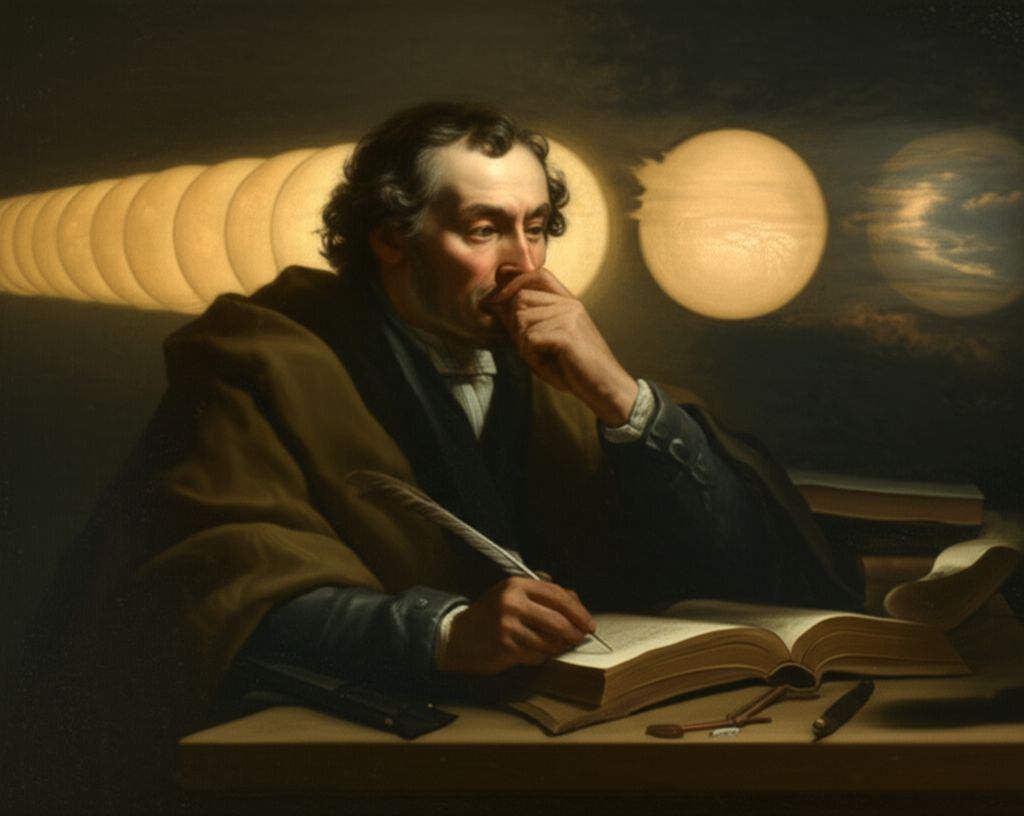
Science's Pragmatic Success vs. Logical Puzzles
Despite Hume's unsettling logic, science has undeniably been incredibly successful. Our technological advancements, medical breakthroughs, and deep understanding of the cosmos are all fruits of the inductive method. We launch rockets, cure diseases, and predict eclipses with astonishing accuracy. This pragmatic success often leads many to dismiss the problem of induction as a mere philosophical curiosity with no real-world implications.
However, the philosophical problem persists. The fact that induction works doesn't logically prove that it must work, nor does it provide a rational justification for its underlying assumption. We are simply observing that it has worked so far.
Attempting to Bridge the Gap: Responses and Reinterpretations
Philosophers and scientists have offered various responses to Hume's challenge:
- Karl Popper's Falsificationism: Popper argued that science doesn't primarily use induction to prove theories, but rather deduction to falsify them. A scientific theory, according to Popper, is one that can be tested and potentially disproven. While this shifts the focus, the initial formulation of hypotheses often still relies on inductive insights.
- Probabilistic Justifications: Some argue that while induction isn't certain, it makes future events probable. However, even probability theory relies on assumptions about the stability of frequencies over time, bringing us back to a similar inductive leap.
- Pragmatic Justification: This approach suggests that induction is the best strategy we have. While not logically guaranteed, it's the only method that has consistently led to successful predictions and technological progress. In the absence of a better alternative, we are practically justified in using it.
The Enduring Philosophical Quandary
The problem of induction highlights a fundamental tension in our pursuit of knowledge. On one hand, our empirical understanding of the world, and indeed our very survival, depends on our ability to learn from experience and anticipate future events. On the other hand, a rigorous philosophical examination reveals that this crucial ability rests on an unproven, perhaps unprovable, assumption about the uniformity of nature.
For the aspiring philosopher or scientist, understanding the problem of induction is not about abandoning science, but about appreciating its profound philosophical depths. It encourages humility about the certainty of our knowledge and reminds us that even the most robust scientific theories ultimately stand on a foundation that, at its deepest level, involves an act of faith in the cosmos.
📹 Related Video: PLATO ON: The Allegory of the Cave
Video by: The School of Life
💡 Want different videos? Search YouTube for: "The Problem of Induction Explained"
📹 Related Video: What is Philosophy?
Video by: The School of Life
💡 Want different videos? Search YouTube for: "David Hume's Philosophy: The Problem of Induction"