

The Enduring Conundrum: Grappling with the Problem of Evil (Sin) in the World
The Problem of Evil stands as one of philosophy's most persistent and vexing challenges, a relentless query that has echoed through the ages, testing the limits of faith and reason. At its core, it asks how a benevolent, omnipotent, and omniscient God can coexist with the manifest suffering, injustice, and moral depravity—often termed Sin—that pervade our World. This isn't merely an academic exercise; it's a profound existential dilemma that touches the very fabric of our understanding of Good and Evil, divine justice, and the human condition itself.
The Core Dilemma: A Benevolent God and a Suffering World
Consider the classic formulation, often attributed to Epicurus, though explored by countless others:
- If God is willing to prevent evil but unable, then He is impotent.
- If God is able to prevent evil but unwilling, then He is malevolent.
- If God is both willing and able, then whence cometh evil?
This logical bind presents a significant Problem for theological systems that posit a perfect deity. The sheer scale of suffering—from natural disasters to the horrors inflicted by humanity upon itself—seems to contradict the notion of an all-powerful, all-loving creator actively engaged in the World. It forces us to confront the uncomfortable tension between our ideals of divine perfection and the stark realities of existence, compelling a deep examination of the nature of Good and Evil.
Tracing the Roots of the Problem of Evil and Sin in Thought
The Problem of Evil is not a modern construct; its tendrils reach back to the earliest philosophical and religious texts. Within the Great Books of the Western World, we find this struggle articulated with profound clarity and anguish.
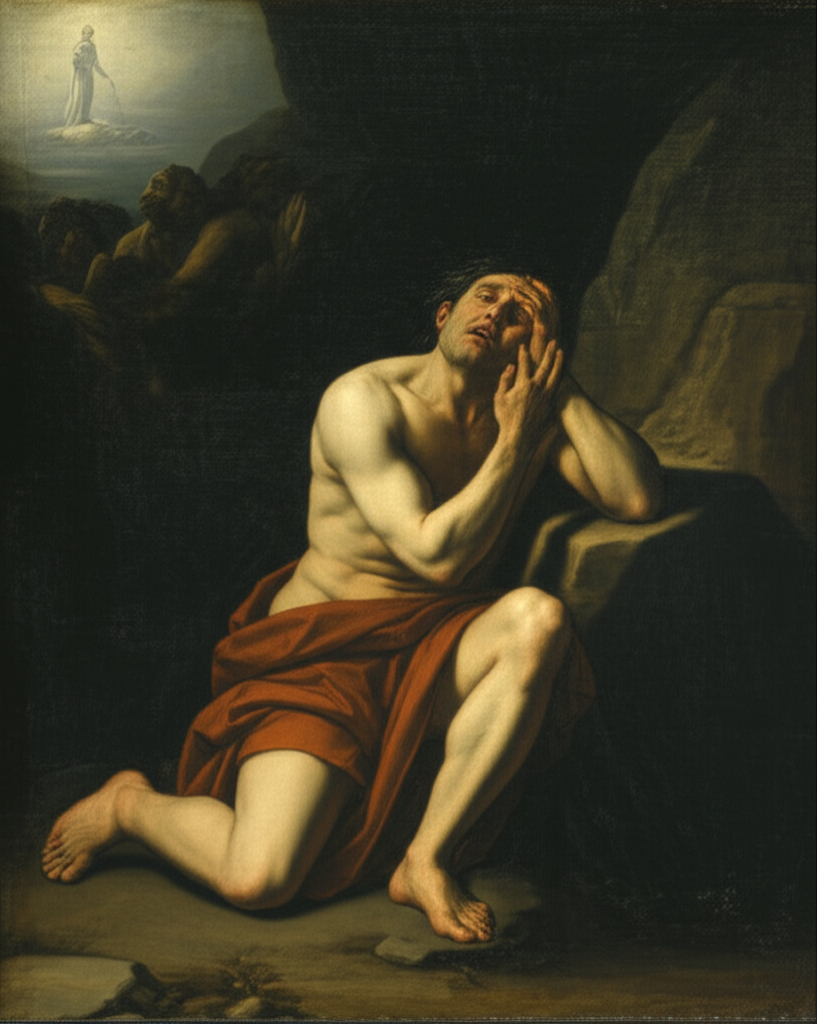
- The Book of Job: Perhaps the most visceral portrayal, Job's story is a direct confrontation with inexplicable suffering. He is righteous, yet afflicted, prompting a desperate plea for understanding from a seemingly silent God. His friends offer traditional explanations (evil as punishment for Sin), but Job rejects them, demanding a deeper truth.
- Plato: While not directly addressing a monotheistic God, Plato's concept of the Forms, particularly the Form of the Good, provides a framework for understanding perfection. Evil, in this context, might be seen as a deviation from or a lack of participation in the Good, an imperfection inherent in the material World.
- Saint Augustine: A pivotal figure, Augustine grappled extensively with the Problem. He famously proposed that evil is not a substance but a privation of good, a falling away from God's intended order. Sin, for Augustine, is an act of the will, a turning away from the higher good towards a lesser good, thereby introducing disorder into the soul and the World. This view posits that evil exists not as a divine creation but as a defect in created things.
- Saint Thomas Aquinas: Building on Augustine and Aristotle, Aquinas also viewed evil as a privation of good. He argued that God permits evil not because He wills it, but because He can bring a greater good out of it, or because it is a necessary consequence of free will, which is itself a great good.
These thinkers, among many others, illuminate the enduring nature of this Problem, highlighting its multifaceted dimensions, encompassing both natural evil (suffering from non-human causes) and moral evil (Sin), which arises from human choices.
| Philosopher/Text | Core Idea on Evil/Sin | Relevance to the Problem |
|---|---|---|
| Book of Job | Inexplicable suffering, challenge to divine justice. | Direct confrontation with the Problem of undeserved evil. |
| Plato | Evil as a lack of participation in the Form of the Good. | Provides a metaphysical basis for understanding imperfection. |
| Augustine | Evil as a privation of good; Sin as a willful turning away. | Shifts responsibility for evil from God to human free will. |
| Aquinas | Evil as privation; permitted for greater good or free will. | Synthesizes theological and philosophical arguments for permissibility. |
The Nature of Sin: A Human Imperative?
While natural evil (earthquakes, disease) presents one facet of the Problem, moral evil, or Sin, introduces the complexities of human agency. Sin represents the deliberate choice to act against what is good, just, or morally upright. From acts of individual cruelty to systemic injustices, Sin is the embodiment of human malevolence, often leading to immense suffering in the World.
The free will defense is a common response to this aspect of the Problem. It posits that a World in which humans have genuine freedom to choose between Good and Evil is inherently more valuable than a World where they are mere automatons, incapable of moral choice. Therefore, God, in granting us this precious freedom, necessarily allows for the possibility of Sin and its consequences. The terrible irony, of course, is that this very freedom is often the wellspring of the greatest evils.
Theodicy: Attempts to Reconcile Good and Evil
The attempts to reconcile God's goodness and power with the existence of evil are known as theodicies. Beyond the free will defense and evil as privation, other prominent arguments include:
- Soul-Making Theodicy (Irenaean Theodicy): Proposed by thinkers like John Hick, this view suggests that the World, with all its challenges and suffering, is a "vale of soul-making." Evil and adversity are necessary for human moral and spiritual development, fostering virtues like courage, compassion, and resilience that would not otherwise be possible.
- The Unknowable Divine Plan: Some argue that God's ways are beyond human comprehension. The Problem of Evil, from this perspective, stems from our limited understanding of a grander, divine purpose that permits or even requires certain evils for an ultimate, greater good. This aligns with the divine voice in Job, which emphasizes God's inscrutable wisdom.
Living with the Question: Good and Evil in Our World
Ultimately, the Problem of Evil (Sin) in the World remains an open question, one that continues to challenge philosophers, theologians, and every individual grappling with suffering. It compels us not only to intellectual rigor but also to profound introspection about our own choices, our capacity for Good and Evil, and our role in shaping the World. This enduring Problem invites us to consider whether faith demands a resolution, or if it can coexist with an acknowledgment of profound mystery and the inherent difficulties of human existence.
📹 Related Video: KANT ON: What is Enlightenment?
Video by: The School of Life
💡 Want different videos? Search YouTube for: "The Problem of Evil explained by philosophers"
📹 Related Video: KANT ON: What is Enlightenment?
Video by: The School of Life
💡 Want different videos? Search YouTube for: "Augustine's view on evil and free will"