

The Ever-Shifting Sands: Unpacking the Philosophical Problem of Change and Opposition
The fundamental philosophical problem of how things change yet retain identity, and the profound role of opposition in this dynamic, has perplexed thinkers since antiquity, shaping our understanding of nature itself. From the ancient Greek debates about constant flux versus immutable being to modern inquiries into identity and becoming, this core dilemma reveals the intricate challenges in defining reality. This article explores the historical roots of this problem, examining how philosophers have grappled with the seeming paradox of change and the inherent opposition that often drives or defines it.
The Ancient Conundrum: Flux vs. Permanence
The earliest Western philosophers were captivated by the nature of reality, specifically by the undeniable presence of change. This observation quickly led to a profound problem: How can something be and not be at the same time? How can identity persist if everything is constantly transforming?
Heraclitus and the River of Constant Flow
Among the most famous proponents of constant change was Heraclitus of Ephesus (c. 535 – c. 475 BCE), whose fragments suggest that "everything flows" (panta rhei). His iconic statement, "You cannot step into the same river twice, for other and yet other waters are ever flowing on," encapsulates his view that the universe is in a perpetual state of flux. For Heraclitus, opposition was not merely a feature of change but its very engine. He believed that strife (polemos) was the father of all things, asserting that "war is the father of all and king of all." This constant tension between opposites—hot and cold, wet and dry, life and death—was what maintained the cosmic order, not disrupted it. Reality, in this view, is a dynamic equilibrium of conflicting forces.
Parmenides' Unchanging Being
In stark contrast to Heraclitus, Parmenides of Elea (born c. 515 BCE) presented a radical solution to the problem of change: he denied its very existence. For Parmenides, true reality, or "Being," is eternal, ungenerated, indestructible, indivisible, and perfectly uniform. Change, motion, and plurality were deemed illusions of the senses, logically impossible because they would require "non-being" to exist—a concept Parmenides argued was incoherent. If something changes, it must become what it is not, which implies that non-being exists, a logical absurdity for him. This created an immense problem for subsequent philosophy: how to reconcile the apparent reality of change with Parmenides' compelling logical arguments for an unchanging reality.
Plato and Aristotle: Seeking Resolution
The profound opposition between Heraclitus's flux and Parmenides' static being laid the groundwork for much of subsequent Greek philosophy, particularly the monumental efforts of Plato and Aristotle to resolve this tension.
Plato's Forms: Bridging the Divide
Plato (c. 428/427 – 348/347 BCE), deeply influenced by both Heraclitus and Parmenides, proposed a dualistic metaphysics. He acknowledged the Heraclitean flux of the sensible world—the world we perceive through our senses—where everything is indeed in a state of change. However, to account for stable knowledge, universal concepts, and the persistence of identity, Plato posited a realm of eternal, immutable Forms. These Forms (e.g., the Form of Beauty, the Form of Justice, the Form of a Human) exist independently of the physical world and serve as the perfect, unchanging archetypes of which sensible things are mere imperfect copies. Thus, the problem of change was addressed by divorcing the transient physical world from the eternal, intelligible realm, with the Forms providing the unchanging essence that allows us to recognize things despite their constant transformation.
Aristotle's Actuality and Potentiality
Aristotle (384–322 BCE), Plato's most famous student, offered perhaps the most comprehensive and influential solution to the problem of change without resorting to a separate realm of Forms. In his Physics and Metaphysics, Aristotle introduced the concepts of potentiality (dynamis) and actuality (energeia). For Aristotle, change is not something becoming what it is not (as Parmenides argued) but rather something realizing a potentiality it already possesses.
Consider a seed: it is potentially a tree. When it grows, it actualizes that potential. The seed doesn't become "non-tree" and then "tree"; it moves from being a potential tree to an actual tree. This allows for identity to persist through change. Aristotle further elaborated on four causes—material, formal, efficient, and final—to explain the nature of things and their transformations, providing a robust framework for understanding how change is possible and intelligible. The opposition is not between being and non-being, but between potential being and actual being.
| Philosopher | View on Change | Role of Opposition | Key Contribution |
|---|---|---|---|
| Heraclitus | Constant flux; fundamental reality | Engine of change; maintains cosmic order | "Everything flows"; "War is the father of all" |
| Parmenides | Illusion; logically impossible | Non-existent; leads to logical absurdity | True reality is unchanging, eternal Being |
| Plato | Real in sensible world; unreal in intelligible world | Between sensible appearance and intelligible reality | Realm of eternal Forms as stable archetypes |
| Aristotle | Actualization of potential | Between potentiality and actuality | Potentiality/Actuality; Four Causes |
The Enduring Problem of Identity Through Change
Even with Aristotle's elegant solutions, the problem of how something maintains its identity through continuous change remains a fascinating philosophical puzzle. If a person's cells are constantly regenerating, if their memories shift and their personality evolves, in what sense are they the "same" person over time? This is often illustrated by thought experiments like the Ship of Theseus, where a ship has all its original planks replaced over time; is it still the same ship?
The opposition here is between the persistent concept of identity and the undeniable reality of transformation. It forces us to question what constitutes the essence of a thing—its form, its matter, its function, or something else entirely. This problem highlights that our understanding of change is not just about observing transformation, but about grappling with the very definition of what it means for something to be.
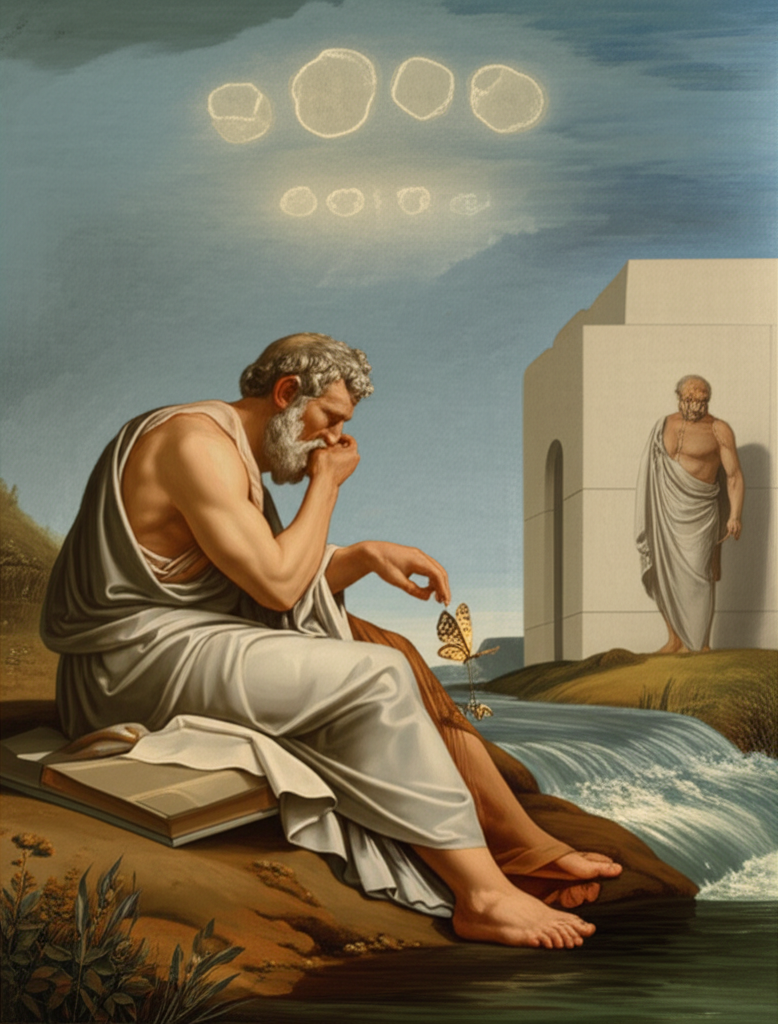
Opposition as the Engine of Nature
Beyond merely being a conceptual hurdle, opposition is often understood as a fundamental principle driving the nature of reality itself. From the earliest philosophical insights, the dynamic interplay of opposites has been seen as essential for existence and evolution.
- Cosmic Balance: Many traditions, both Eastern and Western, recognize that the universe maintains itself through the balance of opposing forces—creation and destruction, order and chaos, light and darkness.
- Dialectical Progress: Later philosophers, notably Hegel, would develop dialectical systems where progress and change occur through the clash and synthesis of opposing ideas or forces (thesis, antithesis, synthesis). This view sees opposition not as a destructive force, but as a generative one.
- Biological Evolution: In the biological realm, the nature of life itself is characterized by change driven by opposition—survival of the fittest, adaptation to environmental pressures, the constant struggle for resources.
This inherent opposition within reality ensures that nothing is truly static. It is the creative tension that propels existence forward, making change not just an occurrence, but an intrinsic aspect of being.
Conclusion: The Unfolding Tapestry of Reality
The problem of change and opposition is far more than an ancient academic debate; it is a foundational inquiry that continues to inform our understanding of reality, identity, and the very nature of existence. From Heraclitus's flowing river to Parmenides' unchanging Being, and through the sophisticated syntheses of Plato and Aristotle, philosophers have relentlessly sought to reconcile the undeniable dynamism of the world with the human need for stability and meaning. The enduring fascination with this problem reminds us that reality is a complex, unfolding tapestry, woven with threads of both permanence and flux, held together by the intricate dance of opposition. Understanding this dynamic is crucial for anyone seeking to grasp the deepest truths about our world.
YouTube:
- Philosophy of Change: Heraclitus vs Parmenides
- Aristotle's Metaphysics: Potentiality, Actuality, and Change Explained
📹 Related Video: What is Philosophy?
Video by: The School of Life
💡 Want different videos? Search YouTube for: "The Problem of Change and Opposition philosophy"