

The Enduring Calculus of Existence: Unpacking the Principle of War and Peace
The human condition is perpetually caught in the grand oscillation between conflict and concord, chaos and order. To truly comprehend this fundamental tension is to delve into "The Principle of War and Peace," a concept far more profound than the mere absence or presence of hostilities. It is a philosophical bedrock, examining the very essence of human nature, the legitimacy and structure of the State, and the elusive pursuit of Justice. This pillar page aims to unravel the intricate tapestry woven by centuries of philosophical inquiry, drawing heavily from the venerable Great Books of the Western World, to illuminate the enduring principles that govern our propensity for both devastating conflict and profound tranquility.
The Foundational Principle: Defining War and Peace
To speak of a Principle of War and Peace is to move beyond a simplistic understanding of these states as mere events. It is to seek the underlying rules, justifications, and philosophical underpinnings that give them form and meaning within the human experience.
Beyond Mere Absence or Presence
- War is not merely violence, but typically an organized, politically motivated conflict between sovereign entities or significant factions within a State. Its principle often lies in the assertion of power, the defense of interests, or the imposition of a particular vision of order or Justice.
- Peace, conversely, is more than the cessation of hostilities. It often signifies a state of order, stability, and the establishment of a just framework for coexistence. The principle of peace, therefore, is frequently intertwined with the establishment of laws, covenants, and systems that promote equity and prevent the degeneration into conflict.
The Dialectic of Conflict and Order
The relationship between War and Peace is inherently dialectical. One often defines the other, and the pursuit of peace frequently involves understanding and mitigating the conditions that lead to war. Philosophers have long grappled with whether war is an aberration or an intrinsic part of human nature, and consequently, how a State can best manage this inherent tension.
Historical Trajectories: A Philosophical Odyssey Through Conflict
The Great Books of the Western World offer an unparalleled chronicle of humanity's struggle with the Principle of War and Peace, revealing how thinkers across millennia have sought to define, justify, and avert conflict.
Ancient Insights: From Thucydides to Augustine
The earliest systematic inquiries into war and peace laid the groundwork for all subsequent thought.
- Thucydides: In his History of the Peloponnesian War, Thucydides presents a stark, realist account where fear, honour, and interest are the primary drivers of conflict. The Melian Dialogue remains a chilling exposition of power politics, where the Principle of might often overrides Justice in international relations.
- Plato: In The Republic, Plato envisions an ideal State where internal harmony is paramount. War, while acknowledged, is often seen as a necessary evil for defense, or a consequence of imperfect states. The philosopher-king's wisdom is meant to guide the State towards Justice and minimize conflict.
- Aristotle: For Aristotle, the State is a natural institution aimed at the good life. War, when waged, must be for a just cause – self-preservation, the acquisition of territory necessary for a good life, or to enslave those "naturally fitted for slavery." This nascent idea of Justice in warfare begins to take shape.
- Augustine of Hippo: A pivotal figure, Augustine's City of God grapples with the morality of conflict within a Christian framework. He develops the early tenets of Just War theory, articulating a Principle that war can only be righteous if waged under divine authority, for a just cause (e.g., to restore peace or punish wrongdoing), and with right intention. This firmly plants Justice at the heart of the Principle of legitimate conflict.
Medieval and Renaissance Perspectives: Law, Sovereignty, and Reason
The development of legal and political theory further refined the Principle of War and Peace.
- Thomas Aquinas: Building on Augustine, Aquinas formalized Just War theory in his Summa Theologica, outlining three essential conditions: just cause (to redress a wrong), legitimate authority (waged by a sovereign), and right intention (to promote good and avoid evil). This scholastic approach cemented Justice as a primary determinant.
- Niccolò Machiavelli: The Prince offers a radically different, pragmatic Principle for statecraft. For Machiavelli, war is an ever-present reality, and a wise ruler must be prepared to wage it effectively, even ruthlessly, to preserve the State. Justice is secondary to utility and survival.
- Hugo Grotius: Often considered the father of international law, Grotius's On the Law of War and Peace sought to establish universal legal principles governing warfare, even between non-Christian states. He argued for a natural law that binds all nations, attempting to temper the brutality of war with reason and Justice.
Architects of Modern Thought: The State, Sovereignty, and Perpetual Peace
The Enlightenment brought forth profound shifts in understanding the State, individual rights, and the prospects for lasting peace.
Hobbes and the Leviathan
Thomas Hobbes, in Leviathan, posited that in the "state of nature," humanity exists in a "war of all against all." His radical Principle is that only an absolute sovereign State, the Leviathan, can impose order and prevent this perpetual conflict. Peace, therefore, is a product of absolute power and the surrender of individual freedoms for collective security.
Locke and Natural Rights
John Locke, in his Two Treatises of Government, presented a more optimistic view of the state of nature, governed by natural law. War, for Locke, is a violation of natural rights, and legitimate government (the State) is formed to protect these rights. The Principle of Justice in war is tied to the defense of life, liberty, and property.
Rousseau and the Social Contract
Jean-Jacques Rousseau, in The Social Contract, argued that war is not a relation between individuals, but between States. Individuals become soldiers only by accident, not as men, but as citizens. The Principle of sovereignty resides in the general will of the people, and a well-ordered State should only wage war for collective defense, not for conquest.
Kant and Perpetual Peace
Immanuel Kant's Perpetual Peace: A Philosophical Sketch presents perhaps the most ambitious philosophical Principle for lasting peace. He proposes three definitive articles for perpetual peace:
- Republican Constitutions: Every State should have a republican (representative) constitution, as citizens are less likely to vote for war if they bear its burdens.
- Federation of Free States: An international federation, not a world State, where nations adhere to a common legal framework.
- Cosmopolitan Law: Universal hospitality, recognizing the right of individuals to interact peacefully across borders.
Kant's vision is founded on reason and the universal Principle of Justice, suggesting that peace is not merely an absence of war, but a moral imperative.
The Contemporary Nexus: War, Peace, and Global Justice
In the 21st century, the Principle of War and Peace continues to evolve, grappling with new forms of conflict and the complexities of a globally interconnected world.
Beyond Interstate Conflict
Modern warfare extends beyond traditional interstate conflicts to include intrastate civil wars, terrorism, cyber warfare, and hybrid threats. This challenges conventional understandings of sovereignty and the traditional Principle of legitimate authority in waging war. The lines between combatants and non-combatants are often blurred, complicating the application of Justice.
The Role of International Law and Institutions
Organizations like the United Nations, the International Criminal Court, and various humanitarian agencies strive to uphold the Principle of international law and promote Justice globally. They represent a collective effort to build upon Kant's vision of a more ordered and peaceful world, albeit with significant challenges.
Ethical Dilemmas in Modern Warfare
Technological advancements, such as drone warfare and autonomous weapons, raise profound ethical questions about accountability, proportionality, and the very nature of combat. Humanitarian intervention also forces a re-evaluation of national sovereignty versus the Principle of protecting human rights, often leading to difficult moral quandaries.
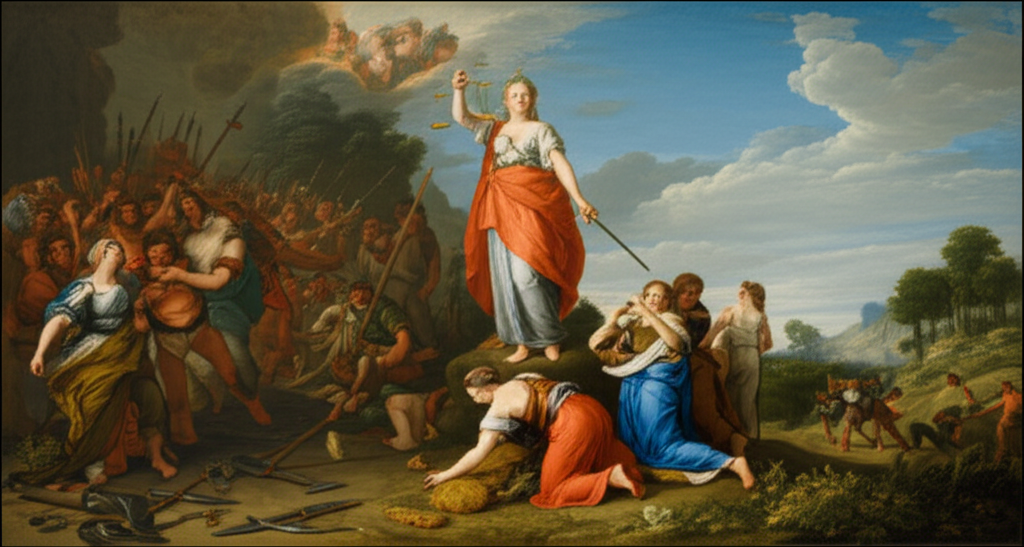
Conclusion: The Unfinished Symphony of Humanity
The Principle of War and Peace remains an indelible feature of the human experience, a constant challenge to our capacity for reason, empathy, and collective action. From the ancient battlefields of Thucydides to Kant's vision of perpetual peace, and into the complex conflicts of our modern era, philosophers have tirelessly sought to understand the forces that drive us to conflict and the pathways to lasting concord.
The State continues to be the primary actor in this drama, its legitimacy and actions perpetually judged against the evolving Principle of Justice. While the nature of conflict may transform, the fundamental questions posed by the Great Books of the Western World endure: How can we live together? What constitutes a just peace? And what principles must we uphold to navigate the enduring calculus of existence? These are inquiries that demand our ongoing philosophical engagement, for the symphony of humanity, whether harmonious or dissonant, is far from over.
📹 Related Video: What is Philosophy?
Video by: The School of Life
💡 Want different videos? Search YouTube for: ""Just War Theory Explained Philosophy""
📹 Related Video: KANT ON: What is Enlightenment?
Video by: The School of Life
💡 Want different videos? Search YouTube for: ""Kant Perpetual Peace Summary""