

The Enduring Paradox: Unpacking the Principle of War and Peace
The human endeavor, from its earliest recorded moments, has been inextricably bound to the twin specters and aspirations of conflict and harmony. The "Principle of War and Peace" is not a simple maxim or a singular theory, but rather a profound and multifaceted philosophical inquiry into the fundamental nature of human interaction, the role of the State, and the elusive pursuit of Justice. This pillar page delves into the core tenets of this enduring principle, tracing its evolution through the seminal works of Western thought, exploring the justifications for conflict, the conditions for lasting peace, and the moral complexities that continue to challenge us. We will navigate the intricate arguments that seek to define when war is permissible, if ever, and how peace might be not merely the absence of violence, but a state of genuine flourishing founded on Justice.
I. Defining the Principle: An Ancient Inquiry into Conflict and Harmony
At its heart, the Principle of War and Peace is an attempt to understand why societies engage in conflict and how they might achieve and maintain peace. It is a recognition that these are not merely historical events but reflections of deeper philosophical truths about human nature, political organization, and moral obligation.
A. Early Philosophical Grapplings with Strife and Order
From the very dawn of philosophical inquiry, thinkers have grappled with the inherent tension between opposing forces. Heraclitus, an early Greek philosopher, famously declared, "War is the father of all and king of all," suggesting that strife is not merely an unfortunate occurrence but a fundamental driving force of existence and change. While not explicitly advocating for war, his thought underscores the pervasive nature of conflict.
Later, Plato, in his Republic, envisioned an ideal State founded on Justice, where each individual and class performs its proper function. For Plato, internal harmony and Justice within the State were paramount, but he also recognized the external threats that necessitated a guardian class, trained for defense. The very structure of his ideal State implicitly acknowledges the potential for war and the need for preparedness, even as it strives for internal peace. Aristotle, in his Politics, further explored the nature of the State and its purpose, which he saw as enabling the good life for its citizens. While he did not develop a full-fledged "just war" theory, his discussions on the ethics of governance and the goals of political communities laid groundwork for later considerations of legitimate force.
B. The Intertwined Concepts: State, Justice, and the Principle
The Principle of War and Peace is deeply intertwined with the concepts of the State and Justice. Is war an inevitable outcome of competing interests between sovereign entities? Or can a truly just State minimize or even eliminate the need for armed conflict? These questions have animated centuries of philosophical debate.
- The State as a Nexus: The State is often the primary agent of both war and peace. It commands armies, declares hostilities, and negotiates treaties. Understanding the Principle requires examining the State's legitimate authority, its responsibilities to its citizens, and its role in the international arena.
- Justice as the Arbiter: The concept of Justice is crucial. Is a war just if it serves the State's interests, or only if it rectifies a profound wrong? Is peace merely the absence of war, or does it demand a positive state of affairs where rights are respected and grievances addressed justly?
II. The State and the Justification of Conflict: Foundations of Just War Theory
The question of when war can be morally justified has been a cornerstone of Western ethical and political thought, particularly within the Christian tradition, which sought to reconcile the teachings of peace with the realities of political power.
A. From Augustine to Aquinas: Forging Just War Doctrine
The intellectual lineage of Just War Theory, a central component of the Principle of War and Peace, can be traced through the works of Augustine of Hippo and Thomas Aquinas.
-
Augustine: In The City of God, Augustine grappled with the tension between Christian pacifism and the need for civic order. He argued that while peace is the ultimate good, war might be a sorrowful necessity to restore peace or punish wrongdoing, provided it was waged with the right intention (love, not vengeance) and by legitimate authority.
-
Aquinas: Building upon Augustine, Aquinas in his Summa Theologica articulated the foundational criteria for a "just war," which remain influential today. These criteria typically fall into two categories:
Jus ad Bellum (Justice in going to war):
- Just Cause: A serious wrong suffered (e.g., self-defense against aggression, or to prevent grave injustice).
- Legitimate Authority: Declared by a sovereign State or ruler.
- Right Intention: Aiming to restore peace and Justice, not for conquest or revenge.
- Last Resort: All peaceful alternatives must have been exhausted.
- Proportionality: The good achieved by war must outweigh the harm caused.
- Reasonable Hope of Success: War should not be waged futilely.
Jus in Bello (Justice in waging war):
- Discrimination: Non-combatants must not be intentionally targeted.
- Proportionality: The force used must be proportionate to the military objective.
B. Machiavelli's Realpolitik: A Counterpoint to Justice
A stark contrast to the moral considerations of Just War Theory is presented by Niccolò Machiavelli in The Prince. Machiavelli's work, a pragmatic guide to acquiring and maintaining political power, largely disregards traditional notions of Justice and morality in favor of the State's survival and stability. For Machiavelli, the Principle governing a ruler's actions, including going to war, is dictated by necessity and the cold calculus of power. A prince must be willing to act immorally if it serves the greater good of the State, even if it means sacrificing ethical Justice for political expediency. This perspective offers a cynical, yet enduring, challenge to idealistic notions of peace and just conflict.
III. The Quest for Perpetual Peace: Visions of a Harmonious World
While some philosophers sought to define the conditions for justified war, others envisioned a future where conflict might be transcended entirely, moving beyond the mere cessation of hostilities to a state of perpetual harmony.
A. Kant's Moral Imperative for Peace
Perhaps the most influential articulation of a path to lasting peace comes from Immanuel Kant in his essay Perpetual Peace: A Philosophical Sketch. Kant argued that peace is not merely a political arrangement but a moral imperative. His vision for perpetual peace rested on several definitive articles:
- Republican Constitutions: States should have republican (representative) forms of government, as citizens, bearing the burdens of war, would be less inclined to rash conflict.
- A Federation of Free States: An international organization, not a world State, where free states would voluntarily agree to resolve disputes without war.
- Universal Hospitality: A right of foreign visitors not to be treated as enemies upon arrival in another country, fostering mutual understanding.
For Kant, the Principle of War and Peace ultimately points towards a rational and moral evolution of humanity, where reason guides international relations and Justice prevails over brute force.
B. Rousseau and the Origins of War
Jean-Jacques Rousseau, in works like The Social Contract, also contributed to the understanding of war's origins. He famously argued that war is not a relationship between men, but between States. Individuals in the state of nature, while potentially fearful, are not inherently warlike; it is the formation of political societies and the pursuit of national interests that give rise to organized conflict. This perspective shifts the blame from individual human nature to the structures of the State itself, suggesting that reforming political systems is key to achieving peace.
IV. Justice, Morality, and the Human Condition: The Enduring Debate
The Principle of War and Peace forces us to confront fundamental questions about human nature: are we inherently aggressive or capable of profound cooperation? How does Justice truly manifest in a world prone to conflict?
A. Hobbes: The State of Nature as War
Thomas Hobbes, in his monumental work Leviathan, presented a stark view of human nature. He argued that in the "state of nature," without a common power to keep them in awe, humans exist in a "war of all against all" (bellum omnium contra omnes), where life is "solitary, poor, nasty, brutish, and short." For Hobbes, the State – a powerful sovereign – is absolutely necessary to escape this chaotic condition and enforce Peace and order through fear. The Principle here is that peace is not natural but an artificial construct maintained by absolute authority.
B. Locke: Natural Rights and Limited Government
In contrast, John Locke, in his Two Treatises of Government, offered a more optimistic view. While acknowledging that a "state of war" can arise, he believed individuals possess natural rights (life, liberty, property) even in the state of nature. The purpose of government is not to suppress inherent aggression, but to protect these natural rights and provide an impartial arbiter for disputes. For Locke, the State's power, including its ability to wage war, is limited by these rights and by the consent of the governed, implying a more constrained and just use of force.
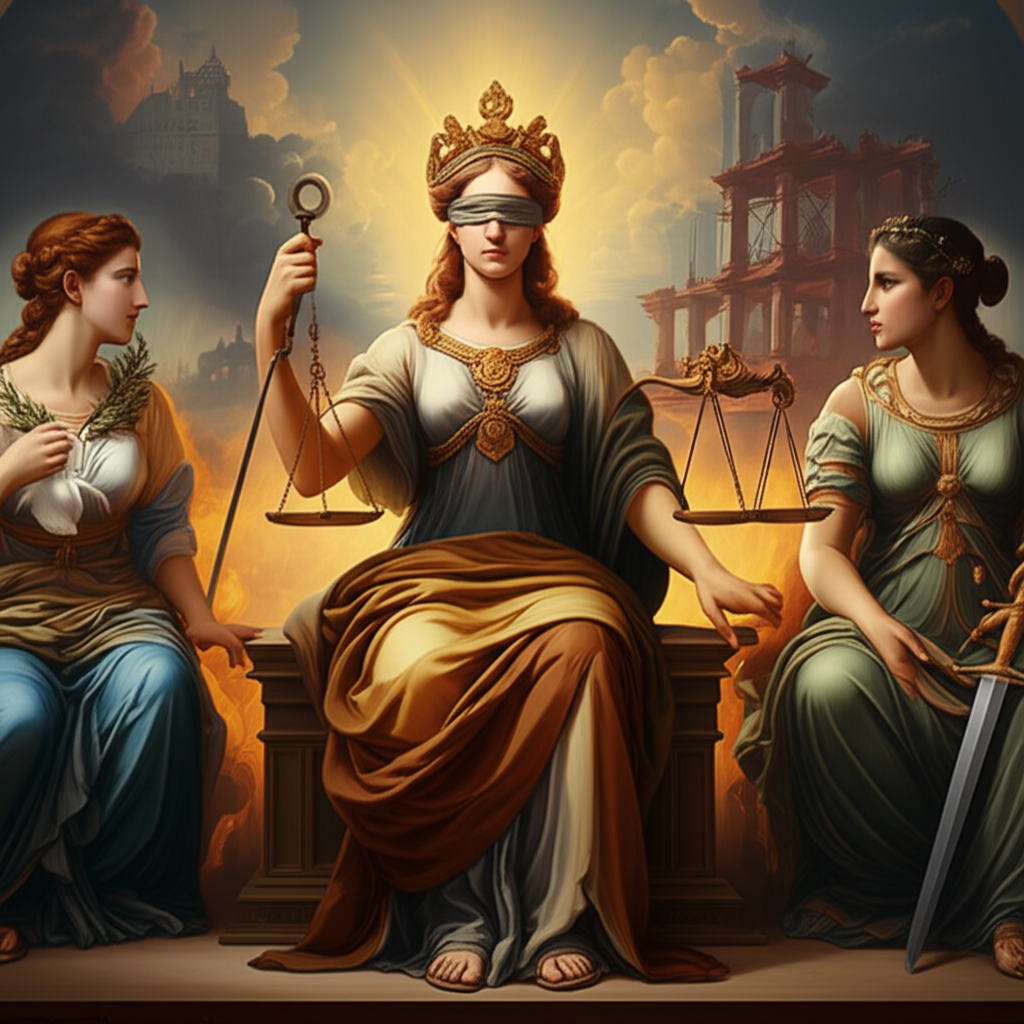
V. Modern Reflections and Enduring Challenges
The Principle of War and Peace remains as relevant today as it was in antiquity, perhaps even more so in an era of globalized conflict, nuclear weapons, and complex international relations.
A. The Principle in a Nuclear Age
The advent of weapons of mass destruction has profoundly altered the calculus of war. Does the potential for total annihilation render traditional Just War considerations obsolete? The Principle now confronts the paradox that the very means of achieving victory could lead to mutual destruction, making the pursuit of Peace an existential imperative. International law and institutions, such as the United Nations, represent ongoing, albeit imperfect, attempts to institutionalize Kant's vision of a federation of states and provide mechanisms for peaceful dispute resolution.
B. Justice and Intervention: Contemporary Dilemmas
Modern conflicts often involve complex questions of humanitarian intervention, state sovereignty, and the global responsibility to protect. When a State commits atrocities against its own people, does the Principle of War and Peace permit external intervention, even if it means violating national sovereignty? This pushes the boundaries of Just War Theory and forces a re-evaluation of Justice on an international scale. The tension between national interest and universal Justice continues to be a defining challenge for the Principle.
Conclusion: The Perpetual Human Endeavor
The Principle of War and Peace is not a solved equation but an ongoing philosophical dialogue, a testament to humanity's perpetual struggle to reconcile its capacity for both profound destruction and sublime cooperation. From Heraclitus's observations of strife to Kant's blueprint for perpetual peace, and from Augustine's ethical constraints on war to Machiavelli's ruthless pragmatism, the Great Books of the Western World offer an indispensable lens through which to examine this most fundamental of human dilemmas. Understanding this Principle is not merely an academic exercise; it is an essential component of informed citizenship and a prerequisite for any meaningful pursuit of a more just and peaceful world. The journey continues, demanding constant reflection, ethical rigor, and an unwavering commitment to the ideals of Justice and human flourishing.
YouTube Video Suggestions:
-
📹 Related Video: What is Philosophy?
Video by: The School of Life
💡 Want different videos? Search YouTube for: ""Just War Theory explained philosophy""
2. ## 📹 Related Video: KANT ON: What is Enlightenment?
Video by: The School of Life
💡 Want different videos? Search YouTube for: ""Kant Perpetual Peace summary""