

Unpacking the Principle of Progress in History: An Enduring Philosophical Inquiry
The notion that history is not merely a sequence of events but an unfolding narrative tending towards improvement – the Principle of Progress in History – has profoundly shaped Western thought. From ancient cyclical views to the Enlightenment's fervent embrace of human perfectibility, and through subsequent periods of both triumph and disillusionment, this Principle has served as a powerful lens through which humanity understands its journey. This article delves into the philosophical underpinnings of historical Progress, examining its evolution, its various interpretations, and the persistent debates surrounding its validity as a driving force of Change. We will explore how different eras have conceived of advancement, what constitutes "progress," and whether a teleological arc genuinely bends towards a better future.
The Shifting Sands of Time: Early Conceptions of Historical Change
For much of antiquity, the idea of linear, continuous Progress was far from dominant. Many ancient civilizations, including the Greeks, often viewed History through a cyclical lens. Philosophers like Plato, in works such as The Republic, posited a decline from ideal forms and a recurring cycle of political regimes, suggesting that societies rise, decay, and eventually return to a starting point, or at least a similar state. The Golden Age was often placed in the past, implying a regression rather than advancement. This perspective understood Change as an inherent part of existence, but not necessarily as a march towards betterment.
It was with the advent of Judeo-Christian thought that a more pronounced linear conception of History began to take root. Thinkers like Saint Augustine, in The City of God, presented History as a purposeful narrative, beginning with creation, moving through specific divine interventions, and culminating in a final judgment and salvation. This was not Progress in the secular, humanistic sense, but rather a divinely guided journey towards a predetermined end, instilling a sense of unique, unrepeatable events and an ultimate telos.
The Enlightenment's Grand Vision: Progress as a Guiding Principle
The true flourishing of the Principle of Progress as we largely understand it today occurred during the Enlightenment. Fueled by scientific discoveries, the rise of reason, and a growing confidence in human capabilities, philosophers of the 17th and 18th centuries began to articulate a robust belief in humanity's capacity for infinite self-improvement.
Key Tenets of Enlightenment Progress:
- Rationality: The application of reason to all aspects of life would lead to the eradication of ignorance, superstition, and tyranny.
- Human Perfectibility: The belief that human beings, through education and enlightened governance, could continuously improve their moral, intellectual, and social conditions.
- Scientific Advancement: The cumulative growth of knowledge and technological innovation was seen as an unstoppable force driving societal betterment.
- Universalism: The idea that Progress was not limited to specific cultures but was a universal human destiny, eventually benefiting all.
Thinkers such as Condorcet, in his Sketch for a Historical Picture of the Progress of the Human Mind, envisioned a future of ever-increasing enlightenment, equality, and justice. Immanuel Kant, in his Idea for a Universal History with a Cosmopolitan Purpose, suggested that despite apparent chaos, a hidden plan of nature might be guiding human History towards a state of perpetual peace and rational governance. This era cemented Progress as a fundamental Principle, suggesting that Change was inherently directed towards a more desirable state.
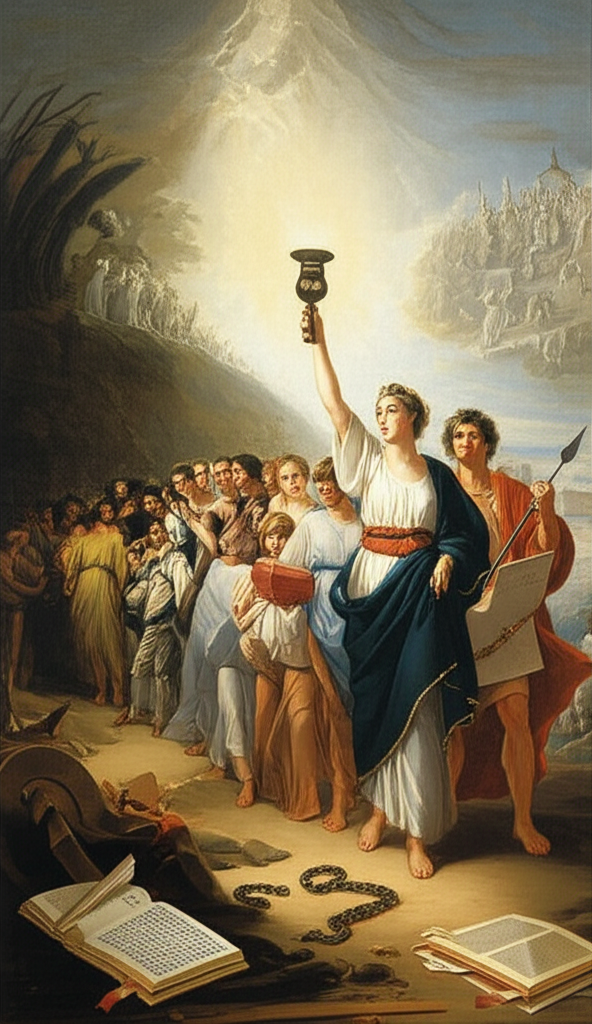
Dimensions of Progress: What Does it Entail?
When we speak of Progress, what exactly are we measuring? The concept encompasses a multitude of dimensions, often intertwined:
| Dimension of Progress | Description | Examples |
|---|---|---|
| Scientific & Technical | Accumulation of knowledge, understanding of the natural world, and innovation in tools and methods. | Development of medicine, space exploration, digital communication. |
| Moral & Ethical | Expansion of empathy, recognition of rights, and reduction of cruelty or injustice. | Abolition of slavery, universal suffrage, human rights declarations. |
| Political & Legal | Evolution of governance structures, establishment of rule of law, and participatory systems. | Rise of democracies, constitutionalism, international legal frameworks. |
| Social & Economic | Improvement in living standards, education, health, and equitable distribution of resources. | Reduction in poverty, increased literacy rates, public health initiatives. |
| Aesthetic & Cultural | Development of art forms, philosophical insights, and expressions of human creativity. | New artistic movements, literary canons, cross-cultural understanding. |
Each of these dimensions reflects a form of positive Change, contributing to the broader narrative of human advancement. The Principle of Progress often assumes a correlation, where advancements in one area facilitate Progress in others.
Challenges and Critiques: The Shadow Side of Progress
Despite its powerful appeal, the Principle of Progress has faced significant challenges and critiques, particularly in the 20th century. Two World Wars, genocides, environmental degradation, and the existential threat of nuclear weapons forced a re-evaluation of humanity's supposed upward trajectory.
- The Problem of Evil: If History is truly progressive, how do we account for the persistent recurrence of brutality, injustice, and suffering? Events like the Holocaust cast a long shadow over the notion of inherent moral Progress.
- Technological Ambivalence: While technology brings benefits, it also creates new problems (e.g., climate change, autonomous weapons, surveillance). Change is not always benign.
- Cultural Relativism: Critics argue that the Enlightenment's vision of Progress was often ethnocentric, imposing a particular Western model of development on diverse cultures. Is there a universal standard for "better"?
- Postmodern Skepticism: Philosophers like Friedrich Nietzsche questioned the underlying values and assumptions of Progress, seeing it as a comforting but ultimately false narrative. Postmodern thought further deconstructed grand narratives, including that of linear Progress, highlighting its potential for oppression and exclusion.
The dialectical view of Georg Wilhelm Friedrich Hegel, where History Progresses through conflict and the synthesis of opposing ideas, and Karl Marx's historical materialism, which saw History as a struggle culminating in a classless society, offered more complex, often violent, pathways to Progress, acknowledging conflict as an inherent part of Change. Yet, even these grand theories faced their own critiques regarding their deterministic nature and the outcomes of their proposed historical trajectories.
The Enduring Relevance: Reappraising the Principle of Progress Today
In the 21st century, the Principle of Progress remains a complex and contested idea. While few would deny the incredible advancements in science, technology, and certain aspects of human rights, a cautious skepticism prevails. We are more aware of the fragility of progress, the constant need for vigilance, and the potential for regression.
Yet, to abandon the idea of Progress entirely might be to relinquish a crucial source of hope and motivation. Perhaps the Principle of Progress is not a guaranteed outcome, but rather a moral imperative – a call to continually strive for a better world, recognizing that Change is constant and our agency in directing that Change is paramount. It is a commitment to learning from History, correcting past wrongs, and fostering conditions for human flourishing, even amidst the undeniable setbacks and challenges that define our shared journey.
YouTube Video Suggestions:
-
📹 Related Video: KANT ON: What is Enlightenment?
Video by: The School of Life
💡 Want different videos? Search YouTube for: ""The Enlightenment: Crash Course World History #12""
2. ## 📹 Related Video: PLATO ON: The Allegory of the Cave
Video by: The School of Life
💡 Want different videos? Search YouTube for: ""Does History Progress? - Alain de Botton""