

The Principle of Progress in History: An Ever-Unfolding Inquiry
The notion that humanity's trajectory is one of continuous advancement, marching steadily towards a more enlightened, just, or prosperous future, is a powerful and persistent one. This idea, often termed "The Principle of Progress in History," posits that the unfolding of human events is not merely a series of random occurrences or cyclical repetitions, but rather an overarching movement towards improvement. Yet, to truly grasp this principle, it behooves us to dissect its origins, its manifestations, and the profound challenges it faces, particularly when confronted with the complex tapestry of Change that defines human History.
Unpacking the Principle of Progress
At its core, the Principle of Progress in History is the belief that human societies, knowledge, technology, and even morality tend to improve over time. It suggests that despite setbacks, wars, and periods of decline, the long arc of human experience bends towards betterment. This isn't merely a descriptive observation of Change, but a normative claim – that this Change is fundamentally for the better.
Historical Trajectories of Thought
The concept of progress, as we understand it today, is a relatively modern construct, though its roots can be traced through various philosophical epochs.
- Ancient Perspectives: Many ancient thinkers, as found within the Great Books of the Western World, often viewed History through a cyclical lens. Plato, for instance, spoke of ideal forms and the degeneration from them. Ecclesiastes famously declares, "There is nothing new under the sun." For these perspectives, Change was inherent, but not necessarily progressive in a linear sense. Time was often seen as a wheel, endlessly repeating patterns of rise and fall.
- Medieval Linear Views: With the advent of Judeo-Christian thought, a linear conception of time emerged. Thinkers like St. Augustine, in The City of God, presented History as a divine drama with a beginning (Creation) and an end (Judgment), moving towards a predetermined spiritual goal. While this was linear, the Progress was primarily spiritual salvation, not necessarily worldly human improvement through human agency.
- The Enlightenment's Embrace of Progress: The 18th century, particularly the Enlightenment, saw the emphatic birth of the modern Principle of Progress. Fueled by scientific discoveries, the rise of reason, and a growing belief in human perfectibility, philosophers like Condorcet and Kant championed the idea that humanity, through rational inquiry and moral development, was destined for ever-greater achievements. This was a Progress driven by human effort, knowledge, and institutional Change. Hegel's dialectic, too, saw History as the unfolding of Spirit, moving towards ever-higher stages of freedom and self-consciousness, a clear form of Progress.
The Elusive Definition of Progress
One of the greatest challenges in affirming the Principle of Progress lies in defining what constitutes progress. Is it:
- Technological Advancement? The undeniable march from the wheel to artificial intelligence.
- Material Prosperity? Increased wealth, comfort, and standard of living for a greater number of people.
- Moral Improvement? The abolition of slavery, the expansion of human rights, greater empathy across cultures.
- Political Freedom? The spread of democracy and individual liberties.
- Scientific Knowledge? A deeper understanding of the universe and our place within it.
Often, progress in one area might coincide with stagnation or even regression in another. The industrial revolution brought material wealth but also new forms of exploitation and environmental degradation. The 20th century, a period of unprecedented scientific and technological Progress, also witnessed two world wars and genocides on an unimaginable scale, forcing a critical re-evaluation of the human capacity for improvement.
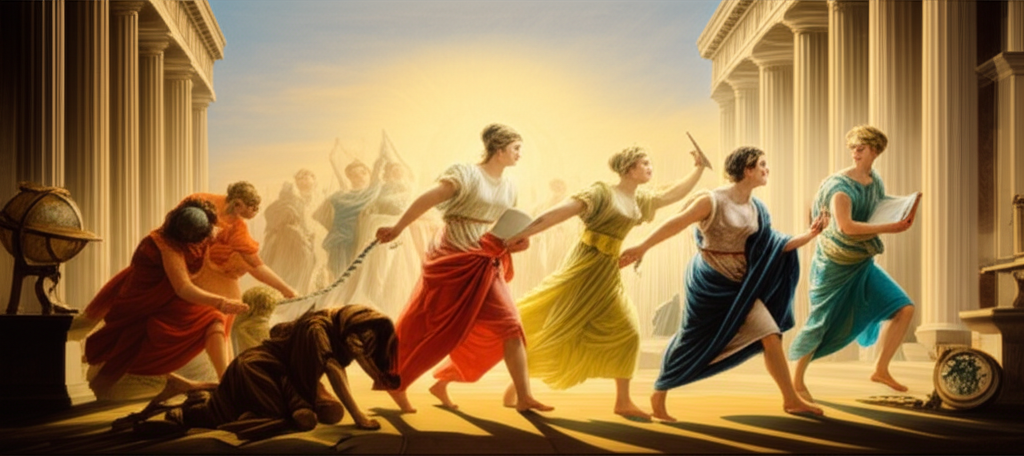
The Dialectic of Change and Stagnation
History is undeniably characterized by Change. Societies rise and fall, empires crumble, new ideas emerge, and old ones fade. But is all Change Progress? The Principle of Progress asserts a qualitative direction to this Change.
However, critics, from Nietzsche's rejection of linear historical narratives to contemporary postmodern thought, question this inherent directionality. They argue that History is often contingent, chaotic, and driven by power dynamics rather than an underlying teleology towards betterment. Periods of significant advancement are frequently punctuated by:
- Regression: The collapse of sophisticated civilizations, loss of knowledge, or reversals in human rights.
- Stagnation: Long periods where little fundamental societal improvement occurs.
- Unintended Consequences: Innovations that solve one problem but create several others.
The very idea of a universal Principle of Progress can also be problematic, often reflecting a particular cultural or Western-centric viewpoint, imposing its values on the diverse narratives of global History.
Reckoning with the Principle Today
Despite the critiques and complexities, the desire to believe in Progress remains a powerful motivator. It underpins our efforts to address global challenges, to innovate, and to strive for a more just world. Yet, a sophisticated understanding of the Principle of Progress requires us to move beyond naive optimism.
We must acknowledge that Progress is not inevitable; it is often hard-won, fragile, and reversible. It demands constant vigilance, ethical reflection, and a critical engagement with the nature of Change itself. The Principle of Progress in History is less a guaranteed outcome and more an ongoing aspiration, a philosophical framework through which we can both understand and actively shape our collective future.
YouTube: "Philosophical debates on historical progress"
YouTube: "Enlightenment views on human perfectibility"
📹 Related Video: What is Philosophy?
Video by: The School of Life
💡 Want different videos? Search YouTube for: "The Principle of Progress in History philosophy"