

The Principle of Progress in Evolution: A Philosophical Inquiry
The concept of progress often accompanies our understanding of evolution, suggesting an inherent drive towards greater complexity, efficiency, or "betterness" over time. Yet, a deeper philosophical examination reveals that while change is undeniably central to evolution, the notion of a guiding Principle of Progress is far more contentious. This article delves into the philosophical underpinnings of this idea, distinguishing between mere adaptation and an assumed teleological ascent, drawing insights from the rich tapestry of Western thought. We will explore whether evolution truly embodies a directionality that can be labeled "progress," or if such a perspective is a human projection onto a fundamentally indifferent, albeit dynamic, natural process.
The Enduring Question of Direction in Nature
From the earliest philosophical inquiries, humanity has sought to discern order and direction in the natural world. Ancient thinkers, as chronicled in the Great Books of the Western World, often posited a universe imbued with inherent purpose or a preordained trajectory. Aristotle's concept of telos, or final cause, suggested that all things strive towards their ultimate form, a notion that could easily be, and often was, extended to the development of life. Does evolution, then, represent a biological telos – a grand unfolding towards an ultimate, perfected state?
The scientific revolution, and particularly Darwin's theory of natural selection, offered a powerful counter-narrative. Evolution became understood as a process driven by variation, competition, and adaptation to local environments, rather than by an overarching, universal blueprint. This shift compels us to ask: Is the Principle of Progress a scientific observation, a philosophical assumption, or perhaps a comforting narrative we impose on the relentless march of change?
Defining "Progress" in a Biological Context
Before we can assert a "Principle of Progress," we must grapple with what "progress" actually means in the context of biological evolution. Is it:
- Increased Complexity? Many lineages have become more complex, but others have simplified. Is a complex mammal inherently "more progressed" than a highly efficient bacterium?
- Greater Adaptability? Adaptability is key to survival, but it's always relative to a specific environment. What is adaptive in one context may be detrimental in another.
- Enhanced Intelligence or Consciousness? These are traits that have emerged in certain lineages, but they are not universal evolutionary goals.
- Longer Lifespan or Reproductive Success? These are direct measures of fitness, but they don't necessarily imply a directional "progress" across all life forms.
The challenge lies in applying a value-laden term like "progress" to a process that, at its core, is amoral and mechanistic. Natural selection favors traits that enhance survival and reproduction in a given environment, leading to change and diversification, but not necessarily to an inevitable climb up a predefined ladder of "betterness."
The Principle of Progress: A Human Projection?
The idea of a universal Principle of Progress in evolution often appears to be a projection of human ideals onto nature. Enlightenment thinkers, grappling with societal and intellectual advancement, frequently viewed history as a linear march towards improvement. It is perhaps unsurprising that this same lens was applied to the burgeoning understanding of biological change.
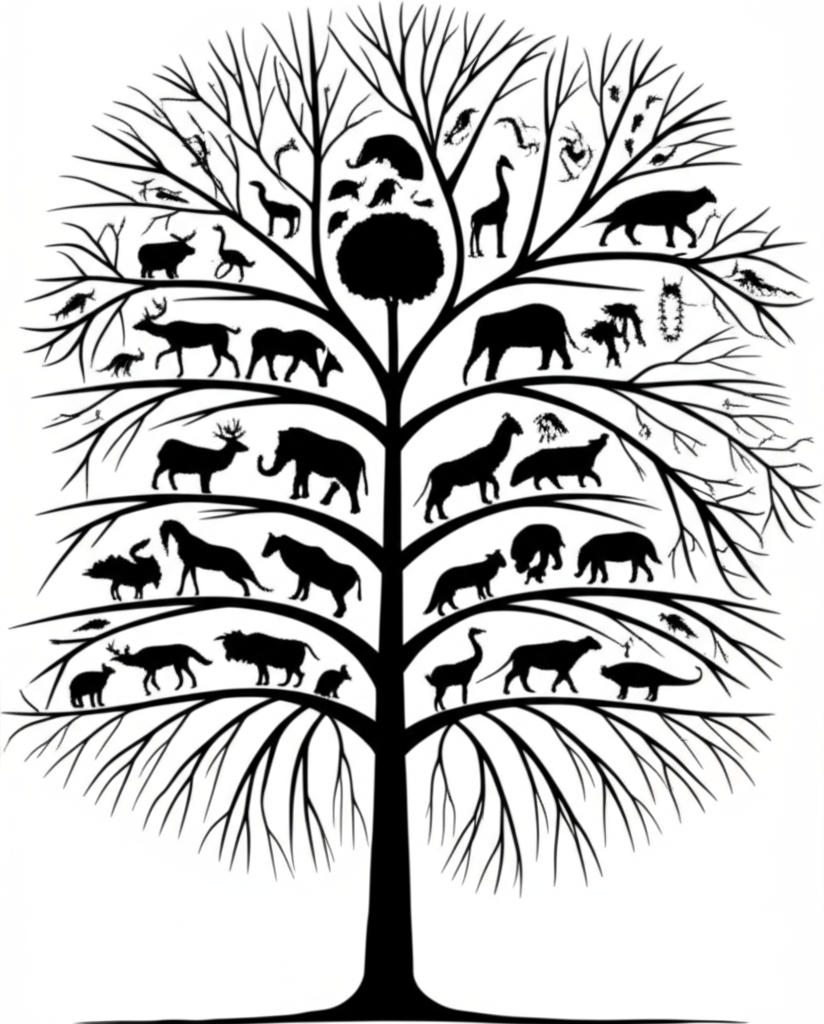
However, Darwin himself was cautious about using "progress" in a teleological sense. His mechanism of natural selection explains adaptation, diversification, and the extinction of less-fit forms, but it does not posit an inherent drive towards a specific, "higher" form of life. The branching tree of life illustrates myriad adaptations, not a single, ascending trunk.
Consider the philosophical implications: if evolution is merely a process of change driven by environmental pressures, without an intrinsic direction towards "progress," what does this mean for our own sense of purpose? The Great Books often explore the human need for meaning, and a universe devoid of inherent teleological progress can be unsettling, challenging our anthropocentric views.
Evolution as Unfolding Change, Not Inevitable Ascent
The true Principle at play in evolution is one of continuous change and adaptation. Life is not striving towards a predetermined apex; it is constantly responding to fluctuating conditions, exploring new niches, and diversifying in myriad ways.
| Feature of Evolution | Interpretation of "Progress" | Philosophical Implication |
|---|---|---|
| Adaptation | Often seen as improvement | Local, context-dependent "betterment" |
| Diversification | Leads to new forms | Exploration of possibility, not necessarily a hierarchy |
| Extinction | Can be seen as failure | Natural consequence of environmental change and competition |
| Complexity | Often equated with progress | An emergent property, not a universal goal |
While some lineages do exhibit an increase in complexity or specific capabilities, this is a consequence of natural selection in particular circumstances, not a universal law. Simpler organisms, such as bacteria, have persisted for billions of years and continue to thrive, demonstrating their profound evolutionary success without necessarily conforming to a linear idea of "progress." Their continued existence highlights that fitness is about survival and reproduction, not about achieving a human-defined "higher" state.
The Allure of Directionality
Why, then, is the idea of a Principle of Progress so persistent? It speaks to a deep human desire for meaning, for a narrative that suggests improvement and purpose. Philosophically, it aligns with teleological worldviews that posit an ultimate aim or design in the cosmos. For many, the idea of a universe without inherent direction can feel nihilistic or meaningless.
However, embracing evolution as a process of continuous change and adaptation, rather than one of predetermined progress, can be equally liberating. It shifts our focus from an imagined destination to the dynamic, creative power of life itself. The Principle is not one of ascent, but of perpetual becoming, a testament to the resilience and inventiveness of biological systems.
Conclusion: A Principle of Adaptation, Not Teleology
In conclusion, while evolution undeniably involves profound change over vast stretches of time, the notion of an inherent Principle of Progress is a philosophical construct that requires careful scrutiny. The scientific evidence points to a process of adaptation and diversification, driven by natural selection and environmental pressures, rather than a teleological march towards an ultimate "better" form.
The Great Books of the Western World provide the intellectual tools to dissect such concepts, urging us to distinguish between observed phenomena and the interpretive frameworks we impose upon them. While we may perceive our own species as the pinnacle of evolutionary progress, this is a subjective assessment. The true Principle of evolution is one of dynamic change, relentless adaptation, and the astonishing capacity of life to persist and diversify in a world without predetermined ends. It is a story of continuous becoming, rich in complexity and wonder, even without a guiding hand of inevitable progress.
📹 Related Video: What is Philosophy?
Video by: The School of Life
💡 Want different videos? Search YouTube for: ""Teleology in philosophy and biology explained""
📹 Related Video: PLATO ON: The Allegory of the Cave
Video by: The School of Life
💡 Want different videos? Search YouTube for: ""Evolutionary progress vs adaptation debate""