

The Elusive Ascent: Unpacking the Principle of Progress in Evolution
The concept of "progress" within the grand narrative of biological evolution is a philosophical tightrope walk, fraught with human interpretation and teleological temptation. At its core, the Principle of Progress in Evolution posits that life, over vast stretches of time, exhibits a directional advancement, often towards greater complexity, intelligence, or adaptation. However, as we delve into the depths of this notion, drawing wisdom from the Great Books of the Western World and contemporary scientific understanding, we find that while change is the undeniable engine of evolution, progress is a far more nuanced and perhaps even illusory principle, deeply entwined with our own values and perspectives. Is evolution an ascent, or merely an unfolding? This article explores this fundamental question, dissecting the philosophical underpinnings of progress within the evolutionary tapestry.
Defining Progress: A Philosophical Labyrinth
Before we can assert a Principle of Progress, we must first grapple with what "progress" truly signifies. Is it an increase in complexity? A greater capacity for consciousness? Enhanced survival rates across all environments? Or simply a better fit for a specific niche? The definition itself is slippery, and its application to natural processes often reveals more about the observer than the observed.
Consider these facets of "progress":
- Increased Complexity: From single-celled organisms to multicellular beings, from simple nervous systems to intricate brains.
- Greater Adaptation: The ability to thrive in a wider range of environments, or to exploit resources more efficiently.
- Energetic Efficiency: The capacity to do more with less energy, or to capture more energy from the environment.
- Enhanced Information Processing: The development of more sophisticated sensory, cognitive, and communicative abilities.
However, each of these metrics can be challenged. A bacterium is perfectly "adapted" to its environment, indeed, it has survived far longer than many complex species. Is a tapeworm, simplified through parasitic adaptation, a step backward in progress? The very act of defining progress often imposes a human-centric, or even anthropocentric, bias onto a process that is fundamentally indifferent to such valuations.
Evolution: Beyond Mere Change, Towards a Direction?
The undeniable truth of evolution is change. Species adapt, diverge, and new forms arise through natural selection, genetic drift, and mutation. This change is constant, relentless, and often breathtaking in its creativity. But does this constant flux inherently imply a direction, an upward trajectory that we can label as "progress"?
For many classical thinkers, the idea of inherent direction, or telos, was central to understanding nature. Aristotle, a towering figure in the Great Books, often spoke of the entelechy of a thing – its inner purpose or potentiality guiding its development towards a specific end. An acorn's telos is to become an oak tree. While Aristotle's framework applied primarily to individual development and the fixed nature of species, his emphasis on purpose and final causes resonates with the human desire to see direction in grand natural processes.
However, modern evolutionary theory, largely influenced by Darwin's insights, largely eschews teleology. Evolution is understood as a blind, undirected process, where variation arises randomly, and selection acts on existing traits based on immediate environmental pressures. There is no predetermined goal, no species striving towards an ideal form. The success of a trait is purely contingent on its utility in a given context, not on its contribution to some grand, overarching plan of "progress."
The Teleological Temptation and its Philosophical Rebuttals
The temptation to perceive progress in evolution is powerful, perhaps because it aligns with our own aspirations for improvement and advancement. We see the development of sophisticated eyes, the emergence of language, the rise of conscious thought, and it feels natural to frame these as "progress." Yet, this is where philosophy must exert its critical lens.
Thinkers like Lucretius, whose On the Nature of Things is a cornerstone of the Great Books, offered a profoundly materialistic and non-teleological view of the universe long before Darwin. For Lucretius, the world arose from the random collision and arrangement of atoms, without divine intervention or inherent purpose. This ancient perspective provides a powerful counter-narrative to the idea of an intrinsic Principle of Progress, suggesting that complex forms arise not from a drive towards perfection, but from the sheer combinatorial possibilities of matter and the long stretches of time.
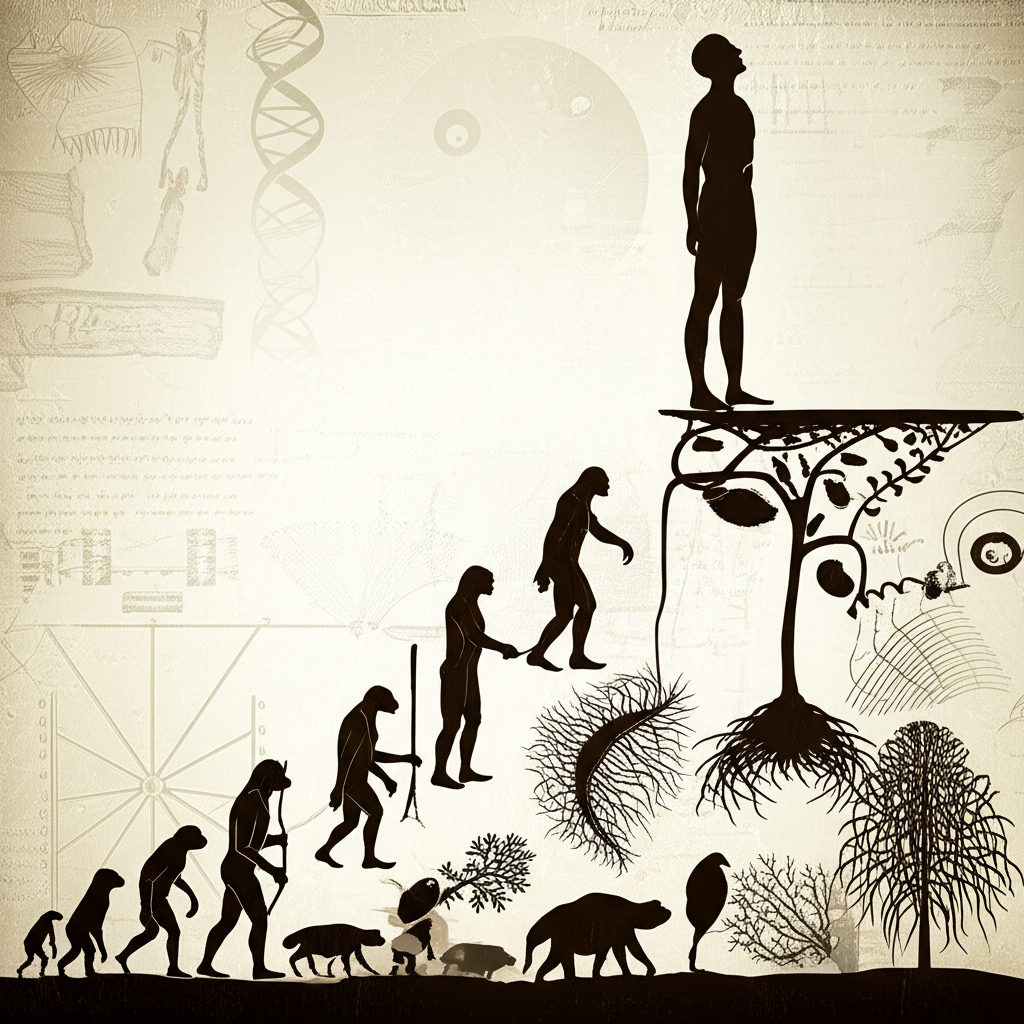
The Enduring Principle of Change, Not Inevitable Ascent
If "progress" is a problematic term, what remains? The Principle of Change in evolution is undeniable. It is the bedrock upon which all biological diversity and adaptation are built. This change is:
- Continuous: Life is never static; environments shift, and species must respond or perish.
- Opportunistic: Evolution seizes upon available variations that confer advantage in the present moment.
- Branching: Evolution is not a ladder but a bush, with countless dead ends and diverse paths, many of which lead to successful, yet utterly different, forms of life.
The Great Books remind us that understanding the world requires careful observation and rigorous thought, distinguishing between what is truly observed and what is projected onto phenomena. While we can certainly trace increases in certain metrics (like brain size or organizational complexity) along specific lineages, to declare this an overarching "Principle of Progress" for all of life is to impose a value judgment where none inherently exists.
Conclusion: A Human Interpretation of a Natural Process
The Principle of Progress in Evolution, then, is less a biological law and more a philosophical interpretation, a lens through which humanity often views its own journey and the history of life. While evolution is undeniably a story of profound and transformative change, the notion of an inherent, directional progress towards a "better" or "higher" form remains a deeply contested idea. It challenges us to reflect on our own biases, our definitions of value, and the true nature of the cosmos – a cosmos that, according to much of our philosophical and scientific inquiry, unfolds without a predetermined script or an ultimate goal, yet generates an astonishing, ever-changing symphony of life.
📹 Related Video: What is Philosophy?
Video by: The School of Life
💡 Want different videos? Search YouTube for: "Philosophy of Evolution: Is There Progress?"
📹 Related Video: ARISTOTLE ON: The Nicomachean Ethics
Video by: The School of Life
💡 Want different videos? Search YouTube for: "Teleology vs. Chance in Nature: Aristotle to Darwin"