

The Unshakable Foundation: Exploring the Principle of Non-Contradiction
Have you ever tried to argue that a door is simultaneously open and closed in the exact same way and at the exact same moment? If you have, you've likely bumped up against one of the most fundamental principles of logic and reasoning: the Principle of Non-Contradiction (PNC). This article delves into this bedrock truth of human thought, exploring its origins, its profound implications, and why it remains indispensable for any coherent understanding of the world. Simply put, the PNC states that something cannot be both true and false at the same time and in the same respect. It's the silent guardian ensuring our thoughts don't descend into utter chaos.
The Ancient Cornerstone: Aristotle's Insight
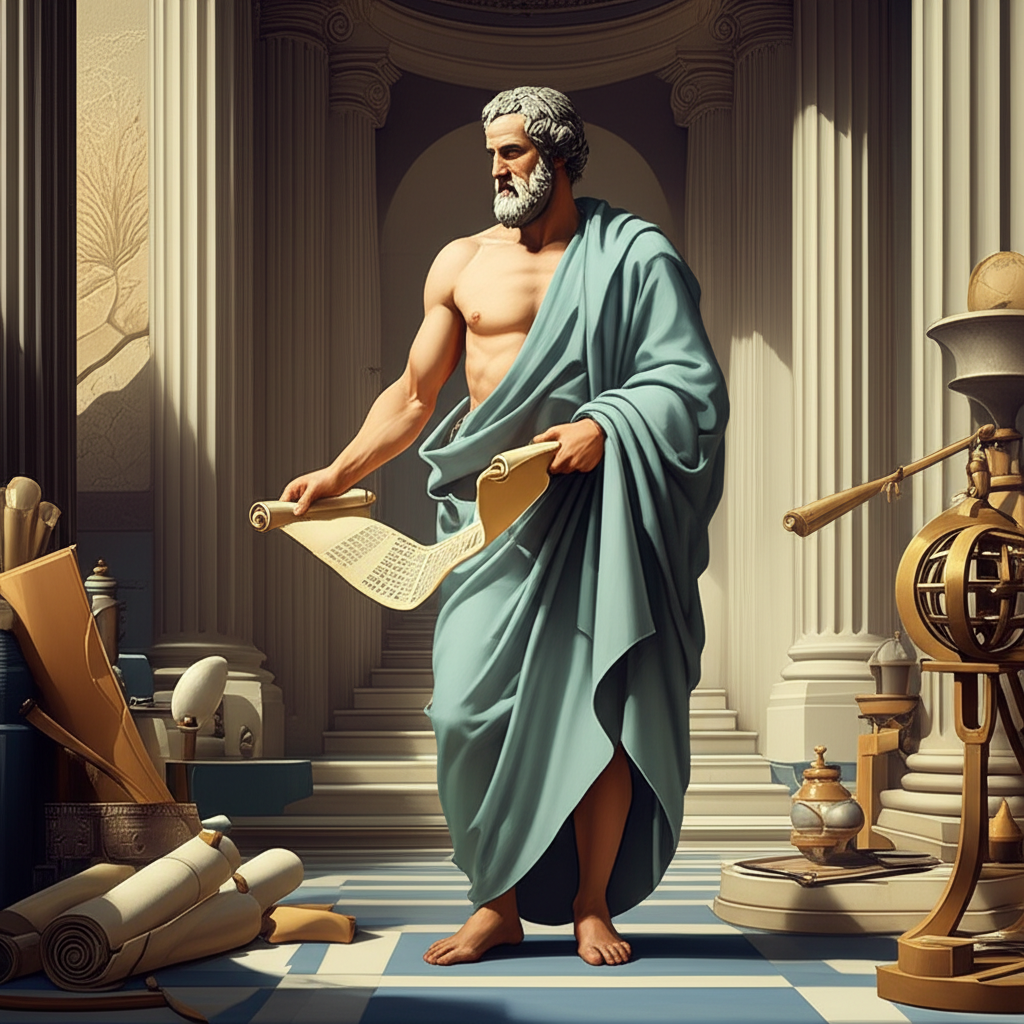
The Principle of Non-Contradiction isn't a modern invention; it's a concept deeply embedded in the very fabric of Western philosophy, articulated most famously by Aristotle in his Metaphysics. Within the pages of the Great Books of the Western World, Aristotle lays out a compelling case for its necessity, asserting it as the most certain of all principles. He didn't just propose it; he vigorously defended it, arguing that even attempts to deny it implicitly rely on it.
Aristotle's formulation is precise:
- "It is impossible for the same thing to belong and not to belong to the same thing at the same time and in the same respect."
This wasn't just an academic exercise for him; it was the very foundation upon which all coherent reasoning could be built. Without it, discourse becomes meaningless, and any claim could be simultaneously true and false, rendering truth itself an illusion.
Unpacking the Principle: What It Truly Means
To fully grasp the PNC, it's crucial to understand its components. It's not merely about avoiding contradictions in speech, but about recognizing an inherent impossibility in reality and thought.
Key Elements of the Principle of Non-Contradiction:
- "The Same Thing": Refers to the subject of the proposition.
- "To Belong and Not to Belong": Refers to the predicate, or the property attributed to the subject, and its negation.
- "At the Same Time": Crucial for avoiding temporal fallacies. A door can be open now and closed later, but not both now.
- "In the Same Respect": Equally vital. A coin can be "heads" on one side and "tails" on the other, but it cannot be "heads" and "not heads" on the same side simultaneously. A person can be "tall" compared to a child and "short" compared to a basketball player, but not "tall" and "not tall" in comparison to the same reference point.
Consider the statement: “The cat is on the mat.”
According to the PNC, it is impossible for the statement “The cat is on the mat” and “The cat is not on the mat” to both be true simultaneously and concerning the same cat and mat. One must be true, and the other false, or vice-versa. This isn't just a rule of grammar; it's a fundamental constraint on reality itself.
The Bedrock of All Reasoning
Why is this ancient principle so incredibly important? Because without it, all forms of reasoning – from simple problem-solving to complex scientific inquiry – would collapse.
Imagine a world without the PNC:
- Science: A hypothesis could be both true and false, making experimentation and observation futile. Gravity could both exist and not exist simultaneously.
- Law: A defendant could be both guilty and innocent of the same crime at the same time, rendering justice impossible.
- Everyday Life: If your car is both in the driveway and not in the driveway, how do you decide to look for it? If a friend is both here and not here, how do you interact?
The PNC is what allows us to distinguish between sense and nonsense. It's the engine of coherent thought, enabling us to form consistent beliefs, make rational decisions, and understand the world around us. It's the very definition of what makes logic logical.
Challenges and Affirmations
While the PNC is widely accepted as a fundamental principle, philosophers throughout history have explored its boundaries and implications, and some have even attempted to argue against its universality, particularly in specific contexts like quantum mechanics or certain non-classical logics. However, even these challenges often operate by defining new systems where "contradiction" might mean something slightly different, or where the "same time and same respect" clause is implicitly modified.
Ultimately, for the vast majority of human reasoning and understanding of objective truth, the PNC stands firm. It is the unshakeable ground upon which we build our knowledge and engage in meaningful discourse. To deny it is, in a profound sense, to deny the possibility of coherent thought itself.
The Enduring Relevance of a Core Principle
The Principle of Non-Contradiction isn't just a dusty relic from ancient philosophy; it's a living, breathing principle that underpins every moment of our rational existence. From deciding what to eat for breakfast to constructing complex ethical arguments, our minds unconsciously rely on the impossibility of contradictions. It ensures that when we say something is true, we implicitly understand that its opposite cannot also be true in the identical context. This understanding is the foundation for all meaningful communication, all scientific discovery, and all pursuit of truth.
Further Exploration:
For those eager to delve deeper into the fascinating world of logic and philosophical principles, these resources can provide excellent starting points:
-
📹 Related Video: ARISTOTLE ON: The Nicomachean Ethics
Video by: The School of Life
💡 Want different videos? Search YouTube for: "Aristotle Principle of Non-Contradiction explained"
-
📹 Related Video: What is Philosophy?
Video by: The School of Life
💡 Want different videos? Search YouTube for: "The Law of Non-Contradiction Philosophy"