

The Unshakeable Foundation: Understanding the Principle of Non-Contradiction
The Principle of Non-Contradiction (PNC) stands as one of the most fundamental tenets of Logic and Reasoning, a bedrock upon which coherent thought is built. Simply put, it asserts that something cannot both be and not be at the same time and in the same respect. It is an indispensable Principle for discerning Truth, guiding our understanding of reality, and allowing for any meaningful discourse. Without it, the very fabric of our intellectual world unravels into an unintelligible chaos where everything and its opposite could simultaneously be true.
What is This Core Principle?
At its heart, the Principle of Non-Contradiction dictates that a statement and its negation cannot both be true. For example, a cat cannot simultaneously be a cat and not be a cat in the same moment and context. A door cannot be both open and closed at the same time. This is not merely a rule of grammar or a convention of language; it's considered a fundamental law governing reality itself and our ability to reason about it.
- Axiomatic Nature: It is often considered an axiom, meaning it's a self-evident Truth that cannot be proven by other, more fundamental principles, because it is itself the most fundamental. Any attempt to prove it would already presuppose its validity.
- Foundation of Logic: All formal Logic systems, from classical to modern, implicitly or explicitly rely on this Principle to maintain consistency and derive valid conclusions.
- Prerequisite for Truth: Without the PNC, the concept of Truth itself becomes meaningless, as any statement could be simultaneously true and false.
Aristotle's Enduring Legacy: The Principle's Ancient Roots
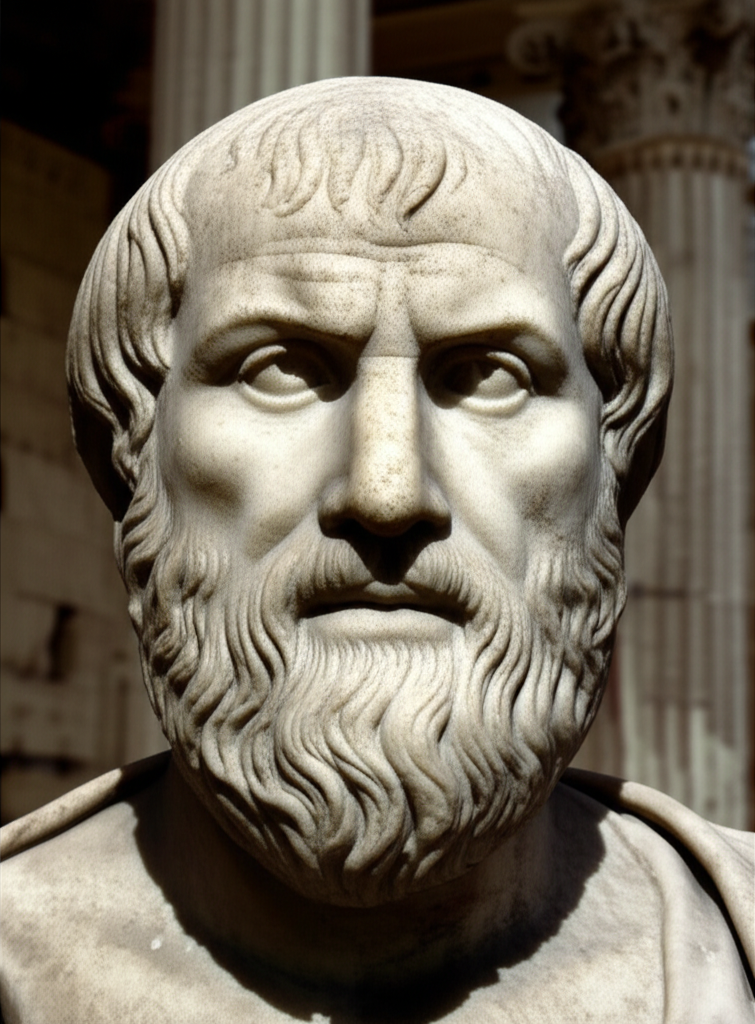
While the intuitive grasp of non-contradiction likely predates formal philosophy, it was the ancient Greek philosopher Aristotle who first articulated it systematically in his work Metaphysics. He declared it to be "the most certain of all principles," arguing that it is impossible for anyone to believe that the same thing can at the same time both be and not be.
Aristotle's formulation is crucial because he understood that:
- It’s Indemonstrable: You cannot prove the PNC without already assuming it. Any argument against it would necessarily use Logic that relies on non-contradiction.
- It’s Necessary for Discourse: If contradictions were permissible, then all statements would be equally true, rendering communication and Reasoning utterly impossible. If "man is a biped" is true, and "man is not a biped" is also true, then the very meaning of "man" or "biped" dissolves.
- It Reflects Reality: For Aristotle, the PNC wasn't just a rule of thought, but a reflection of the way reality itself is structured. Things are what they are, and are not what they are not.
Why is it Indispensable for Coherent Reasoning?
Imagine trying to build a house where the laws of physics allowed a wall to be both solid and non-existent at the same time. The structure would collapse. Similarly, without the Principle of Non-Contradiction, our intellectual structures would crumble.
Consider these implications for Reasoning:
| Aspect of Reasoning | Impact of PNC | Without PNC (Contradiction Allowed) |
|---|---|---|
| Truth & Falsity | Distinguishes clearly between true and false statements. | No distinction; all statements could be both true and false. |
| Argumentation | Allows for valid inferences and logical deductions. | Any conclusion could be drawn from any premise; arguments lose force. |
| Identity | Defines what something is by what it is not. | Objects and concepts lack stable identities. |
| Communication | Enables clear, unambiguous expression of ideas. | Meaning becomes fluid and contradictory; understanding breaks down. |
| Decision-Making | Guides rational choices based on consistent information. | Decisions become arbitrary as contradictory options are equally valid. |
The PNC isn't just a philosophical nicety; it's the very engine that drives our ability to make sense of the world, to form beliefs, and to act purposefully.
The Nature of Contradiction: A Deeper Look
A contradiction arises when two statements, one being the negation of the other, are asserted to be true simultaneously. For example:
- "The sky is blue."
- "The sky is not blue."
According to the Principle of Non-Contradiction, both of these cannot be true at the same time and in the same respect. If we are talking about the same portion of sky at the same moment, then one must be true and the other false.
It's important to differentiate between:
- Actual Contradictions: Where a statement and its direct negation are both affirmed. These are logically impossible according to the PNC.
- Apparent Contradictions: Situations that seem contradictory but, upon closer examination, involve different times, contexts, or aspects. For instance, "The water is hot" and "The water is cold" are not contradictory if they refer to different samples of water, or the same water at different times, or even the same water judged by different people with varying tolerances.
This distinction is crucial for nuanced Reasoning and avoiding false dilemmas.
Modern Philosophical Debates and the PNC
While the Principle of Non-Contradiction remains a cornerstone of most Western philosophy, some modern philosophical currents have explored its boundaries. Dialetheism, for instance, is the view that there are true contradictions. However, even these arguments often rely on a foundational understanding of contradiction to make their case, implicitly affirming the PNC's significance by highlighting its supposed exceptions. For the vast majority of philosophical inquiry and everyday Reasoning, the PNC remains an indispensable tool.
Conclusion: The Bedrock of Truth and Reasoning
The Principle of Non-Contradiction is more than just a rule; it's a fundamental insight into the nature of reality and thought. From the foundational texts of the Great Books of the Western World to contemporary scientific inquiry, this Principle underpins our pursuit of Truth and our capacity for coherent Reasoning. It ensures that our intellectual constructs have a stable footing, allowing us to distinguish what is from what is not, and thereby make sense of the complex world around us. To deny it is to deny the possibility of meaningful thought itself.
YouTube:
- "Aristotle Principle of Non-Contradiction explained"
- "What is the Law of Non-Contradiction? Philosophy Basics"
📹 Related Video: What is Philosophy?
Video by: The School of Life
💡 Want different videos? Search YouTube for: "The Principle of Non-Contradiction philosophy"