

The Unshakable Foundation: Exploring the Principle of Non-Contradiction
The Principle of Non-Contradiction stands as one of the most fundamental tenets of human thought, a bedrock upon which all logic and coherent reasoning are built. Simply put, it asserts that something cannot both be and not be at the same time and in the same respect. This principle is not merely a rule of thumb, but an indispensable prerequisite for discerning truth and making sense of the world around us. Without it, language loses meaning, knowledge becomes impossible, and rational discourse dissolves into absurdity.
What is This Indispensable Principle?
At its core, the Principle of Non-Contradiction (PNC) is an ontological and logical axiom. It states that for any proposition 'P', it is impossible for 'P' and 'not P' to be true simultaneously. Or, to put it another way, a thing cannot possess a certain property and lack that same property at the same time and in the same relation.
Consider these simple formulations:
- A thing cannot be A and not-A simultaneously.
- A statement cannot be true and false at the same time.
- It is impossible for something to exist and not exist in the same way, at the same moment.
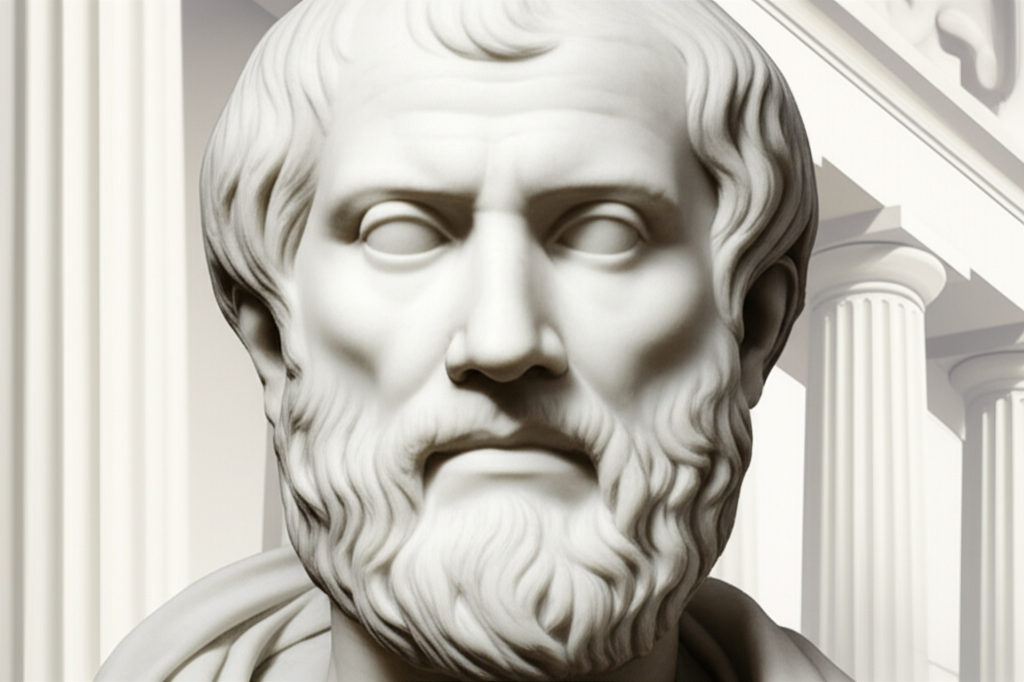
The ancient Greek philosopher Aristotle, a cornerstone figure in the Great Books of the Western World, famously articulated this principle in his Metaphysics, calling it the "most certain of all principles." He argued that even attempts to deny it implicitly rely on it, as one must affirm the denial while simultaneously denying the affirmation.
Aristotle's Insight
Aristotle posited that the PNC is not merely a convention of language or thought, but a reflection of reality itself. If something could both be and not be, then all distinctions would collapse, and there would be no stable reality to talk about. For him, it was the very condition for intelligible discourse and the possibility of knowledge.
Why is it a Foundational Principle for Logic and Truth?
The designation of "Principle" here is crucial. It signifies its status as a primary, self-evident proposition from which other truths can be derived, but which itself cannot be proven by more basic ones, precisely because it underpins all proof.
- Basis of All Reasoning: Every act of reasoning, from solving a complex scientific problem to deciding what to have for dinner, implicitly relies on the idea that contradictory states cannot coexist. If "the stove is hot" and "the stove is not hot" could both be true, then the instruction "don't touch the hot stove" would be meaningless.
- Distinguishing Truth from Falsity: The PNC is the very mechanism that allows us to distinguish truth from falsity. If a statement and its negation could both be true, then no statement could be definitively false, and thus no statement could be definitively true. The very concept of truth would lose its coherence.
- Coherence of Language: Language relies on fixed meanings. If a word could simultaneously mean itself and its opposite, communication would be impossible. The PNC ensures that when we say "this apple is red," we are not simultaneously implying "this apple is not red" in the same sense.
Implications Across Disciplines
The pervasive influence of the Principle of Non-Contradiction stretches far beyond the confines of pure logic.
In Philosophy and Metaphysics
- Existence: The very concept of existence relies on the PNC. If something could exist and not exist simultaneously, the idea of a stable, knowable reality would vanish.
- Identity: A thing's identity is defined by what it is and what it is not. The PNC is vital for understanding that an object remains itself over time, maintaining its distinct properties.
- Epistemology (Theory of Knowledge): How can we claim to know anything if our knowledge can simultaneously be true and false? The PNC is a prerequisite for forming consistent beliefs and coherent systems of knowledge.
In Science and Mathematics
- Scientific Method: Scientific inquiry seeks to establish consistent models of the universe. A theory that generates contradictory predictions is immediately considered flawed and rejected.
- Mathematical Proofs: Mathematical proofs are built step-by-step, ensuring that each deduction follows logically from the previous one, ultimately avoiding contradictions. A contradiction within a proof invalidates the entire argument.
In Everyday Life
- Decision Making: Every decision we make, from crossing the road to choosing a career, assumes a consistent reality where actions have predictable, non-contradictory outcomes.
- Law and Justice: Legal systems operate on the assumption that facts are consistent. A defendant cannot be both guilty and innocent of the same crime at the same time based on the same evidence.
Challenges and Defenses
While the Principle of Non-Contradiction is widely accepted as a fundamental axiom, it has faced philosophical challenges, particularly from schools of thought like dialetheism, which argue that there can be "true contradictions." However, even these challenges often operate within a framework that implicitly acknowledges the PNC for most statements, only positing exceptions for specific paradoxes or semantic ambiguities.
Ultimately, the defense of the PNC often circles back to Aristotle's original argument: its rejection renders all discourse, all reasoning, and all claims to truth utterly meaningless. To deny it is to deny the very possibility of coherent thought.
Conclusion: The Bedrock of Rationality
The Principle of Non-Contradiction is not an arbitrary rule but a profound insight into the nature of reality and thought. It is the silent guardian of logic, the indispensable compass for navigating the terrain of truth, and the fundamental principle that allows us to engage in meaningful reasoning. From the profound depths of metaphysical inquiry to the simple certainties of daily life, its unwavering presence ensures that our world, and our understanding of it, remains intelligible. To question it is to question the very fabric of rationality itself.
📹 Related Video: ARISTOTLE ON: The Nicomachean Ethics
Video by: The School of Life
💡 Want different videos? Search YouTube for: ""Aristotle Principle of Non-Contradiction Explained""
📹 Related Video: What is Philosophy?
Video by: The School of Life
💡 Want different videos? Search YouTube for: ""The Law of Non-Contradiction Philosophy""