

The Unshakable Foundation: Understanding the Principle of Non-Contradiction
The Principle of Non-Contradiction stands as one of the most fundamental tenets of Logic and Reasoning, a bedrock upon which coherent thought, Truth, and meaningful discourse are built. Simply put, it asserts that something cannot both be and not be at the same time and in the same respect. It's an intuitive Principle that underpins our ability to make sense of the world, distinguishing reality from absurdity.
The Cornerstone of Coherent Thought
Imagine a world where a cat could simultaneously be both entirely a cat and entirely not a cat. Or where a statement could be both absolutely true and absolutely false at the very same moment. Such a world, or indeed, such a thought process, would be utterly chaotic, rendering any form of communication or understanding impossible. This is precisely why the Principle of Non-Contradiction is not merely an academic curiosity but a foundational requirement for any system of Logic and indeed, for reality itself as we perceive it.
Aristotle's Articulation: A Timeless Insight
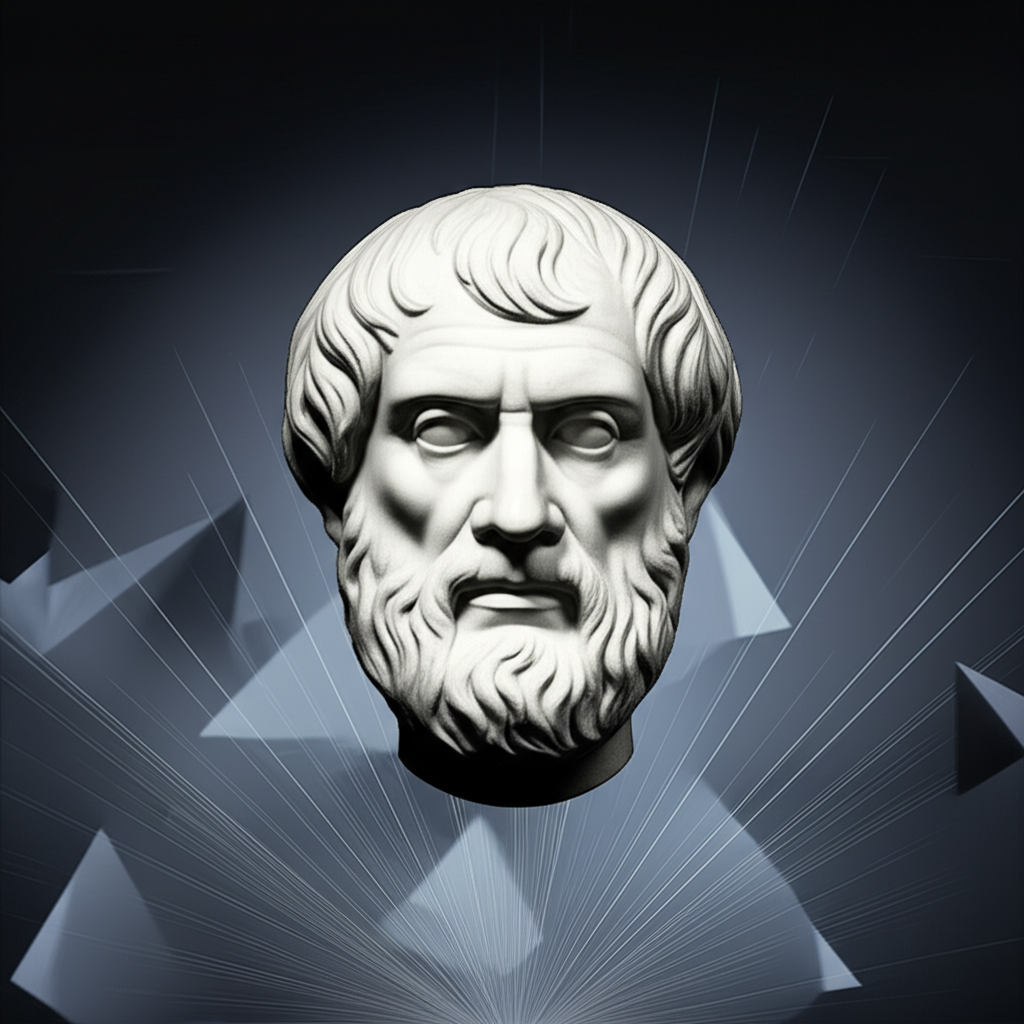
While the concept might seem self-evident to us today, its formal articulation and defense largely fall to the ancient Greek philosopher, Aristotle. Within the pages of the Great Books of the Western World, particularly in his Metaphysics, Aristotle elevates this Principle to the status of the most certain of all principles. He argues that it is impossible for anyone to believe that the same thing can at the same time be and not be.
Aristotle's formulation is often stated as: "It is impossible for the same attribute at the same time to belong and not to belong to the same subject and in the same respect." This precise wording is crucial, as it accounts for changes over time or different aspects. For example, a chair can be "red" today and "not red" tomorrow (if painted), or it can be "comfortable" in one respect but "unstable" in another. The Principle applies when all these conditions (time, subject, respect) are held constant.
Why the Principle is Indispensable
The Principle of Non-Contradiction isn't just a rule; it's the very structure that allows us to differentiate, to define, and to ultimately grasp Truth. Without it, every statement would collapse into meaninglessness.
Pillars of Understanding
Consider the following implications of this Principle:
- Foundation of Truth: If a statement can be both true and false, then the concept of Truth itself dissolves. The Principle ensures that for any given proposition, it is either true or false, but not both.
- Enabling Reasoning: All forms of Reasoning, from simple deductions to complex scientific theories, rely on the ability to draw clear distinctions and avoid contradictions. If 'A' implies 'B', and 'B' is contradictory to 'C', we can logically conclude that 'A' cannot also imply 'C' (given the same context).
- Clarity in Language: Our language, with its distinct words and meanings, is predicated on non-contradiction. When we say "tree," we mean something specific, not simultaneously "tree" and "not-tree."
- Basis for Reality: Our experience of reality is one where objects and properties are distinct. A door is either open or closed (at a given moment, in a given way); it cannot be both. This fundamental order is mirrored by the Principle of Non-Contradiction.
The Challenge and Defense of the Principle
Throughout history, a few philosophical schools, like some forms of ancient skepticism or certain modern dialectical theories, have seemingly attempted to challenge or transcend the Principle of Non-Contradiction. However, upon closer examination, even these challenges often implicitly rely on the Principle to articulate their arguments. To argue against non-contradiction requires one to state that it is not true that 'A' cannot be 'non-A', which itself is a non-contradictory statement about the Principle.
Aristotle himself posited that anyone who genuinely denies the Principle would be unable to speak meaningfully, as their words would lack fixed meaning, or would be unable to distinguish between actions, as every action would be indistinguishable from its opposite.
Conclusion: An Enduring Principle
The Principle of Non-Contradiction is not merely a rule of thumb; it is a fundamental axiom of all intelligible thought and reality. It is the silent guardian of Truth, the architect of coherent Reasoning, and an indispensable Principle that allows us to navigate and understand the world around us. From the ancient insights of Aristotle to the complexities of modern science, its unwavering presence ensures that our pursuit of knowledge remains firmly grounded.
📹 Related Video: ARISTOTLE ON: The Nicomachean Ethics
Video by: The School of Life
💡 Want different videos? Search YouTube for: ""Aristotle Principle of Non-Contradiction Explained""
📹 Related Video: What is Philosophy?
Video by: The School of Life
💡 Want different videos? Search YouTube for: ""Foundations of Logic Philosophy""