

The Unshakeable Foundation: Unpacking the Principle of Non-Contradiction
Summary: The Principle of Non-Contradiction (PNC) stands as a bedrock of human thought and reasoning, asserting that something cannot both be and not be at the same time and in the same respect. It is a fundamental Principle of Logic, without which meaningful discourse, the pursuit of Truth, and even our perception of reality would dissolve into incoherence. This article delves into its profound implications and why it remains indispensable for any serious intellectual endeavor.
Have you ever stopped to consider what makes coherent thought, well, coherent? What underpins our ability to make sense of the world, to argue a point, or even to distinguish between what is and what is not? For centuries, philosophers have pointed to a single, elegant Principle as the very cornerstone of all rational inquiry: The Principle of Non-Contradiction.
It's not merely an academic concept; it's the silent guardian of our intellect, an implicit assumption we rely on every waking moment. Without it, our world would be a whimsical, nonsensical blur where everything and nothing could be simultaneously true.
Aristotle's Enduring Insight: The Birth of a Principle
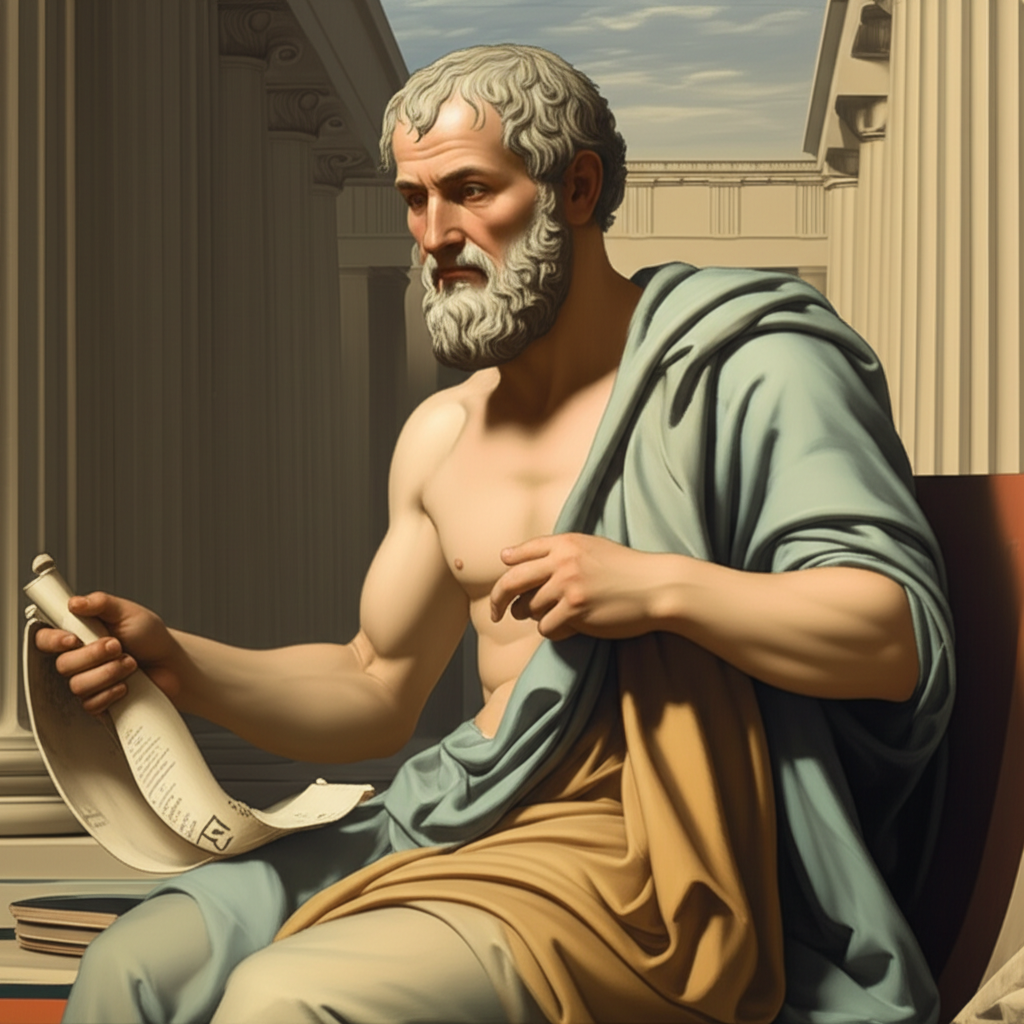
While humanity surely operated on this Principle instinctively for millennia, it was the formidable mind of Aristotle, whose works grace the pages of the Great Books of the Western World, who first articulated it with such profound clarity. In his Metaphysics, Aristotle famously declared:
"It is impossible for the same thing to belong and not to belong to the same thing at the same time and in the same respect."
This isn't just a clever observation; it's presented as the most certain of all Principles, one that even those who would deny it must implicitly rely upon to formulate their denial. It's a foundational axiom, not something derived from other truths, but rather that from which all other Logic and Reasoning flow.
What Exactly Is the Principle of Non-Contradiction?
At its heart, the PNC is deceptively simple. It states that two contradictory propositions cannot both be true simultaneously. Or, to put it another way, a statement and its negation cannot both hold true.
Consider these examples:
- "The ball is red" and "The ball is not red": According to the PNC, these two statements cannot both be true about the same ball at the same time and in the same part (e.g., if one half is red and the other isn't, that's a different "respect").
- "Socrates is mortal" and "Socrates is immortal": These are mutually exclusive. If one is true, the other must be false.
- "It is raining outside" and "It is not raining outside": You cannot experience both simultaneously in the same location.
The critical aspects here are "at the same time" and "in the same respect." These qualifiers prevent trivial objections. A ball can be red now and not red later (different time), or red on one side and blue on another (different respect). The Principle holds firm when these conditions are met.
Why Does This Principle Matter for Truth and Reasoning?
The PNC is not just a philosophical curiosity; it's the very engine room of our cognitive faculties. Its implications are vast and touch every aspect of our intellectual lives:
- Foundation of Logic: Without the PNC, formal Logic would collapse. If a statement could be both true and false, then any deduction, any inference, would become meaningless. The rules we use to build arguments, to prove or disprove hypotheses, all presuppose that contradictions are impossible.
- Pursuit of Truth: If contradictions were permissible, then the very concept of Truth would be undermined. How could we ascertain what is true if its opposite could also be true simultaneously? The PNC provides the necessary distinction between truth and falsehood, allowing us to identify and reject inconsistent claims.
- Meaningful Discourse: Communication relies on shared understanding. If words and concepts could simultaneously mean one thing and its opposite, language would cease to convey meaning. Debates, arguments, and even simple conversations would devolve into chaos.
- Scientific Inquiry: The scientific method is built upon testing hypotheses and eliminating those that are false. If a hypothesis and its negation could both be true, then no experiment could ever truly falsify a theory, halting scientific progress.
- Reality Itself: Many philosophers argue that the PNC is not just a Principle of thought but reflects the very structure of reality. The world is a certain way, and it is not another contradictory way, at the same time and in the same respect.
Here's a quick look at its essential roles:
- Clarity: Distinguishes between what is and what is not.
- Coherence: Ensures that our thoughts and arguments are consistent.
- Discernment: Allows us to identify and reject falsehoods.
- Foundation: Provides the bedrock for all other logical principles.
The Enduring Relevance of an Ancient Principle
Even in contemporary philosophy, with its complex discussions of quantum mechanics or multi-valued logics, the core Principle of Non-Contradiction remains largely unchallenged as the fundamental rule for classical Reasoning. While some niche areas might explore systems where contradictions are handled differently, these are often built upon an understanding of the PNC, or are specifically designed to address phenomena where classical Logic might seem insufficient, rather than outright refuting the Principle itself in its proper domain.
The Principle of Non-Contradiction isn't just an ancient dictum; it's the intellectual oxygen we breathe. It's the silent agreement we make with reality, allowing us to distinguish sense from nonsense, Truth from falsehood, and ultimately, to make any meaningful progress in our understanding of the cosmos and ourselves. To deny it is to deny the very possibility of rational thought.
📹 Related Video: ARISTOTLE ON: The Nicomachean Ethics
Video by: The School of Life
💡 Want different videos? Search YouTube for: "Aristotle Metaphysics Principle Non-Contradiction explained"
📹 Related Video: What is Philosophy?
Video by: The School of Life
💡 Want different videos? Search YouTube for: "Why is the Law of Non-Contradiction important philosophy"