

The Unshakeable Foundation: Understanding the Principle of Non-Contradiction
The Principle of Non-Contradiction (PNC) stands as one of the most fundamental tenets of human thought, an bedrock principle without which logic, coherent reasoning, and the very notion of objective truth would crumble. Simply put, it asserts that something cannot both be and not be at the same time and in the same respect. It is an axiom, a self-evident truth, that underpins all rational discourse and our understanding of reality. To deny it is to embrace intellectual chaos, where everything could simultaneously be true and false, rendering meaningful communication and knowledge impossible.
What is the Principle of Non-Contradiction?
At its core, the Principle of Non-Contradiction is a declaration against absurdity. It's not merely a rule of grammar or a convention; it's a statement about the nature of being itself and the structure of intelligible thought.
Formally, it can be stated in several ways:
- Aristotle's Formulation: "The same attribute cannot at the same time belong and not belong to the same subject in the same respect." (As found in Metaphysics, a cornerstone of the Great Books of the Western World).
- Symbolic Logic: It is impossible for a proposition 'P' and its negation 'not P' to both be true simultaneously. (e.g., A cannot be 'A' and 'not A' at the same time).
- Everyday Language: A thing cannot be both red and not red all over at the same moment; a door cannot be both open and closed simultaneously.
This principle is crucial because it defines the boundaries of what can be considered coherent. Without it, any statement could be simultaneously affirmed and denied, obliterating the distinction between truth and falsehood.
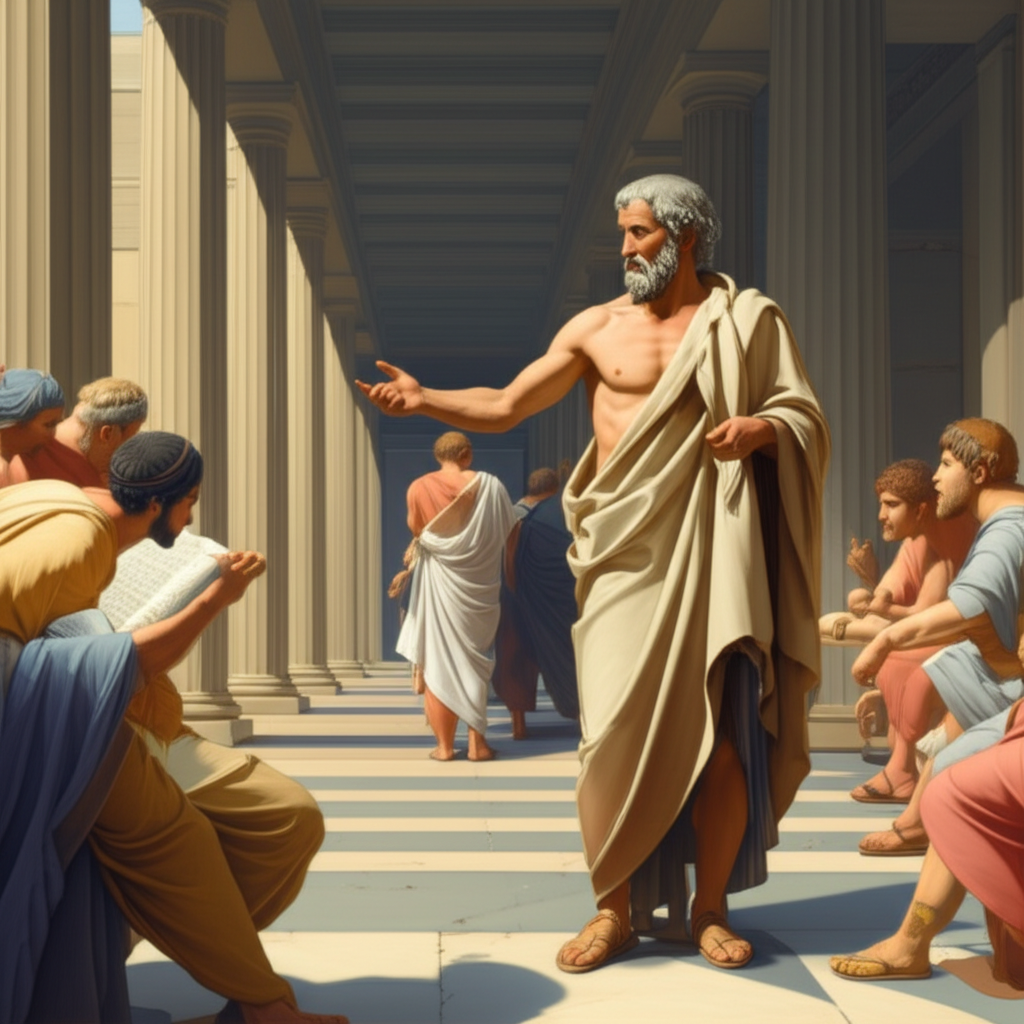
The Pillar of Logic and Reasoning
The significance of the PNC cannot be overstated. It is the very ground upon which all logic builds. Every argument, every deduction, every attempt at rational reasoning implicitly relies on the assumption that contradictions are false.
Consider its role in various domains:
- Scientific Inquiry: If a theory could both predict a phenomenon and its opposite, it would be useless. Scientists strive for consistent models that do not contain internal contradictions.
- Legal Systems: A defendant cannot be both guilty and innocent of the same charge at the same time. Legal reasoning seeks to establish truth by eliminating contradictory evidence.
- Everyday Decision-Making: We make choices based on the assumption that our actions will have consistent outcomes. If pressing a light switch could both turn the light on and turn it off simultaneously, our world would be unpredictable and unnavigable.
The PNC ensures that our thoughts have definite content and that propositions have definite truth values. It allows us to distinguish between what is and what is not, paving the way for genuine knowledge.
Historical Roots and Enduring Relevance
While often associated with Aristotle, the intuitive grasp of the Principle of Non-Contradiction likely predates him, forming an implicit basis for early human reasoning. However, it was Aristotle, whose works are central to the Great Books of the Western World collection, who first articulated it explicitly and defended its foundational status with rigor. In his Metaphysics, he argued vehemently that it is the most certain of all principles, one that cannot be demonstrated because it is presupposed by any attempt at demonstration. To deny it, he suggested, is to deny the very possibility of meaningful language and thought.
Even in contemporary philosophy, despite challenges from certain philosophical schools (e.g., dialetheism, which suggests some contradictions might be true), the PNC remains overwhelmingly accepted as a necessary condition for rational discourse and a coherent understanding of reality. Its enduring relevance speaks to its profound and universal applicability.
Why This Principle Matters to You
Understanding the Principle of Non-Contradiction is not merely an academic exercise; it's a vital tool for critical thinking in your daily life.
- Identifying Fallacies: It helps you spot inconsistencies and fallacies in arguments, allowing you to discern sound reasoning from flawed rhetoric.
- Clarity of Thought: By striving to avoid contradictions in your own thinking, you enhance the clarity and precision of your ideas.
- Pursuit of Truth: It serves as a compass in the pursuit of truth, guiding you away from incoherent claims and towards consistent understanding.
In essence, the Principle of Non-Contradiction is the gatekeeper of sense, ensuring that our intellectual explorations remain tethered to reality and that our quest for truth is built upon a firm and intelligible ground.
YouTube: "Aristotle Principle of Non-Contradiction explained"
YouTube: "Foundations of Logic: The Law of Non-Contradiction"
📹 Related Video: What is Philosophy?
Video by: The School of Life
💡 Want different videos? Search YouTube for: "The Principle of Non-Contradiction philosophy"