

The Unshaken Foundation: Exploring the Principle of Non-Contradiction
A Cornerstone of Logic and Reality
The Principle of Non-Contradiction (PNC) stands as one of the most fundamental tenets of Logic and Reasoning, a bedrock upon which all coherent thought is built. Simply put, it asserts that something cannot be both true and false at the same time and in the same respect. It's not merely a rule of grammar or a convention of language; it's a profound statement about the very nature of Truth and reality itself. Without this indispensable Principle, our ability to make sense of the world, to engage in meaningful discourse, or even to distinguish between what is and what is not, would utterly collapse.
Understanding the Principle's Essence
At its heart, the Principle of Non-Contradiction is remarkably straightforward, yet its implications are vast. It can be formally stated as:
- A cannot be B and not B simultaneously and in the same relationship.
Consider a common example: a door. According to the PNC, this door cannot be both open and not-open (i.e., closed) at the very same moment, from the same perspective. It must be one or the other. This isn't about the door changing its state over time, but about its state at any given instant.
This Principle protects us from logical absurdities. If contradictions were permissible, then any statement could be simultaneously true and false. This would render all statements meaningless, as there would be no distinction between affirming something and denying it. Our pursuit of Truth would become an exercise in futility.
Aristotle's Enduring Insight: The Unquestionable Axiom
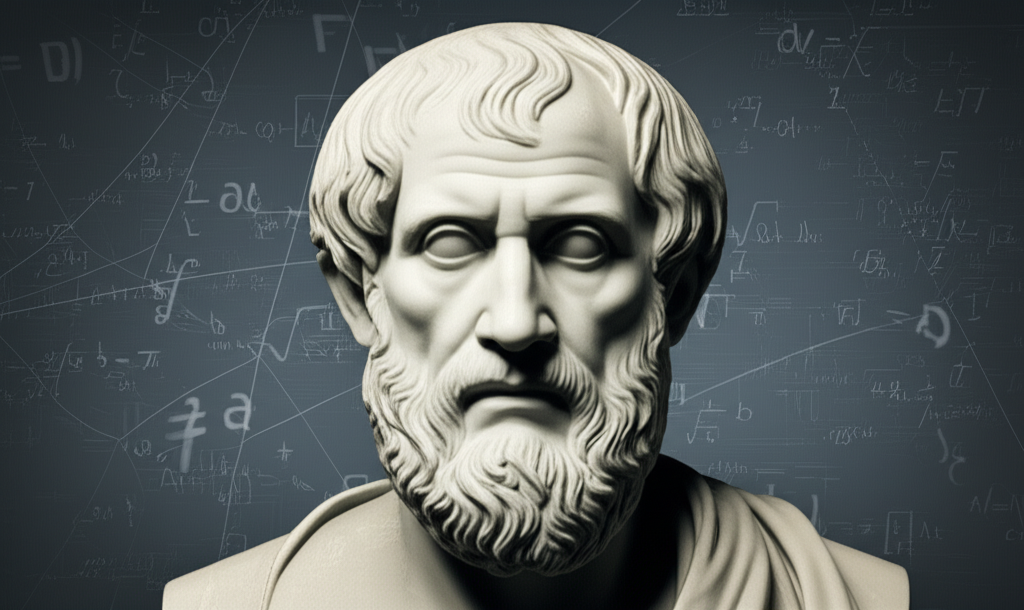
While the Principle of Non-Contradiction might seem intuitively obvious to many, it was the ancient Greek philosopher Aristotle who most famously articulated and defended its paramount importance. In his Metaphysics, Aristotle designated the PNC as the most certain of all Principles, an axiom that cannot be denied without implicitly affirming it.
Aristotle argued that anyone attempting to deny the PNC would inevitably employ it in their very denial. To say "The PNC is false" implies that the statement "The PNC is false" is true and not false, thereby relying on the very Principle it seeks to refute. He believed that even if one chose to remain silent, their actions would betray an adherence to the Principle, as they would not, for instance, simultaneously walk into a well and not walk into a well.
- "It is impossible for anyone to believe the same thing to be and not to be, as some imagine that Heraclitus says." – Aristotle, Metaphysics
Aristotle's profound insight established the PNC as a foundational element of classical Logic, a status it has largely maintained throughout Western philosophical tradition.
The Indispensable Role of Non-Contradiction in Reasoning
The Principle of Non-Contradiction is not merely an abstract philosophical concept; it is the engine that drives coherent Reasoning and the pursuit of Truth in every domain.
Why PNC is Crucial for Logic and Truth:
- Foundation for Deduction: All valid deductive arguments rely on the PNC. If a premise could be both true and false, then any conclusion could be drawn from it, rendering inference meaningless.
- Distinguishing Truth from Falsity: The PNC provides the essential criterion for distinguishing between a true statement and a false one. A statement that contains a contradiction cannot be true.
- Meaningful Communication: Without the PNC, language would lose its power to convey specific meanings. If "yes" could simultaneously mean "no," then no intelligible message could be exchanged.
- Coherent Worldview: Our ability to construct a consistent understanding of reality, to form beliefs, and to make decisions is predicated on the assumption that reality itself is non-contradictory.
Applications Across Disciplines
The reach of the Principle of Non-Contradiction extends far beyond the confines of philosophy, permeating virtually every field of human inquiry.
Areas Where PNC is Applied:
| Discipline | How PNC is Applied |
|---|---|
| Philosophy | Forms the bedrock of Metaphysics (what is real?), Epistemology (how do we know?), and Ethics (what is right?). Philosophical systems strive for internal consistency. |
| Science | Scientific theories must be internally consistent. Experimental results that contradict established Principles lead to re-evaluation, not acceptance of contradiction. Hypotheses are tested for falsifiability, a process that assumes non-contradiction. |
| Mathematics | Mathematical proofs are built on a chain of non-contradictory logical steps. A contradiction in a mathematical system indicates a flaw in its axioms or derivations. |
| Law and Justice | Legal systems demand consistency in evidence and testimony. A defendant cannot be simultaneously guilty and innocent of the same charge at the same time and place. Legal arguments aim to expose contradictions in opposing claims. |
| Everyday Reasoning | From deciding what to eat for dinner (you can't eat both pasta and not-pasta) to planning a trip (you can't be in two places at once), our daily decisions and understanding of the world implicitly rely on the PNC. It guides our practical Reasoning and problem-solving. |
Navigating Apparent Challenges and Misunderstandings
While the PNC is broadly accepted, certain philosophical and scientific discussions sometimes appear to challenge its universality. It's crucial, however, to differentiate between genuine contradiction and complex phenomena.
- Quantum Mechanics: Some interpret quantum phenomena, like superposition (where a particle can be in multiple states simultaneously), as a violation of the PNC. However, physicists typically clarify that these states are not contradictory in the classical sense, but rather represent a different, often probabilistic, description of reality before measurement. The PNC still holds for the measured outcome.
- Dialectical Logic: Philosophers like Hegel and Marx used "dialectics" which involves the tension of opposing ideas (thesis, antithesis, synthesis). This isn't a rejection of the PNC but a description of a dynamic process of development and change, where contradictions are resolved over time into a new state. The "contradictions" here are often conceptual tensions or opposing forces, not simultaneous logical falsehoods in the Aristotelian sense.
These discussions highlight the need for careful definition and context, rather than a fundamental refutation of the Principle itself. The PNC remains a robust tool for assessing the internal coherence of any argument or system.
The Unshaken Foundation of Thought
The Principle of Non-Contradiction is more than just a rule; it is a fundamental insight into how we think, how reality functions, and how we ascertain Truth. It underpins our capacity for coherent Reasoning, allowing us to differentiate, to define, and to ultimately understand. As Daniel Sanderson, I find it profoundly reassuring that amidst the complexities of existence, there remains this clear, unwavering Principle that allows us to navigate the world with a modicum of Logic and an enduring hope for genuine Truth. It reminds us that some truths are so fundamental, they are embedded in the very fabric of thought itself.
YouTube: "Aristotle Principle of Non-Contradiction Explained"
YouTube: "The Laws of Logic: Identity, Non-Contradiction, Excluded Middle"
📹 Related Video: What is Philosophy?
Video by: The School of Life
💡 Want different videos? Search YouTube for: "The Principle of Non-Contradiction philosophy"