

The Unshakeable Foundation: Exploring the Principle of Non-Contradiction
The Principle of Non-Contradiction (PNC) stands as one of the most fundamental principles in all of logic and philosophy, asserting that something cannot both be and not be at the same time and in the same respect. It is the bedrock upon which all coherent reasoning and our understanding of truth are built. Without this foundational axiom, rational discourse would collapse, and the very notion of meaning would dissolve into an unintelligible fog.
Diving into the Core: What is the Principle of Non-Contradiction?
At its heart, the Principle of Non-Contradiction is remarkably simple yet profoundly powerful. It dictates that for any statement 'P', it is impossible for 'P' and 'not P' to both be true simultaneously. Think of it as the ultimate bouncer at the club of reality: it simply won't let contradictory statements occupy the same space at the same time.
- Formal Formulation: A cannot be both B and not B at the same time and in the same respect.
- Everyday Understanding: A door cannot be both open and closed simultaneously. A ball cannot be entirely red and entirely not-red (e.g., blue) at the same time.
This isn't just a rule of grammar or a linguistic convention; it's considered by many, especially those in the tradition of the Great Books of the Western World, to be a basic law of reality itself, a prerequisite for any meaningful engagement with the world.
Aristotle's Enduring Legacy: The Architect of Logic
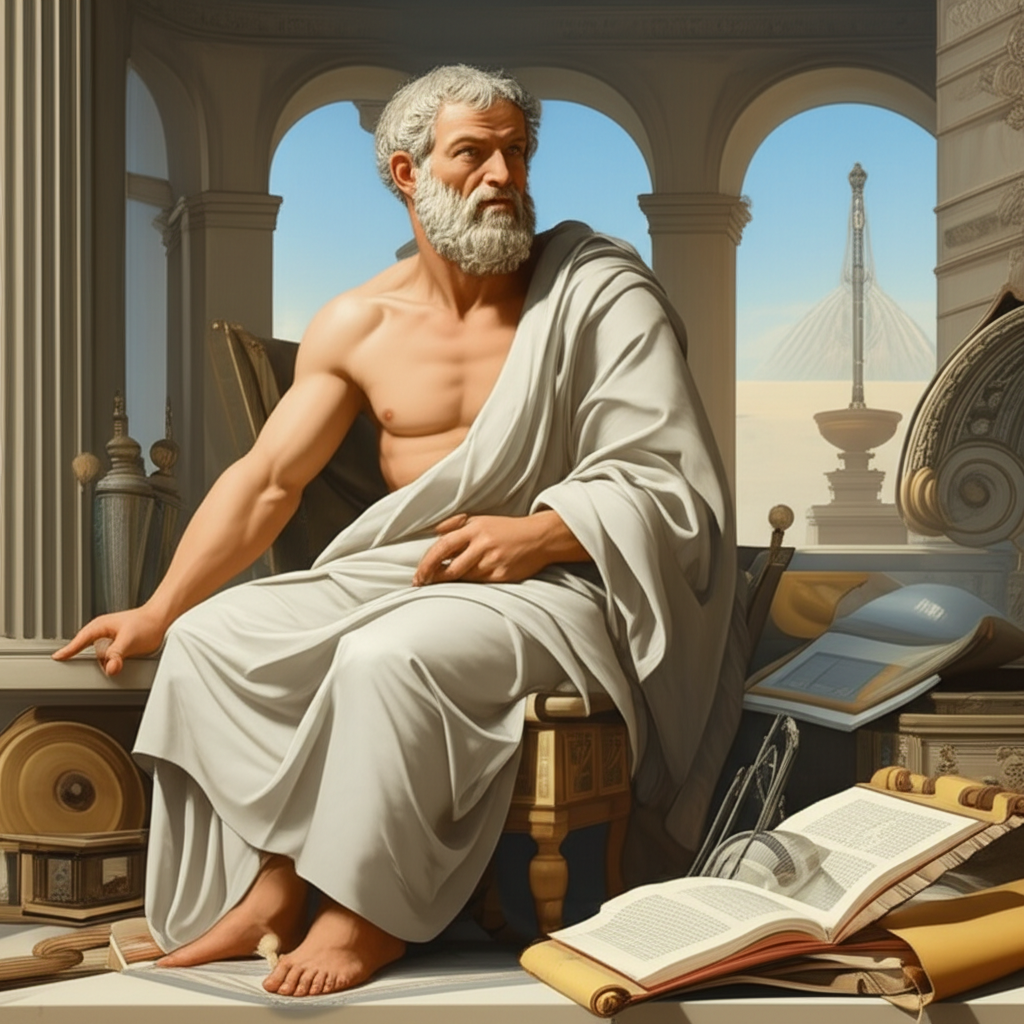
Our journey into the PNC inevitably leads us back to the towering figure of Aristotle. It was the Stagirite philosopher, whose works form a cornerstone of Western thought, who most famously articulated and defended this principle in his Metaphysics. He viewed it not merely as a logical rule, but as the most certain of all principles, one that even those who deny it must implicitly rely upon to make their denial intelligible.
Aristotle argued that if the PNC were false, then everything would be true, and everything would be false. There would be no distinction between being and not being, and thus no stable reality to comprehend. He even posited that one could not think without presupposing it. This isn't just a matter of intellectual convenience; it's about the very possibility of coherent thought.
Why This Principle Is Indispensable for Truth and Reasoning
The significance of the Principle of Non-Contradiction cannot be overstated. It underpins virtually every aspect of our intellectual lives.
The Foundation of All Reasoning
Without the PNC, reasoning would be impossible. Imagine trying to make an argument where your premises could be both true and false at the same time. The conclusion would be meaningless. Every step in a logical deduction, every scientific experiment, every legal argument, and even every casual conversation relies on the assumption that statements have definite truth values that aren't simultaneously contradictory.
Consider a simple argument:
- All men are mortal.
- Socrates is a man.
- Therefore, Socrates is mortal.
This argument works because "Socrates is mortal" and "Socrates is not mortal" cannot both be true simultaneously. If they could, the conclusion would offer no real insight or truth.
Distinguishing Truth from Falsity
The PNC is the ultimate arbiter in distinguishing truth from falsity. If a statement leads to a contradiction, we know it cannot be true. This is why reductio ad absurdum (reduction to absurdity) is such a powerful proof technique: by showing that a proposition implies a contradiction, we can conclude the proposition itself must be false.
| Aspect of Truth | Role of PNC |
|---|---|
| Coherence | Ensures that beliefs and statements form a consistent whole. |
| Clarity | Prevents ambiguity by demanding definite truth values. |
| Objectivity | Allows for shared understanding of reality, as facts cannot contradict themselves. |
| Reliability | Guarantees that valid deductions lead to non-contradictory conclusions. |
Challenges and Its Enduring Strength
While the PNC is widely accepted, some philosophical traditions or specific interpretations of phenomena (like certain aspects of quantum mechanics or dialectical processes) might appear to challenge its absolute applicability. However, upon closer inspection, these apparent challenges often operate within specific contexts or at levels of abstraction that don't fundamentally undermine the principle's core assertion in its proper domain – that of definite being and non-being at the same time and in the same respect.
For instance, a quantum particle might appear to be in multiple states simultaneously, but physicists would argue it's not actually in contradictory states until observed, or that the "states" are not contradictory in the classical sense of "being" and "not being" at the same classical moment. The PNC, in its classical formulation, remains a cornerstone for understanding and communicating about reality.
The Unseen Architect of Our Worldview
From the humblest observation to the most complex philosophical system, the Principle of Non-Contradiction works tirelessly in the background, ensuring the intelligibility of our world. It's the silent guardian of logic, the unwavering standard for truth, and the indispensable guide for all sound reasoning. To deny it is to deny the very possibility of meaningful thought and coherent existence. As we navigate the intricate pathways of philosophy, let us always remember this unshakeable foundation.
YouTube:
-
📹 Related Video: ARISTOTLE ON: The Nicomachean Ethics
Video by: The School of Life
💡 Want different videos? Search YouTube for: "Aristotle Principle of Non-Contradiction Explained"
-
📹 Related Video: What is Philosophy?
Video by: The School of Life
💡 Want different videos? Search YouTube for: "Fundamentals of Logic Truth and Reasoning"