

The Enduring Principle: Navigating Justice in War and Peace
The question of Justice, particularly concerning the realms of War and Peace, stands as one of humanity's most enduring and perplexing philosophical challenges. From the ancient battlefields to modern diplomatic tables, the quest to define, uphold, and apply a guiding Principle of justice has shaped civilizations and driven countless debates. This article delves into the profound philosophical underpinnings of justice in conflict and resolution, drawing upon the rich intellectual heritage preserved within the Great Books of the Western World. It argues that a steadfast commitment to the Principle of justice, understood not merely as legality but as an ethical imperative, forms the bedrock of any truly sustainable Peace and dictates our collective Duty even in the crucible of War.
The Enduring Quest for Justice Amidst Strife
Human history is, in many ways, a testament to the perpetual tension between conflict and cooperation. While the destructive forces of War have repeatedly challenged our ideals, the persistent human aspiration for Peace has equally driven us to seek frameworks for harmonious coexistence. At the heart of this aspiration lies the Principle of Justice. How do we determine what is right when nations clash? What ethical boundaries must be observed even in the most desperate struggles? And what constitutes a just Peace once the fighting ceases? These are not merely academic questions; they are existential inquiries that demand our continuous philosophical engagement, echoing through the works of Thucydides, Augustine, Aquinas, Kant, and many others found within the Great Books.
Foundations of Justice: From Ancient Wisdom to Modern Dilemmas
The concept of Justice itself is multifaceted, evolving through millennia. For Plato, in his Republic, justice was an ideal state of balance and harmony, both within the individual soul and the city-state. Aristotle, in his Nicomachean Ethics, distinguished between distributive and corrective justice, laying the groundwork for how resources are allocated and wrongs are righted. These early philosophical explorations established the fundamental Principle that a well-ordered society, and indeed a well-ordered international community, cannot exist without a robust understanding and application of justice.
The Duty to uphold justice, therefore, emerges not as a mere societal convention, but as a moral imperative. This Duty extends beyond individual actions to the collective responsibilities of states and leaders. The Great Books consistently remind us that power, unchecked by justice, inevitably leads to tyranny and chaos. Thus, the pursuit of justice becomes a foundational Principle for both internal governance and external relations.
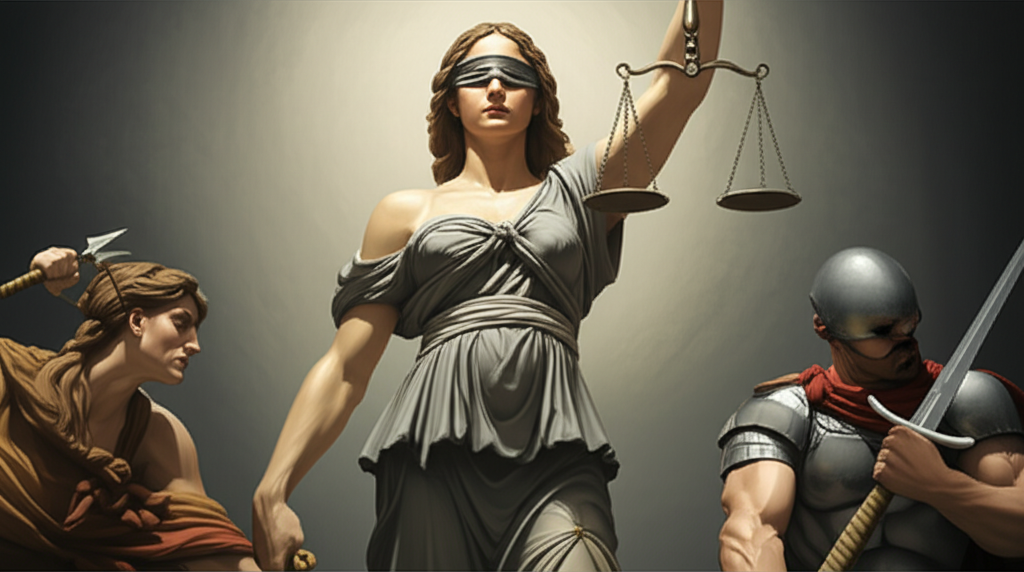 and the other "Peace" (a serene figure with an olive branch), all set against a backdrop of a transitioning landscape from conflict to rebuilding.)
Justice Ad Bellum and In Bello: Navigating the Morality of Conflict
When the specter of War looms, the Principle of Justice becomes critically important, guiding our assessment of when and how armed conflict can be morally permissible. This framework, often referred to as "Just War Theory," has deep roots in Western thought, notably developed by figures like Augustine and refined by Thomas Aquinas, whose ideas are central to the Great Books.
Justice in War (Jus ad Bellum): The Right to Go to War
Jus ad Bellum concerns the conditions under which it is morally justifiable for a state to engage in War. These criteria are not mere suggestions but represent a solemn Duty to exhaust all peaceful alternatives before resorting to violence:
- Just Cause: War must be waged for a morally legitimate reason, typically self-defense against aggression or to prevent grave injustice.
- Legitimate Authority: Only a properly constituted authority (e.g., a sovereign state) can declare war.
- Right Intention: The aim of war must be to achieve a just Peace, not conquest or revenge.
- Proportionality: The anticipated good from going to war must outweigh the expected harm.
- Last Resort: All non-violent options must have been genuinely attempted and failed.
- Reasonable Hope of Success: There must be a realistic chance of achieving the just aims, preventing futile bloodshed.
These principles articulate a profound Duty to consider the gravity of conflict, ensuring that War is never undertaken lightly or for ignoble ends.
Justice in War (Jus in Bello): Right Conduct During War
Even when the decision to go to War is deemed just, the Principle of Justice does not cease to apply. Jus in Bello dictates the moral conduct of combatants during hostilities, emphasizing the Duty to minimize suffering and uphold human dignity amidst the chaos:
- Discrimination (Non-Combatant Immunity): Civilians and non-combatants must not be intentionally targeted. The Duty to distinguish between combatants and non-combatants is paramount.
- Proportionality: The harm inflicted must be proportional to the military advantage gained. Excessive force, even against legitimate targets, is unjust.
- Military Necessity: Actions must be necessary to achieve a legitimate military objective. Wanton destruction is prohibited.
These rules underscore the idea that even in War, there are moral boundaries. The Principle of humanity must prevail, and the Duty to adhere to ethical conduct remains, even when faced with an adversary.
The Architecture of Peace: Forging a Just Resolution
The cessation of hostilities does not automatically usher in true Peace. For Peace to be enduring and meaningful, it must be founded upon the Principle of Justice. The post-conflict phase, often termed Jus Post Bellum, demands careful consideration of how to heal divisions, rebuild societies, and ensure accountability.
- Reconstruction and Reparations: The Duty to assist in the rebuilding of war-torn societies and to offer appropriate reparations for damages inflicted, particularly by the aggressor, is a crucial aspect of restorative justice.
- Accountability: Holding individuals and states accountable for war crimes and crimes against humanity reinforces the Principle that even leaders are subject to moral and legal standards.
- Reconciliation: True Peace often requires processes of truth-telling, forgiveness, and reconciliation to mend deeply fractured communities. This is perhaps the most challenging Duty, demanding profound empathy and a long-term commitment.
The Great Books offer numerous reflections on the fragility of peace and the difficulty of establishing a just order after conflict. From the peace treaties of ancient Greece to the philosophical visions of perpetual peace, the message is clear: Peace is not merely the absence of War, but the active presence of Justice.
Conclusion: The Perpetual Duty to Uphold the Principle of Justice
The Principle of Justice in War and Peace is not a static dogma but a dynamic and evolving framework that demands continuous reflection and application. It is a testament to humanity's persistent struggle to reconcile the brutal realities of conflict with our highest moral aspirations. The works compiled in the Great Books of the Western World provide an invaluable resource for this ongoing inquiry, offering profound insights into the nature of justice, the ethics of warfare, and the pathways to lasting peace.
Our collective Duty remains clear: to tirelessly champion the Principle of Justice in all our endeavors, recognizing that only through its steadfast application can we hope to mitigate the horrors of War and build a truly equitable and sustainable Peace for generations to come. This is not a task for governments alone, but a fundamental responsibility for every thinking individual committed to the betterment of our shared human experience.
**## 📹 Related Video: KANT ON: What is Enlightenment?
Video by: The School of Life
💡 Want different videos? Search YouTube for: ""Just War Theory Explained" and "Philosophical Foundations of International Justice""**