

The Unseen Hand: Unraveling Cause and Effect in the Mechanical Universe
At the heart of our understanding of the physical world lies the profound Principle of Cause and Effect. This fundamental concept, deeply embedded in both our intuitive grasp of reality and the rigorous framework of Mechanics and Physics, posits that every event is the inevitable outcome of prior conditions. From the celestial ballet of planets to the simple push of a lever, this Principle provides the very bedrock upon which scientific inquiry and philosophical contemplation are built, offering a lens through which we seek to understand the universe's intricate workings. It is the silent, pervasive logic that underpins our attempts to predict, explain, and ultimately, comprehend the cosmos.
The Inescapable Logic: Defining the Principle
The Principle of Cause and Effect asserts that nothing simply "happens" without a preceding trigger. Every effect has a cause, and every cause necessarily leads to an effect. This isn't merely an observation; it's a foundational assumption that allows us to make sense of a chaotic world, transforming it into a predictable system.
Historically, this Principle has captivated thinkers for millennia. From the ancient Greeks, whose philosophical inquiries into the nature of motion and change laid the groundwork for future scientific thought, to the Enlightenment philosophers who sought to codify natural laws, the idea of an ordered, causal universe has been paramount. Aristotle, in his exploration of causality, famously categorized causes into four types—material, formal, efficient, and final—providing a comprehensive framework for understanding why things are the way they are. While modern Physics primarily focuses on the "efficient cause" (that which directly brings about the effect), Aristotle's broader scope highlights the deep philosophical roots of this fundamental idea.
Classical Mechanics: A Clockwork Universe
It is in the realm of classical Mechanics that the Principle of Cause and Effect finds its most elegant and powerful expression. Isaac Newton's laws of motion, formulated in his Principia Mathematica, represent the zenith of this causal framework.
Consider Newton's three laws:
- Law of Inertia: An object at rest stays at rest, and an object in motion stays in motion with the same speed and in the same direction unless acted upon by an unbalanced force. Here, force is the cause of a change in motion.
- Law of Acceleration: The acceleration of an object as produced by a net force is directly proportional to the magnitude of the net force, in the same direction as the net force, and inversely proportional to the mass of the object (F=ma). This law precisely quantifies how a cause (force) leads to an effect (acceleration).
- Law of Action-Reaction: For every action, there is an equal and opposite reaction. This illustrates a symmetrical causal relationship, where one force (action) immediately triggers another (reaction).
These laws, together with Newton's law of universal gravitation, describe a universe that operates like a grand, intricate clockwork. Given the initial positions and velocities of all particles, and the forces acting upon them, the future state of the system can, in principle, be perfectly predicted. This concept of determinism is a direct outgrowth of the Principle of Cause and Effect in classical Physics. Every planetary orbit, every projectile's trajectory, every impact of billiard balls—all are seen as the inevitable consequences of preceding physical interactions.
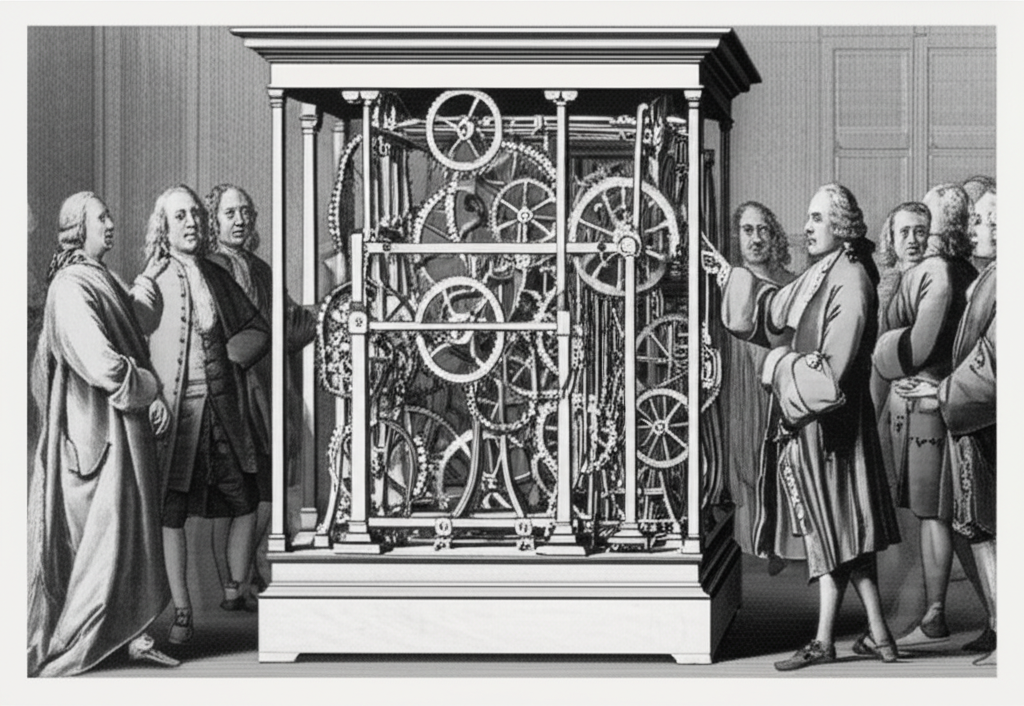
The Philosophical Crucible: Doubts and Affirmations
While the scientific success of classical Mechanics seemed to affirm the Principle of Cause and Effect unequivocally, philosophical inquiry continued to probe its very nature.
David Hume's Skepticism: The Scottish philosopher David Hume famously challenged the notion of a necessary connection between cause and effect. In his An Enquiry Concerning Human Understanding, Hume argued that we never truly observe causality itself, but only a constant conjunction of events. We see one event (the cause) consistently followed by another (the effect), and through repeated experience, we form an expectation that this pattern will continue. However, this expectation, Hume contended, is a psychological habit, not an inherent logical necessity. We cannot rationally prove that the sun must rise tomorrow; we only expect it because it always has.
Immanuel Kant's Synthesis: Immanuel Kant responded to Hume's challenge by arguing that causality is not merely an empirical observation but a fundamental category of understanding that the mind imposes on experience. In his Critique of Pure Reason, Kant posited that our minds are structured in such a way that we cannot experience an objective world without organizing it causally. The Principle of Cause and Effect is, for Kant, an a priori truth, a necessary precondition for coherent experience, rather than something we derive solely from experience. Without it, our world would be an unintelligible succession of unrelated events.
These philosophical debates, though abstract, profoundly impact how we interpret the findings of Physics. They force us to consider whether causality is an intrinsic feature of reality, a product of our minds, or merely a useful descriptive tool.
The Enduring Relevance in Modern Physics
Even as modern Physics ventures beyond the strictly deterministic world of classical Mechanics into the probabilistic realm of quantum mechanics, the Principle of Cause and Effect retains its profound significance. While quantum events may not be predictable with absolute certainty, they are still understood as having antecedent conditions that influence the probability of outcomes. The very design of experiments and the search for fundamental laws in Physics are predicated on the assumption that there are underlying causal relationships to be uncovered.
The Principle of Cause and Effect is not just a scientific tool; it is a profound philosophical statement about the orderliness and intelligibility of the universe. It underpins our ability to learn, to innovate, and to build a coherent understanding of the world around us. From the simplest act of pushing a button to the grandest theories of cosmic evolution, the unseen hand of causality guides our inquiry, urging us to seek the "why" behind every "what."
Key Philosophical Perspectives on Causality:
- Aristotle: Introduced the Four Causes (Material, Formal, Efficient, Final) as a comprehensive framework for explaining phenomena.
- David Hume: Argued that we observe only constant conjunction of events, not a necessary connection, challenging the rational basis of causality.
- Immanuel Kant: Proposed that causality is an a priori category of human understanding, a necessary condition for experiencing an objective world.
📹 Related Video: KANT ON: What is Enlightenment?
Video by: The School of Life
💡 Want different videos? Search YouTube for: ""Hume on Causality Explained""
📹 Related Video: What is Philosophy?
Video by: The School of Life
💡 Want different videos? Search YouTube for: ""Newtonian Mechanics Determinism Philosophy""