

The Unseen Hand: The Principle of Cause and Effect in Mechanics
The Principle of Cause and Effect is arguably one of the most fundamental tenets underpinning our understanding of the universe, particularly within the realm of Mechanics and Physics. At its core, this Principle posits that every event, or "effect," is the inevitable outcome of one or more preceding events, or "causes." In the structured world of classical mechanics, this translates into a predictable, deterministic universe where the past dictates the future, allowing us to not only explain what has happened but also to forecast what will happen next. This article delves into the historical philosophical underpinnings and practical applications of this indispensable Principle within the physical world, exploring its profound implications for how we perceive reality.
The Grand Tapestry of Causality: From Ancient Wisdom to Modern Physics
Our journey into the Principle of Cause and Effect begins not in a laboratory, but in the contemplative halls of ancient philosophy. From the earliest inquiries into the nature of reality, thinkers have sought to understand why things happen. The Great Books of the Western World reveal a consistent thread: the human mind's innate drive to connect events in a meaningful sequence.
- Aristotle's Four Causes: While distinct from the modern scientific understanding, Aristotle's articulation of material, formal, efficient, and final causes laid foundational groundwork. His "efficient cause" – that which brings something about – is the closest ancestor to our contemporary notion of a cause in physics, describing the agent or action responsible for a change.
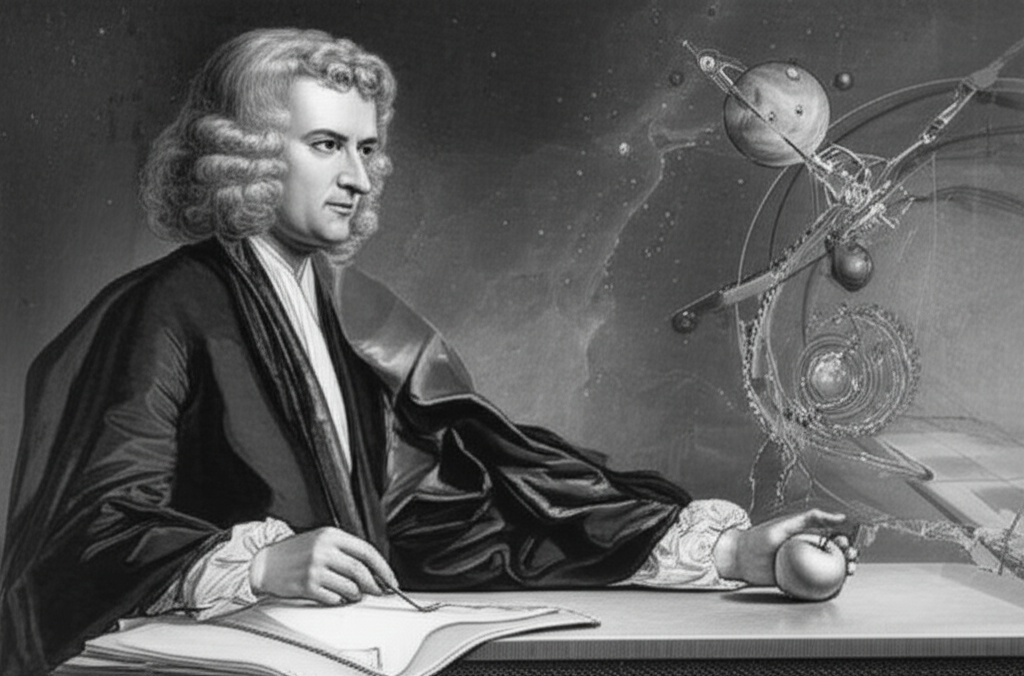
- The Enlightenment and Mechanistic Worldview: With the scientific revolution, particularly championed by figures like René Descartes and Isaac Newton, the Principle of Cause and Effect truly found its home in mechanics. The universe began to be seen as a grand, intricate machine, where every gear turn, every lever push, had a direct, predictable consequence.
This shift from teleological (purpose-driven) explanations to efficient, mechanistic ones was revolutionary. It empowered scientists to formulate laws that didn't just describe phenomena but explained their causes.
Cause and Effect in Classical Mechanics: A Predictable Universe
In classical mechanics, the Principle of Cause and Effect is not merely a philosophical concept; it's an operational framework. Newton's Laws of Motion are perhaps the most eloquent expressions of this Principle.
- Newton's First Law (Inertia): An object at rest stays at rest and an object in motion stays in motion with the same speed and in the same direction unless acted upon by an unbalanced force. Here, the "unbalanced force" is the cause that changes the state of motion (the effect).
- Newton's Second Law (F=ma): The force acting on an object is equal to the mass of that object times its acceleration. This is a direct causal relationship: apply a force (cause), and you get an acceleration (effect) proportional to the force and inversely proportional to the mass.
- Newton's Third Law (Action-Reaction): For every action, there is an equal and opposite reaction. While often seen as simultaneous, it still describes a pair of causally linked events. One force (action) causes the other (reaction).
Illustrative Example: The Billiard Table
Consider a game of billiards. When the cue ball strikes another ball, the sequence of events is a perfect demonstration of the Principle of Cause and Effect in mechanics:
| Cause | Effect | Relevant Principle / Law |
|---|---|---|
| Cue stick applies force to cue ball. | Cue ball accelerates and moves. | Newton's Second Law |
| Cue ball collides with object ball. | Cue ball changes direction/speed; object ball moves. | Conservation of Momentum and Energy, Newton's Laws |
| Object ball hits cushion. | Object ball bounces off cushion. | Elastic collision, Newton's Third Law |
| Object ball enters pocket. | Object ball is removed from play. | Gravitational force, design of the table |
Each action directly leads to a subsequent reaction, creating a chain of events that is entirely predictable given sufficient information about the initial conditions and forces involved. This deterministic view of the universe, where every outcome is precisely determined by its antecedent causes, became a cornerstone of scientific thought for centuries.
Philosophical Echoes and Modern Quandaries
While the Principle of Cause and Effect in mechanics seems straightforward, its philosophical implications are profound and have been debated vigorously.
- Hume's Skepticism: David Hume, another luminary from the Great Books, famously challenged the idea of a necessary connection between cause and effect. He argued that we only ever observe constant conjunction – one event consistently following another – but never the inherent "power" or "necessity" that binds them. Our belief in causality, he suggested, is a habit of mind, not an empirical certainty.
- Determinism vs. Free Will: The absolute predictability implied by a strict causal Principle in mechanics raises questions about free will. If every action is predetermined by prior causes, where does human choice fit in?
- Quantum Mechanics and the Limits: Modern physics, particularly quantum mechanics, introduces complexities that challenge the classical deterministic view. At the subatomic level, events often appear probabilistic rather than strictly causal. While the Principle holds true in the macroscopic world of classical mechanics, the quantum realm suggests a more nuanced, perhaps less rigidly deterministic, reality. This doesn't negate causality but refines our understanding of its domain and nature.
The Enduring Significance of the Principle
Despite philosophical challenges and quantum revelations, the Principle of Cause and Effect remains indispensable, especially in mechanics and our everyday understanding of the world. It provides the framework for scientific inquiry, engineering innovation, and even our basic ability to navigate reality. We instinctively understand that dropping a glass causes it to break, and that pushing a swing causes it to move. This fundamental Principle allows us to build explanations, make predictions, and ultimately, to shape our environment. It is the unseen hand guiding our understanding of how the universe works, from the simplest lever to the most complex celestial mechanics.
📹 Related Video: What is Philosophy?
Video by: The School of Life
💡 Want different videos? Search YouTube for: ""David Hume on Cause and Effect Philosophy" or "Newton's Laws of Motion Explained Simply""