

The Unseen Threads: Exploring the Principle of Cause and Effect in Mechanics
A Foundation Stone of Understanding
The Principle of Cause and Effect stands as one of the most fundamental tenets underpinning our understanding of the universe, particularly within the realm of mechanics and physics. It posits that every event, or "effect," is the inevitable outcome of a preceding event, or "cause." This article delves into this profound principle, exploring its philosophical origins, its indispensable role in classical mechanics, and how it shapes our perception of a predictable and ordered cosmos. From the grand cosmic dance to the simplest interactions, causality provides the logical framework through which we interpret the world, enabling us to predict, explain, and ultimately harness the forces around us.
Tracing the Philosophical Lineage of Causality
Long before the advent of modern science, philosophers grappled with the notion of cause and effect, seeking to understand the underlying mechanisms that govern existence. The Great Books of the Western World offer a rich tapestry of these inquiries, revealing a consistent human endeavor to connect phenomena.
From Ancient Wisdom to Modern Science: The Great Books Perspective
- Aristotle, in his Physics and Metaphysics, meticulously outlined his famous four causes: the material, formal, efficient, and final. While broader than the modern scientific understanding, his "efficient cause" directly aligns with our concept of a preceding agent that brings about a change or motion. For Aristotle, understanding something meant understanding its causes.
- René Descartes, a pivotal figure in modern philosophy and science, championed a mechanistic view of the universe in works like Discourse on Method. He saw the physical world as a vast machine, governed by precise, quantifiable laws where every motion had a distinct cause. This laid crucial groundwork for the scientific revolution.
- The Enlightenment thinkers, building on these foundations, increasingly sought to apply rational and empirical methods to uncover these causal links, particularly in the physical world. This intellectual lineage culminated in the groundbreaking work of Isaac Newton.
The Principle of Cause and Effect in Classical Mechanics
It is within classical mechanics that the Principle of Cause and Effect finds its most explicit and powerful expression. Here, the relationship between cause and effect becomes quantifiable, predictable, and foundational to the entire discipline of physics.
Newton's Clockwork Universe: Determinism and Predictability
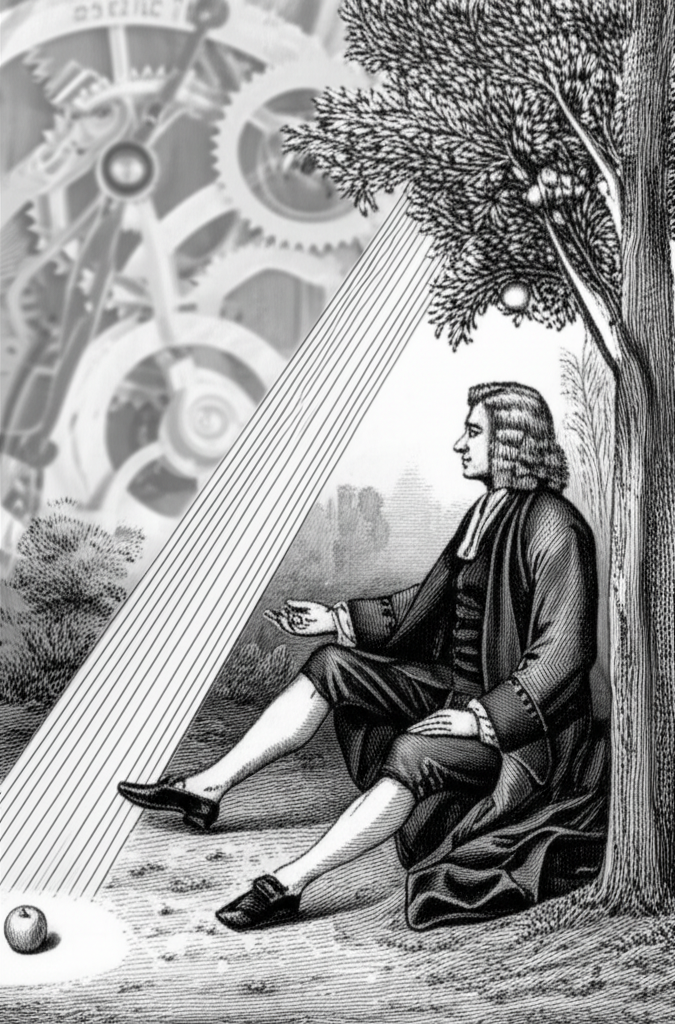
Sir Isaac Newton's laws of motion, detailed in his Principia Mathematica, provided the mathematical framework for understanding how forces cause motion. His second law, F = ma (Force equals mass times acceleration), is the quintessential statement of causality in physics.
- Force (F) is the cause – an external influence acting upon an object.
- Mass (m) is the inherent property of the object resisting change.
- Acceleration (a) is the effect – the resulting change in the object's velocity.
This equation demonstrates a direct and proportional relationship: apply a force, and an object will accelerate. Remove the force, and the acceleration ceases (or changes). This deterministic view of the universe suggested that if one knew the initial conditions and all the forces at play, the future state of any system could, in theory, be perfectly predicted. This gave rise to the metaphor of the "clockwork universe," a grand machine operating on predictable causal chains.
The Indispensable Role of Forces: How Causes Manifest
In mechanics, causes are primarily understood through the concept of forces. Whether it's gravity pulling an apple, friction slowing a rolling ball, or the tension in a rope, forces are the agents that initiate or alter motion.
Consider these examples of the Principle in action:
- Gravity: The mass of the Earth (cause) exerts a gravitational force on the moon (effect), keeping it in orbit. Without this force, the moon would fly off into space.
- Collisions: When a billiard ball strikes another (cause), it transfers momentum, causing the second ball to move (effect), while its own motion is altered. Newton's third law ("for every action, there is an equal and opposite reaction") beautifully illustrates the reciprocal nature of these causal interactions.
- Engine Power: The combustion of fuel in an engine (cause) creates expanding gases that push pistons (effect), ultimately driving a vehicle.
- Friction: The roughness between two surfaces (cause) generates a resistive force that slows down or prevents motion (effect).
These examples highlight how the Principle of Cause and Effect is not merely an abstract philosophical idea, but the very language through which we describe and analyze physical phenomena.
Beyond the Predictable: Nuances and Further Inquiry
While the Principle of Cause and Effect remains paramount in classical mechanics, it's important to acknowledge that modern physics, particularly quantum mechanics, introduces complexities that challenge a purely deterministic worldview at the subatomic level. Here, probabilities often replace certainties, and the very act of observation can influence the outcome. However, for the macroscopic world that we experience and engineer, the classical understanding of causality provides an incredibly robust and accurate framework.
Conclusion: A Guiding Light in the Cosmos
The Principle of Cause and Effect is more than just a scientific law; it is a fundamental mode of human thought, a lens through which we seek order and meaning in the universe. From the ancient philosophers who first pondered the "why" behind events, to the Newtonian scientists who quantified the "how," this enduring principle has been a guiding light. In mechanics, it provides the bedrock for understanding motion, forces, and energy, enabling us to build bridges, launch rockets, and predict the celestial ballet. It reminds us that the universe, at its most tangible level, is a tapestry woven with discernible threads of action and reaction, a testament to an underlying, comprehensible order.
📹 Related Video: ARISTOTLE ON: The Nicomachean Ethics
Video by: The School of Life
💡 Want different videos? Search YouTube for: ""Aristotle's Four Causes explained philosophy""
📹 Related Video: PLATO ON: The Allegory of the Cave
Video by: The School of Life
💡 Want different videos? Search YouTube for: ""Newton's Laws of Motion causality physics""