

The Unseen Hand: Unraveling the Principle of Cause and Effect in Mechanics
The universe, in its grand and intricate dance, often appears as a sequence of events unfolding with an undeniable logic. At the heart of our ability to comprehend this cosmic ballet lies a fundamental truth: the Principle of Cause and Effect. This isn't merely a scientific hypothesis; it's a bedrock assumption woven into the very fabric of our understanding, particularly evident in the predictable world of Mechanics. From the smallest interaction to the grandest celestial movements, every action, every change, seems to have a preceding impetus. This article explores how this essential Principle underpins our scientific inquiries and philosophical reflections, offering a glimpse into the structured beauty of Physics.
The Enduring Principle of Causality: A Philosophical Anchor
For millennia, thinkers have wrestled with the notion that nothing happens without a reason. The Principle of Cause and Effect, in its most basic form, posits that every event or state of affairs (the effect) is the inevitable outcome of a preceding event or state (the cause). This idea isn't a modern invention; it's a profound philosophical legacy.
Ancient Greek philosophers, as documented in the Great Books of the Western World, meticulously explored causality. Aristotle, for instance, articulated four distinct types of causes – material, formal, efficient, and final – to fully explain why something exists or changes. While all are crucial for a complete understanding, it is the efficient cause that most closely aligns with the modern scientific understanding of cause and effect: the primary source of the change or motion. A sculptor's hands are the efficient cause of a statue taking shape. This foundational concept underpins our very capacity to make sense of the world, allowing us to ask "why?" and seek meaningful answers. Without this Principle, the universe would be an incomprehensible chaos of random occurrences.
Mechanics as a Testament to Causal Chains
Nowhere is the Principle of Cause and Effect more vividly demonstrated and rigorously applied than in the realm of Mechanics. This branch of Physics deals with the motion of physical objects under the influence of forces. Here, causes and effects are often quantifiable, observable, and remarkably predictable.
Consider the foundational laws laid down by Isaac Newton, also a towering figure in the Great Books. His three laws of motion are essentially an eloquent articulation of causality in the physical world:
- Newton's First Law (Inertia): An object at rest stays at rest and an object in motion stays in motion with the same speed and in the same direction unless acted upon by an unbalanced force. The "unbalanced force" is the cause of a change in motion (the effect).
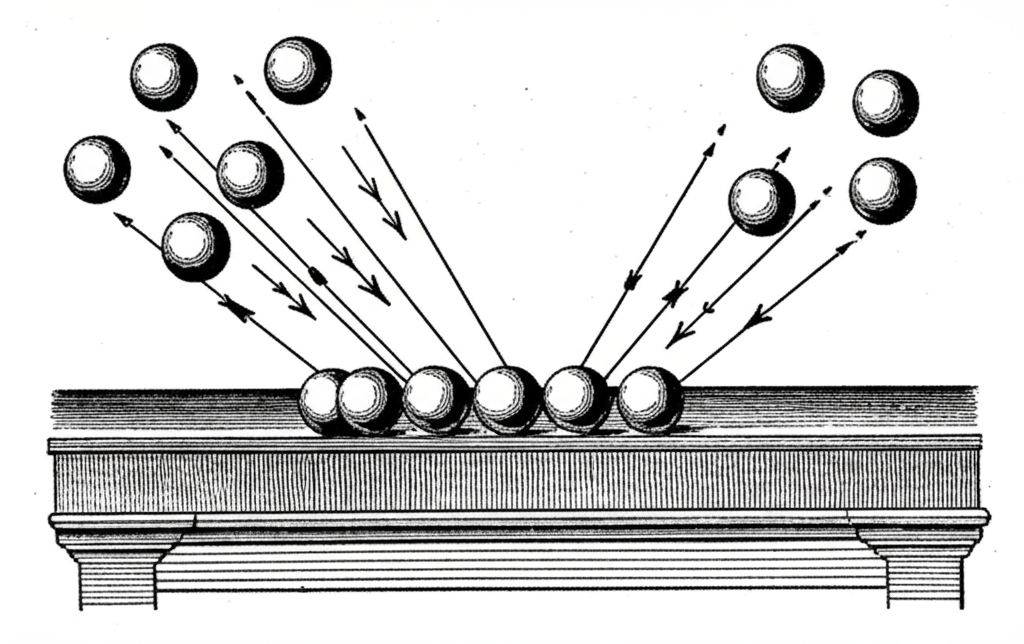
- Newton's Second Law (F=ma): The acceleration of an object is directly proportional to the net force acting on it and inversely proportional to its mass. Here, force (F) is the direct cause of acceleration (a), modulated by mass (m). Apply a greater force, and you get a greater acceleration – a direct causal link.
- Newton's Third Law (Action-Reaction): For every action, there is an equal and opposite reaction. While this describes interacting forces, it implicitly speaks to how one action (cause) immediately generates a corresponding reaction (effect).
These laws allow engineers to design bridges, physicists to predict planetary orbits, and even a child to understand why a thrown ball follows a specific trajectory. The ability to predict future states from current conditions is a direct consequence of our faith in consistent causal relationships.
From Predictability to Philosophical Inquiry: The Reach of Physics
The success of Physics in explaining and predicting phenomena has profoundly influenced our philosophical outlook. The consistent application of the Principle of Cause and Effect in Mechanics suggests a universe that is orderly, deterministic, and fundamentally intelligible. This worldview, often termed "mechanistic," posits that if we knew all the initial conditions and all the laws, we could predict the future with absolute certainty.
However, this very predictability also sparks deeper questions. Does strict causality in the physical world imply a lack of free will for conscious beings? While classical Mechanics paints a picture of clockwork precision, other areas of Physics, like quantum mechanics, introduce elements of probability and uncertainty, challenging simplistic deterministic views. Yet, even in the quantum realm, the search for underlying causal mechanisms, albeit probabilistic ones, continues. The Principle remains a guiding beacon, even when its manifestations become more subtle or complex.
Reflections on the Nature of Reality
Ultimately, the Principle of Cause and Effect in Mechanics is more than a scientific tool; it's a lens through which we perceive and interact with reality. It speaks to an inherent order in the cosmos, an elegant dance where every step is informed by the one that came before. It empowers us not just to observe, but to understand, to predict, and even to shape our environment. This fundamental Principle allows us to not only appreciate the intricate workings of the physical world but also to ponder our place within its grand, causal tapestry.
Further Exploration:
-
📹 Related Video: ARISTOTLE ON: The Nicomachean Ethics
Video by: The School of Life
💡 Want different videos? Search YouTube for: "Aristotle Four Causes Explained"
-
📹 Related Video: PLATO ON: The Allegory of the Cave
Video by: The School of Life
💡 Want different videos? Search YouTube for: "Newton's Laws of Motion Explained Simply"