

The Eloquent Architect: How Rhetoric Shapes the Soul of Democracy
In the vibrant, often tumultuous theater of democratic governance, few forces wield as much subtle yet profound influence as rhetoric. Far from being mere ornate speech, rhetoric is the fundamental art of persuasion, the very language through which ideas are articulated, debated, and ultimately, transformed into collective opinion and public policy. It is the unseen architect of our shared understanding, capable of both elevating discourse to reasoned deliberation and debasing it into manipulative demagoguery. This article explores rhetoric's indispensable, often perilous, role in shaping the democratic experiment, drawing insights from the enduring philosophical inquiries that have grappled with its power since antiquity.
The Unseen Architect of Collective Thought
Rhetoric, at its core, is the strategic use of language to achieve a particular effect on an audience. In a democracy, where the will of the people is paramount, the ability to persuade, to articulate a vision, and to mobilize consensus is not merely advantageous; it is essential. From the ancient Greek agora to modern parliamentary debates, the skillful deployment of words has been the primary tool for leaders to convey policies, for movements to rally support, and for citizens to express their grievances and aspirations. It is through rhetoric that complex issues are framed, values are invoked, and the very fabric of public opinion is woven.
Rhetoric's Dual Nature: Persuasion and Manipulation
The power of rhetoric is inherently a double-edged sword, capable of both enlightenment and deception.
The Constructive Force: Building Consensus and Clarity
- Informing the Electorate: Effective rhetoric simplifies complex ideas, making them accessible to a broad public, fostering an informed citizenry crucial for a functioning democracy.
- Mobilizing for Change: It inspires action, rallying individuals around shared ideals and causes, from civil rights movements to environmental advocacy.
- Articulating Diverse Opinions: Rhetoric provides the framework for individuals and groups to voice their perspectives, ensuring that a multitude of opinions can enter the public discourse.
- Facilitating Deliberation: When used ethically, rhetoric encourages reasoned debate, presenting arguments with logical coherence (logos), establishing credibility (ethos), and connecting with the audience's values (pathos).
The Destructive Potential: Demagoguery and Deception
Conversely, the same tools of persuasion can be weaponized:
- Emotional Manipulation: Exploiting fears, prejudices, or desires to bypass rational thought, leading to impulsive or uninformed decisions.
- Misinformation and Disinformation: Crafting narratives that distort truth or spread falsehoods, undermining trust in institutions and facts.
- Demagoguery: The rise of leaders who appeal to popular prejudices and false claims to gain power, often at the expense of sound governance and democratic principles.
- Erosion of Trust: When rhetoric consistently prioritizes winning over truth, it degrades the quality of public discourse and fosters cynicism.
The Democratic Arena: Where Language Shapes Destiny
In a democracy, the public sphere is a marketplace of ideas, and language is the currency. Political speeches, media commentaries, social justice campaigns, and even everyday conversations are all arenas where rhetoric is actively shaping our collective reality. The choice of words, the metaphors employed, the narratives constructed—all contribute to how issues are perceived and how opinion is formed.
Consider the framing of an economic policy: one rhetorical approach might emphasize "fiscal responsibility" and "market freedom," while another might highlight "social equity" and "worker protection." Each frame, through its specific language, seeks to activate different values and elicit different emotional responses from the audience, guiding their opinion toward a particular conclusion. This ongoing contest of linguistic framing is central to the dynamic nature of democratic politics.
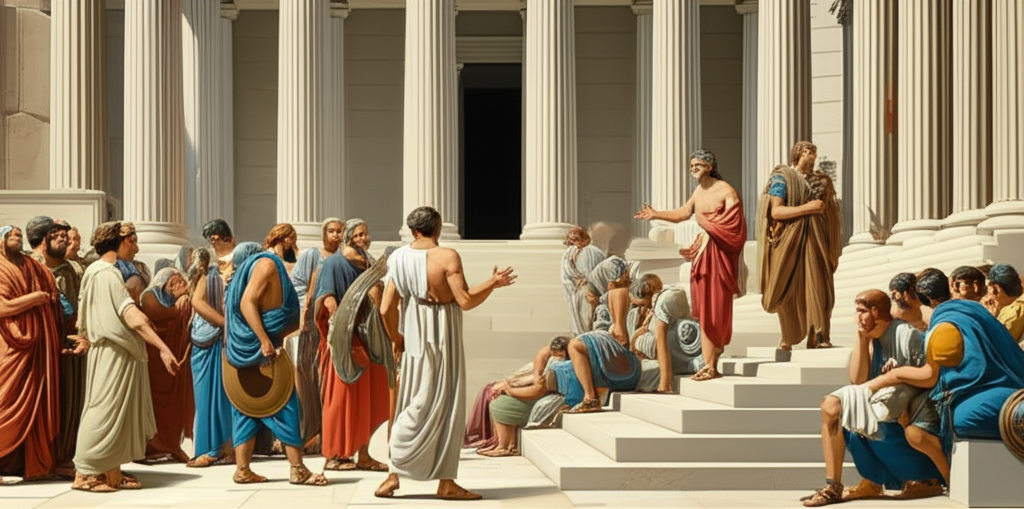
A Philosophical Lineage: From Plato to the Modern Age
The profound implications of rhetoric have been a cornerstone of Western philosophical inquiry, particularly illuminated within the Great Books of the Western World. Ancient Greek thinkers grappled intensely with its ethical dimensions:
- Plato's Skepticism: In dialogues like Gorgias, Plato, through Socrates, famously expressed deep suspicion of rhetoric, viewing it often as a mere "knack" for flattery, concerned with appearance over truth, and capable of leading the populace astray. For Plato, true knowledge (episteme) was superior to mere belief (doxa), and rhetoric, if unchecked, could easily manipulate belief without regard for truth.
- Aristotle's Pragmatism: In contrast, Aristotle, in his seminal work Rhetoric, offered a more systematic and nuanced analysis. He saw rhetoric as an art that, while capable of misuse, was ethically neutral—a tool that could be employed for noble or ignoble purposes. He meticulously dissected its components: logos (logic), pathos (emotion), and ethos (character/credibility), arguing that effective and ethical persuasion integrates all three. For Aristotle, rhetoric was indispensable for civic life and the pursuit of justice in a democracy.
These ancient debates resonate powerfully today. In our media-saturated world, where information spreads instantaneously and persuasive appeals bombard us from every angle, understanding the mechanics of rhetoric is more critical than ever for maintaining a robust democracy.
Cultivating a Discerning Citizenry: The Antidote to Rhetorical Abuse
To safeguard democracy against the potential abuses of rhetoric, a vigilant and discerning citizenry is paramount. This requires not just intellectual capacity, but a commitment to critical engagement with the language that shapes our world.
Here are ways to foster a more discerning approach:
- Question the Source and Intent: Who is speaking? What are their motives? What do they stand to gain or lose?
- Identify Rhetorical Devices: Recognize common persuasive techniques like appeals to emotion, logical fallacies, metaphors, analogies, and loaded language.
- Seek Diverse Perspectives: Actively expose oneself to a range of opinions and arguments, rather than remaining in an echo chamber.
- Evaluate Evidence: Distinguish between assertions, opinions, and verifiable facts. Demand evidence for claims.
- Understand Underlying Values: Recognize the values and assumptions embedded in the rhetoric being presented.
The power of rhetoric in a democracy is undeniable. It is the very breath of public discourse, shaping opinion and directing collective action. By understanding its mechanisms, acknowledging its dual nature, and committing to critical engagement with language, we can strive to harness its immense power for the betterment of our societies, ensuring that the eloquent architect builds foundations of truth, reason, and genuine progress.
YouTube Video Suggestions:
- "Plato's Gorgias: On Rhetoric and the Good Life Explained"
- "Aristotle's Rhetoric: Ethos, Pathos, Logos in Action"
📹 Related Video: What is Philosophy?
Video by: The School of Life
💡 Want different videos? Search YouTube for: "The Power of Rhetoric in Democracy philosophy"