

The Unseen Architect: Rhetoric's Enduring Power in Democracy
Summary: In any vibrant democracy, rhetoric is not merely an optional flourish but a fundamental, often invisible, force that shapes public opinion, drives discourse, and ultimately influences governance. Far from being just empty words, rhetoric is the art of persuasion through language, a potent tool capable of both illuminating truth and obscuring it. Understanding its mechanisms, from the ancient agora to modern digital forums, is crucial for any citizen wishing to navigate the complex currents of a self-governing society.
The Unavoidable Art: When Words Become Power
From the foundational dialogues of ancient Greece to the cacophony of contemporary political debate, the power of rhetoric has remained an indispensable, if often controversial, element of human society, particularly within the framework of democracy. It is the very essence of how ideas are communicated, debated, and ultimately adopted or rejected by the collective. For us at planksip, exploring this deep-seated connection reveals much about the nature of our shared reality and the mechanisms by which our opinions are forged.
Consider the democratic ideal: a marketplace of ideas where the best arguments prevail, leading to just and rational decisions. But how are these "best arguments" presented? Through the art and science of rhetoric. It is the skillful deployment of language to inform, to persuade, and to move an audience, whether that audience is a jury, a legislative body, or the entire citizenry. The Great Books of the Western World are replete with examples and analyses of this power, from Plato’s skeptical critiques to Aristotle’s pragmatic treatise.
Rhetoric's Dual Nature: A Philosophical Conundrum
The philosophical tradition has long grappled with the inherent duality of rhetoric. Is it a noble pursuit, essential for the propagation of truth, or a dangerous art, capable of manipulating the masses with sophistry and deceit?
- The Socratic Critique: Plato, through characters like Socrates in works such as Gorgias and Phaedrus, expressed profound skepticism. For Plato, rhetoric, especially when practiced by the Sophists, was often a form of flattery, a means to create belief without knowledge, obscuring genuine truth. It appealed to emotions rather than reason, leading to a superficial consensus rather than true understanding.
- Aristotle's Pragmatic View: Aristotle, in his seminal work Rhetoric, offered a more systematic and nuanced perspective. He saw rhetoric not as inherently good or evil, but as a neutral art, a counterpart to dialectic. It was a tool, and like any tool, its moral value depended on the user's intent. Aristotle meticulously categorized the appeals of persuasion:
- Ethos: The speaker's credibility or character.
- Pathos: The appeal to the audience's emotions.
- Logos: The appeal to logic and reason.
Aristotle believed that in a democracy, where decisions are made through public deliberation, the ability to persuade effectively was not just useful but necessary. However, he stressed the ethical responsibility of the rhetorician to use these tools for just ends, emphasizing that logos should always be the foundation.
Language as the Crucible of Opinion in Democracy
In a democracy, the shared space for deliberation is built on language. It is through words that policies are proposed, grievances are aired, and visions for the future are articulated. The power of rhetoric lies precisely in its capacity to shape collective opinion by framing issues, evoking shared values, and constructing narratives that resonate with the public.
Consider these facets of rhetoric's role in shaping opinion:
- Framing: How an issue is presented significantly impacts how it is perceived. Is a new tax described as a "burden on the working class" or an "investment in our future"? The choice of language is rhetorical, designed to elicit a specific emotional and intellectual response.
- Narrative Construction: Humans are storytellers. Political campaigns often construct compelling narratives about a nation's past, present, and future. These narratives, crafted with rhetorical skill, aim to unify diverse groups under a common banner, influencing their collective opinion and electoral choices.
- Emotional Appeals (Pathos): While often viewed with suspicion, appeals to emotion are a powerful and often legitimate part of democratic discourse. A call for empathy towards a marginalized group, or an appeal to patriotism in times of crisis, can galvanize action. The ethical challenge lies in ensuring these appeals do not override rational consideration.
The Modern Democratic Landscape: Echoes of Antiquity
The fundamental principles laid out by ancient philosophers regarding rhetoric are startlingly relevant today. While the mediums have changed from the Athenian assembly to broadcast media and digital platforms, the core challenge remains: how do citizens discern truth amidst a deluge of persuasive language?
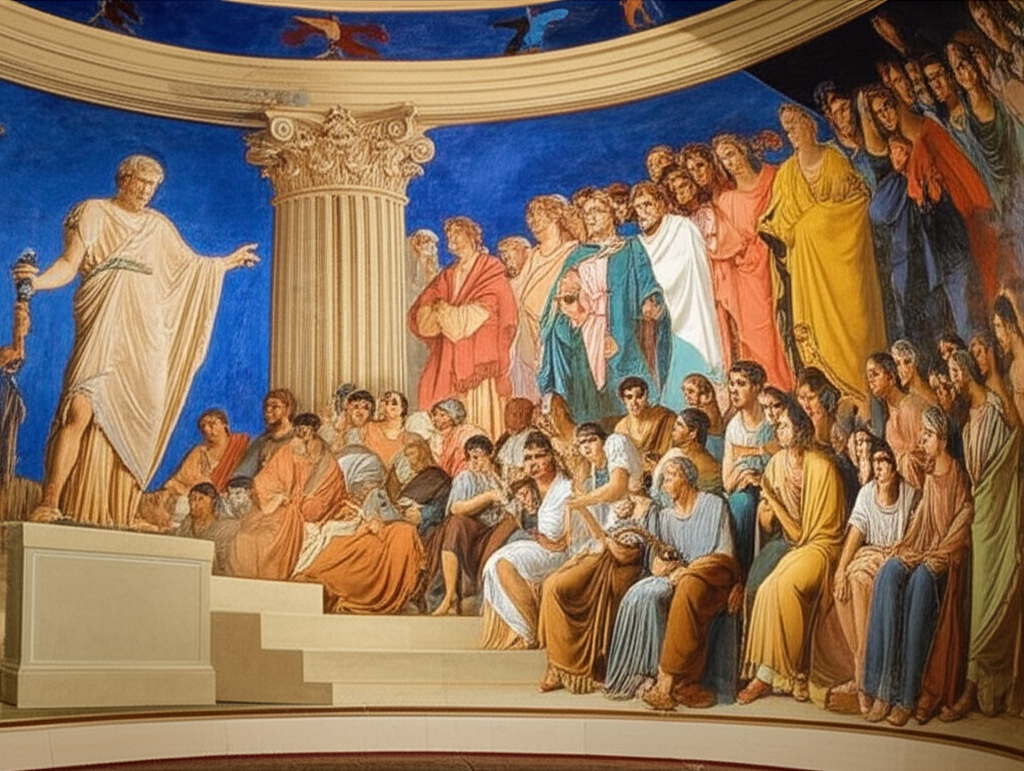
The speed and reach of modern communication amplify rhetoric's impact, making critical engagement more vital than ever. Every political speech, every news commentary, every social media post that aims to convince, to inform, or to move, is an exercise in rhetoric. The health of our democracy hinges on our collective ability to recognize, analyze, and respond thoughtfully to these rhetorical appeals.
Navigating the Rhetorical Current: A Citizen's Imperative
Understanding the power of rhetoric is not just an academic exercise; it is a civic duty. For the individual in a democracy, it means cultivating a certain philosophical skepticism and analytical rigor.
Here are key approaches for navigating the rhetorical landscape:
- Deconstruct the Message: Go beyond the surface. What are the speaker's underlying assumptions? What rhetorical appeals (ethos, pathos, logos) are being used?
- Identify the Purpose: Is the speaker aiming to inform, persuade, entertain, or manipulate?
- Evaluate the Evidence: Does the language used to support a claim hold up to scrutiny? Are facts presented accurately and fairly?
- Recognize Bias: Both in the speaker and in oneself. Our pre-existing opinions can make us more susceptible to certain rhetorical strategies.
The power of rhetoric is undeniable. It is the engine of debate, the shaper of opinion, and the very fabric of political language in a democracy. To ignore it is to remain a passive recipient of influence; to understand it is to become an active, discerning participant in the ongoing philosophical experiment of self-governance.
📹 Related Video: PLATO ON: The Allegory of the Cave
Video by: The School of Life
💡 Want different videos? Search YouTube for: ""Plato's Critique of Rhetoric and the Sophists Explained""
📹 Related Video: ARISTOTLE ON: The Nicomachean Ethics
Video by: The School of Life
💡 Want different videos? Search YouTube for: ""Aristotle's Rhetoric: The Art of Persuasion in Democracy""