

The Muses of the Mind: The Power of Memory and Imagination in Art
In the grand tapestry of human endeavor, few threads are as intricately woven and fundamentally critical as Memory and Imagination in the creation and apprehension of Art. This article posits that these two faculties of the Mind are not merely auxiliary tools but are, in fact, the very bedrock upon which artistic experience is built. From the ancient Greeks who pondered the nature of mimesis to modern philosophers grappling with creativity, the interplay of what we remember and what we can envision has been recognized as the quintessential force driving human expression and understanding. Without the rich archive of memory to draw upon, and the boundless capacity of imagination to transform and synthesize, art would remain a mere imitation, devoid of its transformative power.
The Indispensable Duo: Memory and Imagination
At the heart of all creative acts lies a profound reliance on two distinct yet deeply intertwined cognitive processes: memory and imagination. While memory anchors us to the past, providing the raw material of our experience, imagination allows us to transcend it, to rearrange, combine, and invent new realities. Together, they form a dynamic partnership that enables artists to articulate the ineffable, to represent the unseen, and to evoke emotions and ideas that resonate deeply within the human Mind.
Memory: The Wellspring of Artistic Material
Memory, far from being a simple record-keeping device, is a complex faculty that shapes our perception and understanding of the world. For the artist, it is an inexhaustible reservoir of forms, emotions, sensations, and narratives.
- Recollection and Retention: Artists draw upon personal histories, cultural legacies, and collective memories. A painter might recall the precise quality of light at dawn, a writer the cadence of a forgotten conversation, a composer the emotional resonance of a childhood melody. These recollections are not static; they are imbued with feeling and meaning, ready to be reinterpreted.
- The Archive of Experience: As thinkers from Aristotle to Locke have explored, our Mind is furnished with ideas derived from experience. Memory stores these sensory inputs, emotional responses, and intellectual insights. This stored experience becomes the vocabulary of the artist, allowing them to communicate profound truths without explicit declaration. It is the wisdom gleaned from living, distilled and prepared for creative transformation.
- Cultural Inheritance: Beyond personal memory, artists engage with the vast memory of humanity – myths, histories, symbols, and archetypes. This shared cultural memory provides a framework, a common language through which art can speak across generations and geographies, connecting individual experience to universal themes.
Imagination: The Architect of New Realities
If memory provides the bricks and mortar, imagination is the architect, the visionary force that constructs new structures, reshapes landscapes, and invents entirely new worlds. It is the faculty that liberates art from mere imitation.
- Synthesis and Transformation: Imagination takes disparate elements from memory and combines them in novel ways. It can fuse the familiar with the strange, the real with the surreal, creating images, narratives, and sounds that have never existed before. This is the "productive imagination" that philosophers like Kant identified as crucial for human understanding and creation.
- Empathy and Projection: Through imagination, artists can step into other skins, explore alternative realities, and project their inner worlds outward. This allows for the creation of compelling characters, believable worlds, and profound emotional depth that invites the audience to share in a vicarious experience.
- Vision and Foresight: Imagination is not just about rearranging the past; it is also about envisioning the future, conceiving of possibilities, and pushing the boundaries of what is known. It allows artists to challenge conventions, to innovate, and to offer new perspectives on existence, thereby shaping our collective Mind.
The Interplay: When Memory and Imagination Unite
The true power of these faculties in art emerges not when they operate in isolation, but in their seamless and often unconscious collaboration. An artist does not simply remember and then imagine; rather, memory informs imagination, and imagination reconfigures memory.
Consider a novelist crafting a story: they draw upon remembered emotions (sorrow, joy, fear) and real-world observations (the texture of a city street, the quirks of human behavior), but then their imagination reshapes these elements, inventing characters, plots, and settings that transcend mere autobiography. Similarly, a musician might recall a melodic phrase (memory) and then, through imagination, develop it into a complex symphony, exploring variations, harmonies, and orchestrations that elevate the initial spark into a profound sonic experience.
This dynamic interplay is beautifully captured in the philosophical tradition. From Plato's discussions of mimesis (imitation) and the Forms, to Aristotle's analysis of phantasmata (images in the mind) as necessary for thought, and further to the Romantic poets like Coleridge who distinguished between "primary imagination" (perceiving the world) and "secondary imagination" (the creative, transformative power), the centrality of these mental faculties has been a consistent theme in the Great Books of the Western World.
Functions of Memory and Imagination in Artistic Creation
| Faculty | Primary Function in Art | Philosophical Echoes | Impact on Experience |
|---|---|---|---|
| Memory | Provides raw material, experience, emotional archives | Aristotle's phantasmata, Locke's ideas of sensation | Anchors art in reality, evokes shared human condition |
| Imagination | Transforms, synthesizes, invents new realities | Kant's productive imagination, Coleridge's secondary imagination | Elevates art beyond imitation, sparks wonder, new insights |
| Together | Creates meaning, fosters empathy, shapes cultural narrative | Plato's Forms, Artistic Genius | Profound emotional and intellectual engagement, catharsis |
The Mind as a Crucible of Creation
Ultimately, the artistic act is a testament to the extraordinary capabilities of the human Mind. It is in the inner sanctum of consciousness that Memory and Imagination converge, fermenting ideas, refining visions, and giving birth to works that resonate with truth and beauty. This process is not merely intellectual; it is deeply embodied, engaging our emotions, our senses, and our very being. The experience of both creating and appreciating art is an invitation to engage with these fundamental human faculties, to explore the boundaries of what we know and what we can conceive.
The power of Memory and Imagination in art lies in their capacity to bridge the gap between the internal and external worlds, between the personal and the universal. They allow us to make sense of our past, to envision our future, and to find meaning in the present. This profound interplay ensures that art remains not just a reflection of life, but an active force in shaping it, a continuous dialogue between what was, what is, and what could be.
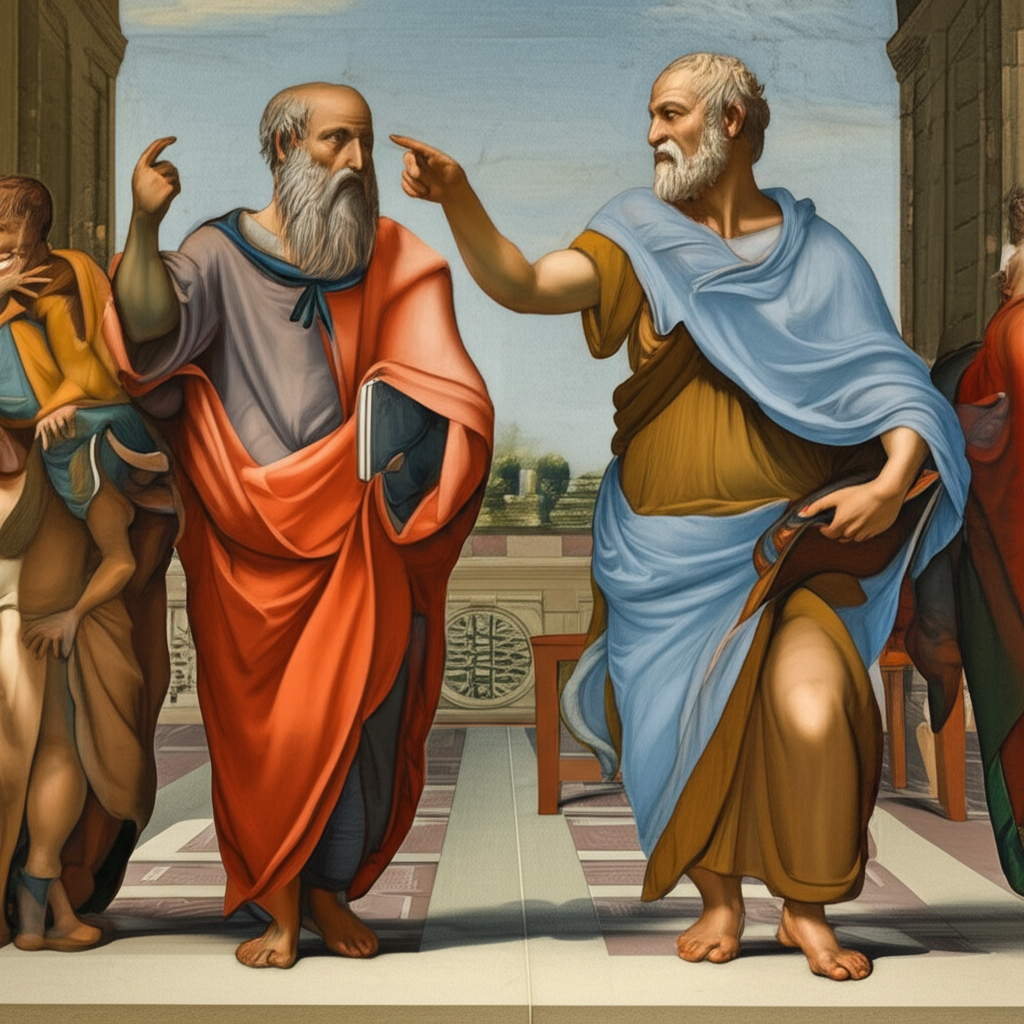 and Aristotle gesturing horizontally towards the earth (representing observation/memory), all against a backdrop that subtly blends classical architecture with abstract, swirling patterns of thought, symbolizing the confluence of concrete experience and abstract ideation in the mind.)
Further Exploration
📹 Related Video: PLATO ON: The Allegory of the Cave
Video by: The School of Life
💡 Want different videos? Search YouTube for: ""Plato's Theory of Forms Explained""
📹 Related Video: KANT ON: What is Enlightenment?
Video by: The School of Life
💡 Want different videos? Search YouTube for: ""The Role of Imagination in Kant's Philosophy""