

The Architect of Assent: How Language Sculpts Our Opinions
Language is far more than a mere tool for conveying information; it is the fundamental architect of our understanding, the unseen hand that sculpts our perceptions, and ultimately, the potent force that shapes our opinions. From the nuanced turn of a phrase to the grand narratives that define cultures, every word we utter or absorb carries the potential to sway belief, ignite conviction, or sow doubt. This article explores the profound philosophical underpinnings of how language actively creates and transforms opinion, drawing insights from the enduring wisdom contained within the Great Books of the Western World.
The Foundational Role of Language in Cognition
Before an opinion can even form, language provides the very categories through which we apprehend reality. As philosophers from Aristotle to Wittgenstein have explored, words are not simply labels applied to pre-existing thoughts; they are the very structures that enable thought itself.
- Defining Reality: Our lexicon dictates what we can name, categorize, and thus, what we can consciously consider. A concept without a word struggles to gain traction in the collective consciousness.
- Framing Experience: The way an event is described — its chosen verbs, adjectives, and metaphors — pre-frames our emotional and intellectual response, guiding the initial seeds of opinion.
Rhetoric: The Art of Persuasion and Opinion Crafting
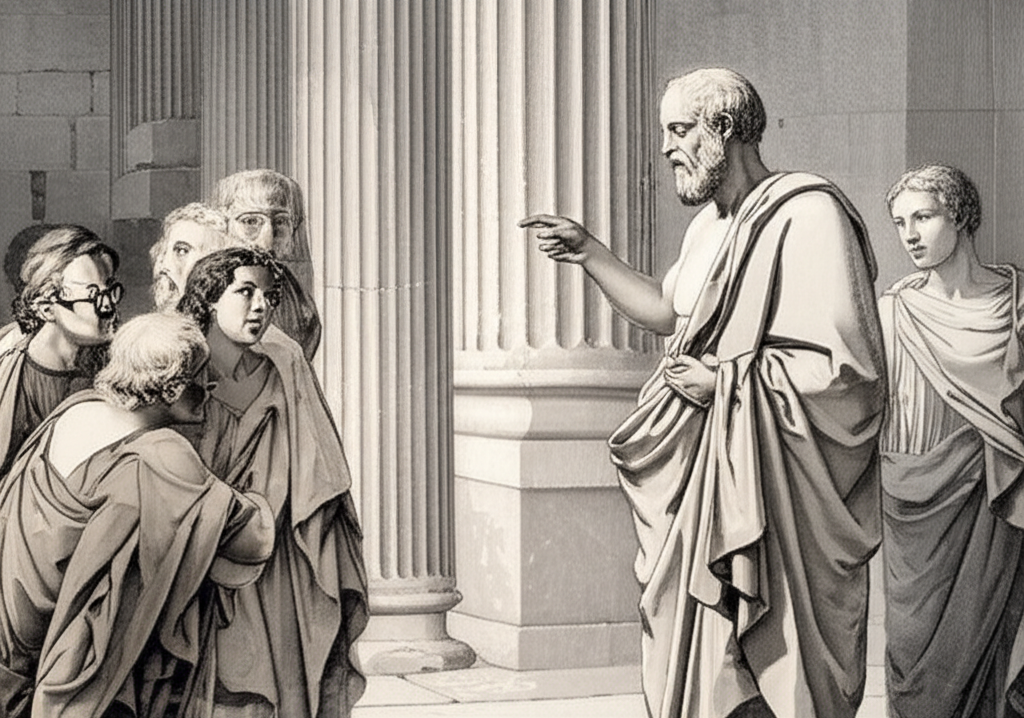
Perhaps no discipline illuminates the power of language to create opinion more directly than rhetoric. Aristotle, in his seminal work Rhetoric, meticulously dissects the art of persuasion, demonstrating how effective communication is not merely about truth, but about presenting truth (or an argument) in a manner that resonates with an audience's pre-existing beliefs, emotions, and values.
Aristotle's three appeals—ethos, pathos, and logos—are linguistic strategies designed to cultivate specific opinions:
- Ethos (Credibility): The speaker's character, established through their language, tone, and reputation, influences how readily an audience accepts their assertions. A trusted voice, using confident and authoritative language, can easily sway opinion.
- Pathos (Emotion): Language imbued with emotional resonance—through vivid imagery, evocative metaphors, or compelling narratives—can bypass purely rational deliberation and forge an emotional connection that predisposes an audience to a particular opinion.
- Logos (Logic): While seemingly objective, even logical arguments are constructed with language. The selection of evidence, the structure of an argument, and the clarity of its presentation are all linguistic choices that can make a conclusion seem inevitable, thereby shaping opinion.
Table: Rhetorical Devices and Their Impact on Opinion
| Rhetorical Device | Description | How it Shapes Opinion | Example We are not merely communicating with words; we are shaping realities.
The Semiotics of Persuasion: Understanding Signs and Symbols
At its heart, the creation of opinion by language relies on the distinction between a sign and a symbol. A word is a sign—an arbitrary sound or mark—that stands for something else. What it stands for is its symbolic meaning. The power of language lies in its ability to evoke, not just to denote.
- Words as Signs: The word "freedom" is a sign.
- Words as Symbols: The concept of "freedom" it evokes—with all its historical, emotional, and political connotations—is the symbol.
The way we use language to invoke these symbols directly influences opinion. Consider the difference between:
- "Investment in public infrastructure" vs. "Government spending spree."
- "Healthcare reform" vs. "Socialized medicine."
Both phrases might refer to the same underlying policy, but the symbols they trigger are vastly different, leading to disparate opinions. This is where the political philosopher's concern for propaganda and the careful crafting of public discourse becomes paramount. The battle for opinion is often fought not over facts, but over the symbolic resonance of the language used to describe those facts.
The Narrative Construction of Opinion
Human beings are inherently storytellers. Our understanding of the world, our sense of identity, and our deepest convictions are often woven into narratives. Language is the thread of these narratives, and through them, opinion is not just formed but deeply embedded.
- Personal Narratives: The stories we tell ourselves about our lives, successes, and failures shape our self-perception and, consequently, our opinions on everything from personal responsibility to societal structures.
- Collective Narratives: Nations, communities, and movements are built upon shared narratives. These stories, communicated through language in speeches, texts, and media, define common enemies, celebrate heroes, and articulate collective aspirations, forging powerful shared opinions.
- Metaphorical Language: Metaphors are not mere literary flourishes; they are cognitive tools that allow us to understand one thing in terms of another. Describing a problem as a "war" or a "journey" fundamentally alters our approach and opinion on how to address it.
The power of language to create opinion is therefore a profound responsibility. From the philosopher grappling with the precise definition of justice to the politician seeking to unite a populace, the careful, ethical, and deliberate use of language is essential. It is through this mastery that we can not only communicate our thoughts but actively shape the very landscape of human belief.
YouTube: "Aristotle Rhetoric explained"
YouTube: "Philosophy of language and opinion formation"
📹 Related Video: What is Philosophy?
Video by: The School of Life
💡 Want different videos? Search YouTube for: "The Power of Language to Create Opinion philosophy"