

The Architect of Thought: Language's Unseen Hand in Shaping Opinion
Language is far more than a mere tool for communication; it is the very architecture of our thought, the invisible hand that sculpts our perceptions, and ultimately, the potent force that creates opinion. From the subtle nuances of a single word to the grand narratives woven by master rhetoricians, the way we articulate ideas directly influences how those ideas are received, understood, and ultimately, believed. This article explores the profound philosophical underpinnings of language's power, drawing insights from the enduring wisdom of the Great Books of the Western World.
The Linguistic Lens: How Words Frame Reality
Our understanding of the world is inextricably linked to the words we possess to describe it. Before we can form an opinion on anything, we must first conceptualize it, and that conceptualization is largely a linguistic act. Words are not just labels; they are vessels carrying layers of meaning, cultural context, and emotional resonance.
Consider the relationship between Sign and Symbol. A sign might be a direct indicator – smoke is a sign of fire. A symbol, however, is a representation that stands for something else, often abstract, through convention or association. Words are powerful symbols. The word "freedom," for instance, isn't freedom itself, but a symbol that evokes a vast array of concepts, experiences, and political ideals. The specific symbols chosen, and the way they are combined, inevitably guide our interpretation of reality.
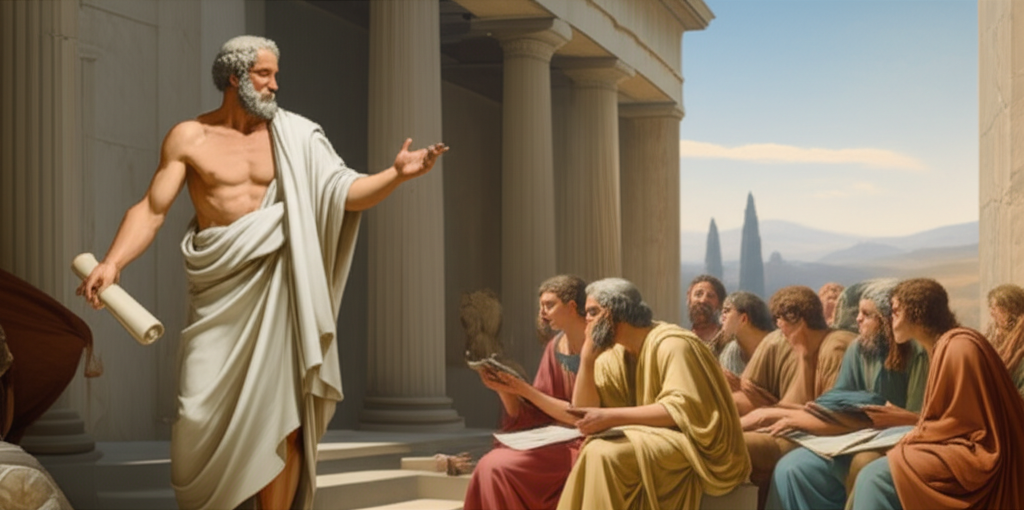
Rhetoric: The Art of Shaping Minds
The conscious application of language to persuade and influence is known as Rhetoric. As articulated by Aristotle in his seminal work Rhetoric, a cornerstone of the Great Books, this art is not merely about eloquent speaking, but about understanding the human psyche and the various means by which conviction can be fostered. Aristotle identified three primary modes of persuasion:
- Ethos: Appealing to the speaker's credibility or character.
- Pathos: Appealing to the audience's emotions.
- Logos: Appealing to logic and reason.
Each of these modes relies heavily on the careful deployment of language. A speaker using ethos might employ humble yet authoritative language, while one aiming for pathos would choose emotionally charged words and vivid imagery. Logos demands precise, clear, and logically structured language to build a compelling argument. The master rhetorician understands that the choice of words is paramount in directing an audience's opinion.
From Perception to Persuasion: The Opinion-Forming Process
The power of language to create opinion is not always overt. Often, it works subtly, shaping our perceptions before we even realize an opinion is being formed.
The Power of Framing
How an issue is "framed" through language can entirely dictate the conversation around it and the opinions that emerge. Consider the difference between describing a government measure as "tax relief" versus "tax cuts for the wealthy," or "pro-choice" versus "pro-abortion." The underlying policy might be identical, but the linguistic framing immediately steers public perception and opinion in vastly different directions. This highlights how language can pre-package an argument, making one viewpoint seem inherently more reasonable or moral than another.
Connotation and Context
Every word carries both a denotative (literal) meaning and connotative (associated, emotional) meanings. The skillful use of connotation is a powerful tool in shaping opinion. For example, describing a leader as "firm" versus "stubborn," or an activist as "passionate" versus "fanatical," uses words with similar denotations but vastly different connotations, thereby imbuing the subject with a particular moral or emotional valence. The context in which these words are used further amplifies their impact, allowing language to subtly guide our judgments.
Mechanisms of Influence
The specific ways language influences and creates opinion are multifaceted. Here are a few key mechanisms:
- Naming and Categorization: The act of naming defines and categorizes, establishing boundaries and relationships. How something is named immediately impacts how it is perceived.
- Metaphor and Analogy: These figures of speech allow us to understand complex ideas by relating them to simpler, more familiar ones. They can powerfully shape our understanding and lead us to particular conclusions.
- Repetition: The repeated use of certain phrases or keywords embeds ideas into the collective consciousness, making them seem more familiar, and thus more acceptable or true.
- Appeals to Authority/Emotion: Language can be crafted to evoke trust in an authority figure or to stir strong emotions, bypassing purely rational consideration.
- Narrative Construction: Stories, whether personal anecdotes or grand historical accounts, are powerful vehicles for shaping opinion. The way a story is told, the characters highlighted, and the moral drawn, all guide the audience's conclusions.
Conclusion: A Call for Critical Engagement
The profound power of language to craft opinion demands our constant vigilance and critical engagement. As readers, listeners, and citizens, we must cultivate an awareness of the linguistic strategies at play in public discourse. By understanding the intricate interplay between Sign and Symbol, the art of Rhetoric, and the subtle ways words frame our reality, we can become more discerning consumers of information and more thoughtful participants in the ongoing philosophical dialogue. The Great Books of the Western World remind us that the pursuit of truth often begins with a rigorous examination of the language we use to define it.
📹 Related Video: ARISTOTLE ON: The Nicomachean Ethics
Video by: The School of Life
💡 Want different videos? Search YouTube for: ""Philosophy of Language Explained" or "Aristotle's Rhetoric: The Art of Persuasion""
📹 Related Video: ARISTOTLE ON: The Nicomachean Ethics
Video by: The School of Life
💡 Want different videos? Search YouTube for: ""Semiotics and Symbolism in Communication""