

The Power of Hypotheses in Mathematics: A Philosophical Inquiry
Mathematics, often perceived as an edifice of immutable truths, paradoxically finds its most potent engine of progress in the humble hypothesis. Far from being mere guesses, these foundational ideas serve as the conceptual bedrock and the aspirational frontier of mathematical exploration. They are propositions, unproven yet conceived with profound insight, that challenge the boundaries of our understanding and, through the rigorous application of logic, drive the discipline forward, unveiling new structures and deeper truths. This article delves into the philosophical significance of hypotheses, tracing their journey from intuitive idea to established theorem, and highlighting their indispensable role in the grand narrative of mathematics.
The Genesis of Mathematical Understanding: From Observation to Assumption
The journey of mathematical discovery often begins not with certainty, but with a spark of an idea – a pattern observed, a relationship intuited, or a question posed. In the realm of mathematics, these initial insights frequently crystallize into what we call a hypothesis. Unlike empirical sciences, where hypotheses are tested through experimentation, mathematical hypotheses are propositions about the nature of numbers, shapes, or abstract structures that are then subjected to the unyielding scrutiny of logic.
Consider the ancient Greeks, whose contributions to mathematics are chronicled in the Great Books of the Western World. Euclid's Elements, for instance, does not begin with proofs, but with definitions, postulates, and common notions – essentially, a set of foundational hypotheses that form the basis of his geometric system. These were not proven, but accepted as self-evident truths or starting points from which all other theorems could be deductively derived. This highlights a crucial aspect: a hypothesis in mathematics is often a carefully constructed idea, a potential axiom, waiting to be validated or disproven by the force of logic.
From Idea to Axiom: The Philosophical Weight of a Hypothesis
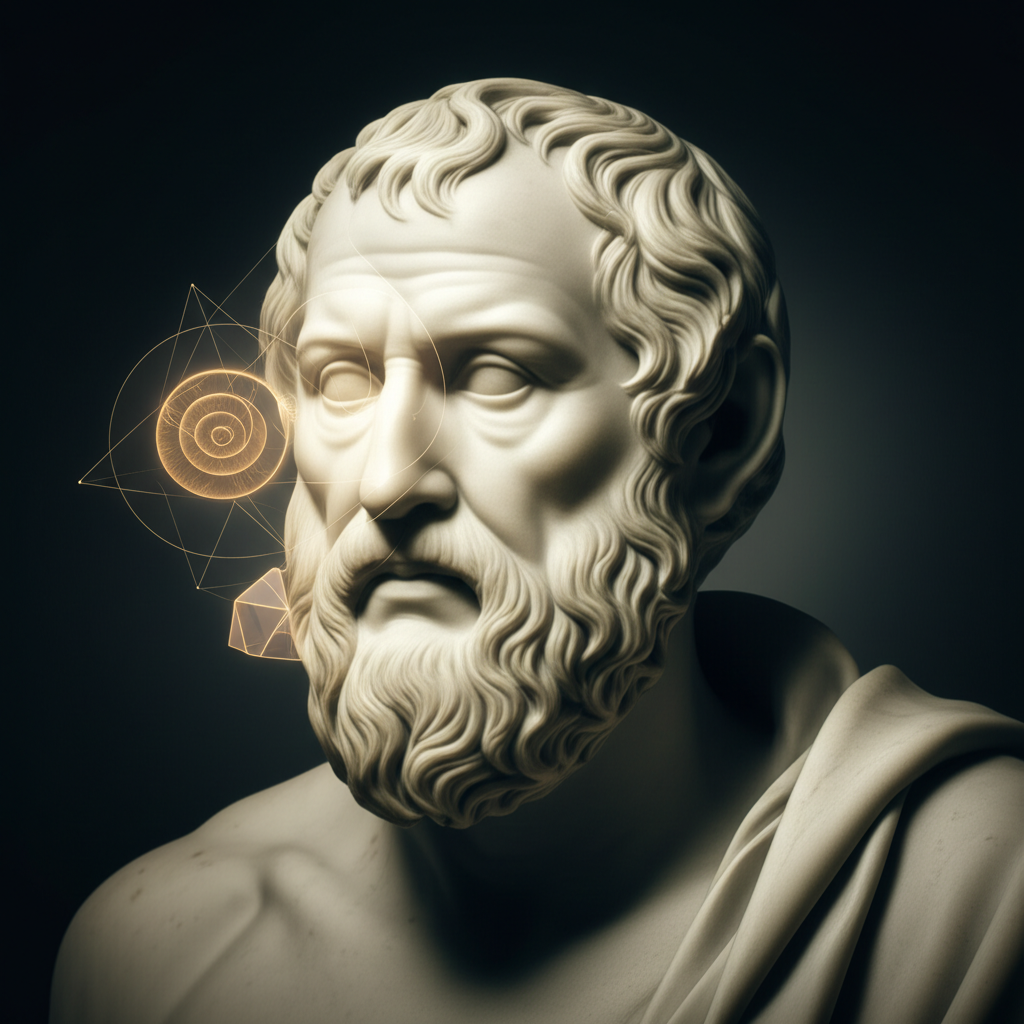
The transformation of a mathematical idea into a formal hypothesis carries significant philosophical weight. It represents a leap of intellectual imagination, a formulation of a potential truth that, if proven, could fundamentally alter our understanding of a mathematical domain. Plato, in his dialogues, often spoke of mathematical objects as existing in a realm of perfect Forms, accessible through intellect. A hypothesis, in this sense, could be seen as an attempt to articulate one of these Forms, to bring a glimmer of that ideal reality into our grasp.
The process involves:
- Intuition and Observation: Recognizing a pattern or relationship.
- Formulation: Expressing the idea as a clear, precise mathematical statement.
- Conjecture: Proposing that this statement holds true, often based on extensive evidence (computational, analogical) but lacking formal proof.
- Deduction: The application of logic to explore the consequences of the hypothesis.
The Logic of Deduction: Testing the Hypothesis
Once an idea has been formalized into a hypothesis, the rigorous work of mathematics truly begins. This is where logic becomes the ultimate arbiter. Unlike scientific hypotheses that might be disproven by a single counter-example from the physical world, a mathematical hypothesis stands or falls entirely on the strength of deductive reasoning.
Mathematicians employ a vast arsenal of logical tools to:
- Derive Consequences: What other statements must be true if the hypothesis is true?
- Seek Contradictions: Can the hypothesis lead to a logical inconsistency within the established system of mathematics?
- Construct Proofs: Can a sequence of logically sound steps, starting from accepted axioms and definitions, lead directly to the hypothesis as a conclusion?
- Find Counterexamples: Can a specific instance be found where the hypothesis fails, thus disproving it?
This relentless pursuit of logical coherence is what gives mathematics its unique certainty. As René Descartes, another luminary from the Great Books, emphasized in his Discourse on Method, the path to clear and distinct knowledge often involves starting with simple, undeniable truths (or hypotheses) and building complex understanding through rigorous deduction. Even when a hypothesis remains unproven, the exploration it sparks often leads to the development of new mathematical techniques, theories, and branches of study.
Famous Mathematical Hypotheses: Unveiling New Worlds
Throughout history, certain hypotheses have captured the imagination of mathematicians and driven centuries of research. These profound ideas serve as beacons, challenging the brightest minds to either prove their veracity or demonstrate their falsehood.
Here are a few prominent examples:
- Fermat's Last Theorem (now a theorem): Proposed by Pierre de Fermat in 1637, stating that no three positive integers a, b, and c can satisfy the equation a^n + b^n = c^n for any integer value of n greater than 2. It remained an unproven hypothesis for over 350 years, inspiring vast developments in number theory before Andrew Wiles finally proved it in 1994.
- The Riemann Hypothesis: One of the most famous unsolved problems in mathematics, proposed by Bernhard Riemann in 1859. It concerns the distribution of prime numbers and states that all non-trivial zeros of the Riemann zeta function have a real part of 1/2. Its proof (or disproof) would have profound implications across number theory and cryptography.
- The Goldbach Conjecture: Proposed in 1742 by Christian Goldbach, stating that every even integer greater than 2 is the sum of two prime numbers. Despite extensive computational verification, it remains an unproven hypothesis, a testament to the enduring challenges in mathematics.
- The Continuum Hypothesis: Proposed by Georg Cantor in 1878, concerning the possible sizes of infinite sets. It states that there is no set whose cardinality is strictly between that of the integers and that of the real numbers. It was later shown by Kurt Gödel and Paul Cohen that this hypothesis is independent of the standard axioms of set theory, meaning it can neither be proven nor disproven from them.
These ideas illustrate the power of hypotheses not just as targets for proof, but as organizing principles that shape entire fields of mathematics.
The Creative Act: Hypotheses as Engines of Discovery
Beyond the rigid strictures of logic, the formulation of a powerful hypothesis is fundamentally a creative act. It requires intuition, imagination, and a deep understanding of existing mathematical structures. It's the ability to see beyond the known, to posit a new relationship or an underlying principle that might unify disparate concepts.
The process of forming a good hypothesis mirrors, in some ways, the philosophical endeavor to understand reality. It's about asking "what if?" and then systematically exploring the consequences of that "what if." This creative impulse is what keeps mathematics vibrant and ever-expanding, pushing the boundaries of what is known and what is knowable.
Conclusion: The Enduring Legacy of the Mathematical Idea
The power of hypotheses in mathematics cannot be overstated. They are the initial ideas, the bold conjectures, and the unyielding challenges that propel the discipline forward. From Euclid's postulates to the Millennium Prize Problems, hypotheses serve as both the foundation and the frontier of mathematical inquiry. They demand the utmost rigor of logic for their verification, yet they originate from the most profound and creative aspects of human thought. In this interplay between imaginative idea and unyielding logic, mathematics continues its timeless quest for understanding, revealing the intricate beauty and profound order of the universe, one hypothesis at a time.
**## 📹 Related Video: ARISTOTLE ON: The Nicomachean Ethics
Video by: The School of Life
💡 Want different videos? Search YouTube for: "The Riemann Hypothesis Explained Simply"**
**## 📹 Related Video: What is Philosophy?
Video by: The School of Life
💡 Want different videos? Search YouTube for: "Philosophy of Mathematics: Is Math Discovered or Invented?"**