

The Political Structure of Ancient Aristocracy: A Philosophical Inquiry
The concept of Aristocracy, derived from the Greek aristokratia (rule of the best), represents a foundational form of Government in ancient political thought. This article will explore its theoretical underpinnings and historical manifestations, examining how philosophers like Plato and Aristotle defined and debated its structure. Far from a mere historical curiosity, understanding ancient Aristocracy offers profound insights into enduring questions about justice, leadership, and the ideal State. We will delve into its defining characteristics, its often-complex relationship with other political systems, and its philosophical legacy, drawing heavily from the insights preserved within the Great Books of the Western World.
Defining Ancient Aristocracy: Beyond Mere Elitism
In contemporary discourse, "aristocracy" often connotes inherited privilege or an entrenched elite. However, within the classical philosophical tradition, particularly in ancient Greece, the term carried a far more specific and aspirational meaning. For thinkers like Plato and Aristotle, true Aristocracy was not merely the rule of the wealthy or the well-born, but the Government of those deemed "best" – individuals excelling in virtue, wisdom, and a commitment to the common good.
Aristocracy, in its purest theoretical form, was considered a virtuous and stable State. It stood in stark contrast to its corrupted form, oligarchy, which Aristotle meticulously distinguished as the rule of the wealthy for their own benefit, rather than for the benefit of the entire polis. This distinction is crucial for understanding the philosophical weight placed upon this particular political structure.
Philosophical Foundations: Plato and Aristotle on the Ideal State
The philosophical underpinnings of Aristocracy are most vividly articulated by Plato and Aristotle, whose works remain cornerstones of political philosophy.
Plato's Philosopher-Kings
In Plato's magnum opus, The Republic, the ideal State is an Aristocracy governed by "philosopher-kings." These are not rulers by birthright or wealth, but individuals who have undergone rigorous intellectual and moral training, ascending to the highest forms of knowledge and understanding. Their rule is justified by their superior wisdom and their selfless dedication to the well-being of the State. For Plato, this form of Government represents the pinnacle of justice, where each class performs its natural function, guided by those most capable of discerning truth and goodness. The philosopher-kings, having seen "the Good," are uniquely equipped to steer the State towards harmony and virtue.
Aristotle's Classification of Governments
Aristotle, in his Politics, offers a more empirical and systematic classification of Government forms. He distinguishes between "correct" forms, which aim at the common good, and "deviant" forms, which serve the private interests of the rulers.
Table: Aristotle's Classification of Governments
| Number of Rulers | Correct Form (Common Good) | Deviant Form (Self-Interest) |
|---|---|---|
| One | Monarchy | Tyranny |
| Few | Aristocracy | Oligarchy |
| Many | Polity (Constitutional Rep.) | Democracy (Mob Rule) |
For Aristotle, Aristocracy is the rule of the few who are genuinely "best" – best in terms of virtue, education, and moral character. It is a Government where merit, not merely wealth or lineage, dictates leadership. He notes that while it often coincides with the wealthy or well-born, its legitimacy rests on the virtue of its rulers. When this virtue degrades, and the few rule solely for their own enrichment, Aristocracy devolves into oligarchy.
Historical Manifestations and Characteristics
While the pure, ideal Aristocracy of Plato's vision rarely, if ever, existed in practice, various ancient societies exhibited aristocratic features. The History of these States often reveals a complex interplay between the theoretical ideal and the pragmatic realities of power.
Key Characteristics of Ancient Aristocratic States:
- Rule by a Select Few: Power was concentrated in the hands of a small number of families or individuals. This selection might be based on birth, wealth, military prowess, or perceived wisdom.
- Emphasis on Lineage and Tradition: Hereditary privilege often played a significant role, with certain families claiming a divine right or historical claim to rule. Tradition and ancestral customs were highly valued as guiding principles for Government.
- Education and Virtue: In theory, aristocratic rulers were expected to possess superior education, moral character, and a commitment to civic duty. Plato's philosopher-kings are the ultimate expression of this ideal.
- Land Ownership: Wealth, particularly in land, was often a prerequisite for political participation in many aristocratic societies, providing both economic independence and a vested interest in the State's stability.
- Military Leadership: Aristocrats frequently served as military commanders, reinforcing their status through martial prowess and defense of the State.
- Council-Based Governance: Decision-making often involved councils (e.g., the Spartan Gerousia, the Roman Senate in its early form) composed of elder or distinguished aristocrats, providing a check on individual power.
Image: 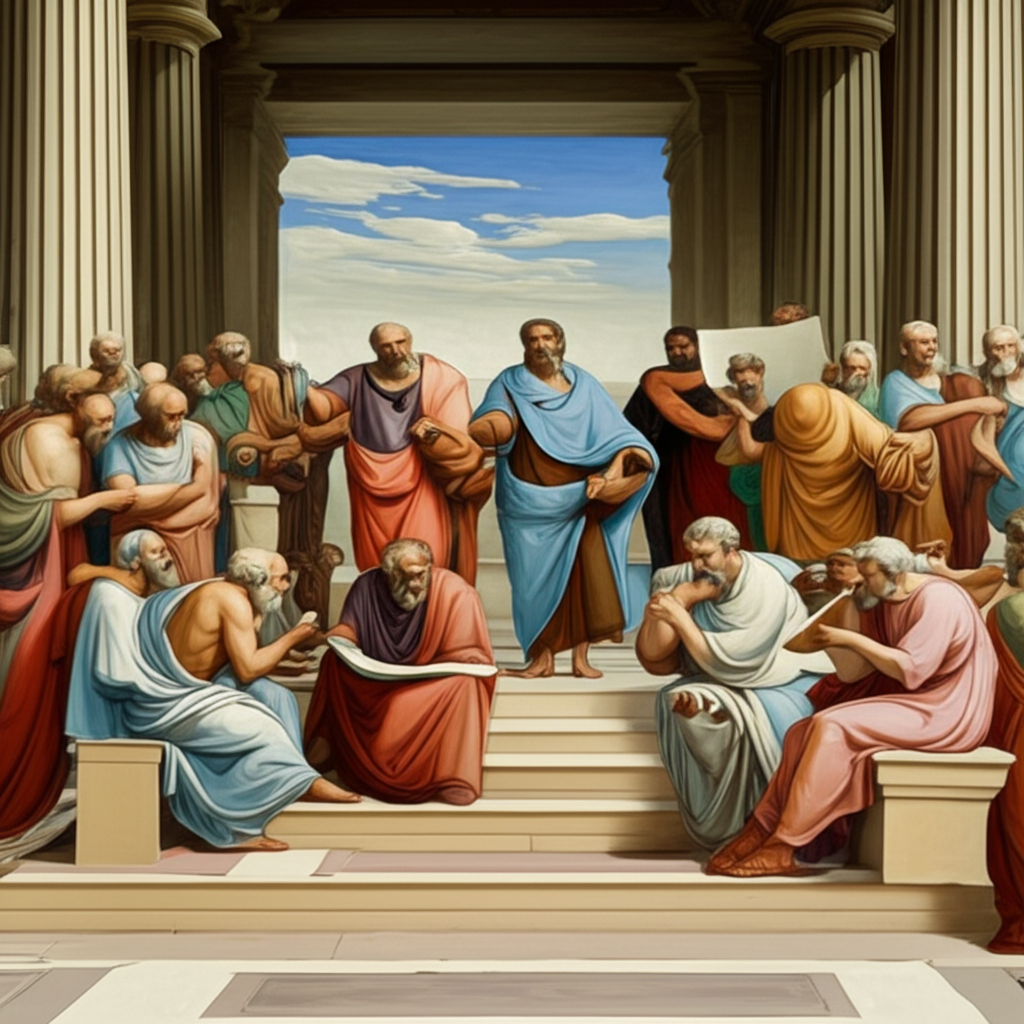
Examples from History:
- Sparta: Often cited as a historical example with aristocratic elements, Sparta was governed by two kings and a council of elders (Gerousia), chosen from a select group of aristocratic families. While not a pure Aristocracy in the Platonic sense, its emphasis on military virtue, discipline, and a ruling elite controlling the helot population demonstrates aristocratic principles.
- Early Rome: The Roman Republic, particularly in its early centuries, was heavily influenced by its patrician class. The Senate, initially composed exclusively of patricians, wielded immense power, and magistracies were largely held by members of leading aristocratic families.
- Archaic Athens: Before the reforms leading to full democracy, Athens was governed by aristocratic families, the Eupatridae, who controlled the archonships and the Areopagus council. Solon's reforms, while moving towards broader participation, still retained elements of timocracy (rule by property qualification), often benefiting the wealthy elite.
The Enduring Legacy and Transformation
The History of ancient Aristocracy is rarely one of static perfection. As Aristotle observed, political systems are dynamic. True Aristocracy was always vulnerable to corruption, often devolving into oligarchy as the focus shifted from virtue to wealth or power for its own sake. The inherent tension between the ideal of rule by the "best" and the reality of inherited privilege or economic dominance proved a constant challenge.
The decline of many ancient aristocratic States often paved the way for other forms of Government, including tyranny, and perhaps most significantly, democracy. The struggle between the few (aristocrats/oligarchs) and the many (the demos) is a recurring theme in ancient political History, shaping the development of Western political thought. Yet, the philosophical ideal of rule by the wise and virtuous continues to resonate, informing debates about meritocracy, leadership, and the qualities required for sound Government.
Conclusion
The political structure of ancient Aristocracy, as envisioned by Plato and Aristotle, represents a profound philosophical ideal: the Government of the "best" for the common good. While its historical manifestations were often imperfect and prone to corruption, the concept itself forces us to confront fundamental questions about who should rule, on what basis, and for what purpose. From the rigorous training of Plato's philosopher-kings to Aristotle's careful distinctions between virtuous rule and self-serving oligarchy, the study of ancient Aristocracy remains an indispensable lens through which to examine the enduring challenges of political organization and the pursuit of the just State.
YouTube Video Suggestions:
-
📹 Related Video: PLATO ON: The Allegory of the Cave
Video by: The School of Life
💡 Want different videos? Search YouTube for: "Plato's Republic Philosophy Summary"
2. ## 📹 Related Video: ARISTOTLE ON: The Nicomachean Ethics
Video by: The School of Life
💡 Want different videos? Search YouTube for: "Aristotle Politics Summary Aristocracy Oligarchy Democracy"