

The Physics of World Mechanics: A Philosophical Inquiry into the Cosmos
The universe, in its grandest scale and its most intricate details, operates according to principles that have fascinated and perplexed humanity for millennia. This pillar page delves into the profound philosophical implications of "The Physics of World Mechanics," exploring how our understanding of physical laws has shaped, and continues to shape, our perception of the world itself. From the earliest cosmological musings of the ancients to the astonishing revelations of modern physics, we trace the intellectual journey to comprehend the fundamental mechanics governing matter and motion, and ponder what these scientific insights truly tell us about existence, order, and our place within the grand design.
The Ancient Cosmos: Immanent Order and Purpose
Long before the advent of what we now recognize as modern physics, ancient philosophers wrestled with the fundamental question of how the world works. Their inquiries were deeply intertwined with metaphysics and theology, seeking not just how things moved, but why they moved.
- Plato's Timaeus: In this seminal work, Plato describes the cosmos as the work of a divine Craftsman, the Demiurge, who imposes order upon pre-existing chaos. The world is a living organism, imbued with a soul, and its mechanics are a reflection of ideal forms. The celestial bodies, for instance, move in perfect circles, embodying the most rational and divine motion.
- Aristotle's Teleological Universe: Aristotle's cosmology posited a geocentric world with celestial spheres, each driven by a desire to imitate the perfection of the Unmoved Mover. His physics was qualitative, rooted in the four causes (material, formal, efficient, final). The mechanics of the world were thus inherently purposeful; objects sought their natural places, and change was a process of actualizing potential. Matter itself was seen as a substratum, always striving towards form.
These early frameworks provided a coherent, albeit non-empirical, understanding of the world's operations, where order was not merely observed but intended.
The Dawn of Modern Physics: Universal Laws and the Clockwork World
The Scientific Revolution marked a radical departure from the teleological explanations of the ancients, ushering in an era where empirical observation and mathematical description became paramount in understanding the mechanics of the world.
- Challenging the Geocentric View: Figures like Copernicus, Kepler, and Galileo meticulously observed the heavens, gradually dismantling the Aristotelian-Ptolemaic model. Their work demonstrated that the celestial mechanics were far more intricate and less anthropocentric than previously imagined, laying the groundwork for a new physics.
- Newton's Grand Synthesis: Isaac Newton's Principia Mathematica stands as a monumental achievement, articulating universal laws of motion and gravitation that applied equally to terrestrial and celestial phenomena. The world was no longer governed by separate sets of rules for earth and sky, but by a single, elegant system of forces.
- Key Principles of Newtonian Mechanics:
- Inertia: Matter in motion tends to stay in motion; matter at rest tends to stay at rest, unless acted upon by an external force.
- Force and Acceleration: The acceleration of an object is directly proportional to the net force acting on it and inversely proportional to its mass.
- Action-Reaction: For every action, there is an equal and opposite reaction.
- Universal Gravitation: Every particle of matter in the universe attracts every other particle with a force directly proportional to the product of their masses and inversely proportional to the square of the distance between their centers.
- Key Principles of Newtonian Mechanics:
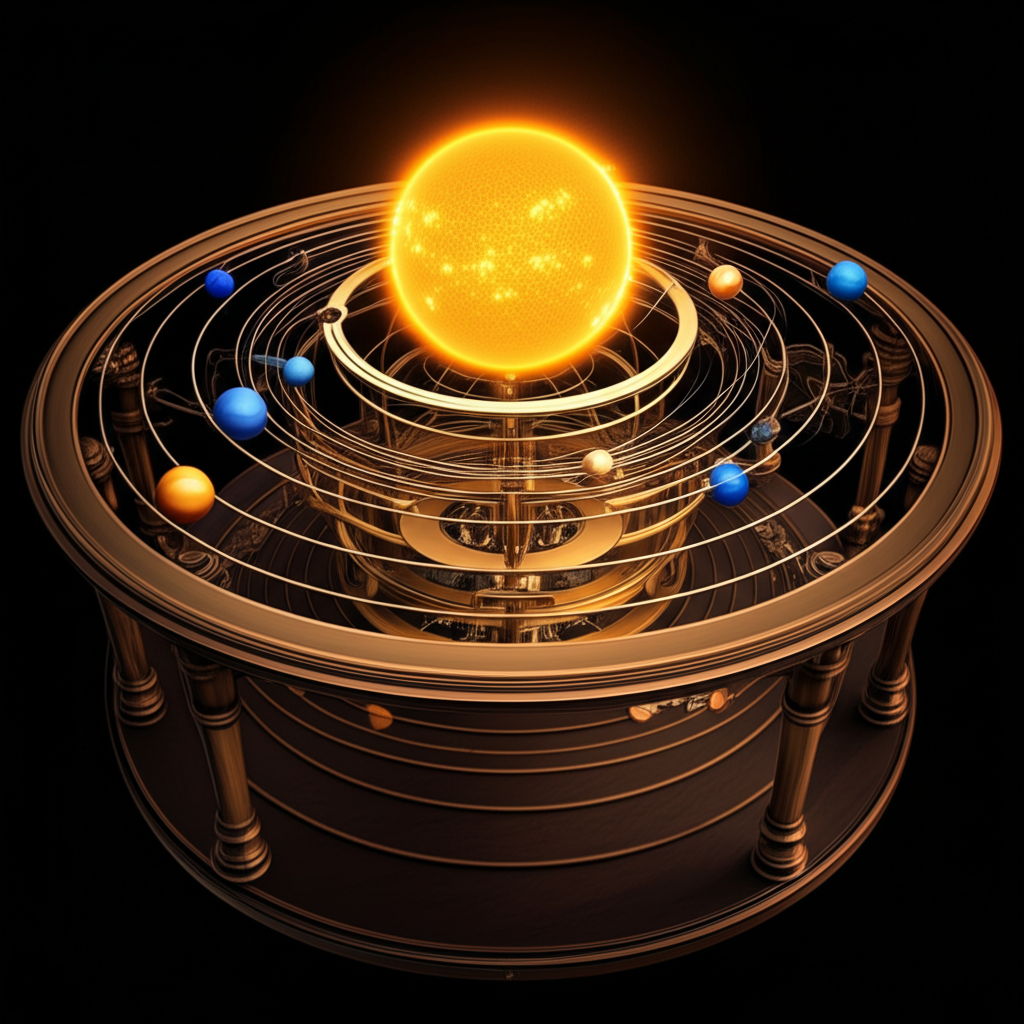
Newton's physics painted a picture of a deterministic, clockwork world, where every event was the inevitable consequence of prior causes. This mechanistic view profoundly influenced subsequent philosophical thought, suggesting that if we knew the initial conditions of all matter and forces, the future could, in principle, be perfectly predicted.
The Nature of Matter: From Atoms to Quantum Fields
The understanding of matter itself has undergone equally transformative shifts, fundamentally altering our grasp of the world's mechanics.
- Ancient Atomism: Philosophers like Democritus and Leucippus proposed that all matter was composed of indivisible, indestructible particles called atoms, moving in a void. This early mechanistic view suggested that the diversity of the world arose from the arrangement and motion of these fundamental constituents.
- Descartes' Extended Substance: René Descartes posited that the physical world (res extensa) was characterized by extension and motion, essentially a vast machine composed of undifferentiated matter. His physics was based on contact mechanics, where forces were transmitted through direct interaction.
- The Rise of Modern Atomic Theory: Dalton, Mendeleev, and others established the empirical basis for atomic theory, demonstrating that matter is indeed composed of discrete elements.
- Quantum Mechanics and the Subatomic Realm: The 20th century brought a revolutionary paradigm shift with quantum mechanics. At the subatomic level, matter and energy behave in ways that defy classical intuition:
- Wave-Particle Duality: Particles can exhibit wave-like properties, and waves can exhibit particle-like properties.
- Uncertainty Principle: It's impossible to simultaneously know with perfect precision certain pairs of properties, such as a particle's position and momentum.
- Quantum Entanglement: Particles can become linked in such a way that the state of one instantaneously influences the state of another, regardless of distance.
These quantum phenomena challenge the very notion of a predictable, localized matter upon which classical physics was built, opening new philosophical questions about the nature of reality, causality, and the observer's role in shaping the world.
Determinism, Free Will, and the Grand Mechanism
The mechanics of the world, as described by physics, have profound implications for philosophical debates concerning determinism and free will.
- Laplace's Demon: Pierre-Simon Laplace famously articulated the deterministic vision: if an intellect knew all the forces acting in nature and the positions of all constituent particles at a given instant, it could predict the entire future of the universe. This "demon" epitomized the ideal of classical physics as a complete description of the world's mechanics.
- Philosophical Challenges to Free Will: A fully deterministic world seems to leave no room for genuine human choice or moral responsibility. If all actions are pre-determined by the laws of physics and the initial conditions of matter, then our sense of agency might be an illusion.
- Quantum Indeterminacy as a Counterpoint: The inherent probabilistic nature of quantum mechanics offers a potential, though controversial, escape route from strict determinism. If events at the fundamental level are genuinely random, then the world itself might not be entirely predictable, leaving room for emergent properties like free will. However, critics argue that randomness is not the same as freedom, and merely replaces one form of constraint with another.
This ongoing tension between the physics of the world and our subjective experience of freedom remains a central philosophical puzzle.
The Observer, Reality, and the Limits of Physics
Ultimately, the philosophical inquiry into the physics of world mechanics leads us to question the very nature of reality and the limits of scientific knowledge.
| Philosophical Concept | Relation to Physics of World Mechanics | Key Thinkers |
|---|---|---|
| Realism | The world described by physics exists independently of our minds. | Most classical physicists, many contemporary philosophers |
| Idealism | Reality is fundamentally mental; the physical world is a construct of consciousness. | George Berkeley |
| Critical Idealism | Immanuel Kant's distinction between the noumenal world (things-in-themselves) and the phenomenal world (how things appear to us). Physics describes the phenomenal world, shaped by our categories of understanding. | Immanuel Kant |
| Instrumentalism | Scientific theories are useful tools for prediction and control, but may not represent ultimate reality. | Some interpretations of quantum mechanics |
Modern physics, particularly quantum mechanics, has highlighted the intricate relationship between the observer and the observed, blurring the lines of an objective, independent world. Does the act of measurement "collapse" a wave function, bringing a specific reality into being? If so, then the mechanics of the world are not entirely separate from our consciousness.
The philosophical journey through the physics of world mechanics is a testament to humanity's enduring quest to understand the universe and our place within it. From the purposeful cosmos of Aristotle to the probabilistic dance of quantum matter, each scientific advance has opened new vistas for philosophical contemplation, reminding us that the deepest questions often lie at the intersection of observation and interpretation.
📹 Related Video: ARISTOTLE ON: The Nicomachean Ethics
Video by: The School of Life
💡 Want different videos? Search YouTube for: ""Physics and Philosophy: The Nature of Reality" or "Great Books of the Western World: Aristotle's Physics""