

The Physics of Space and Time: A Philosophical Inquiry
The very fabric of our existence, the stage upon which all phenomena unfold, is woven from the enigmatic threads of Space and Time. Far from being mere empty containers, these fundamental concepts have captivated philosophers and scientists alike for millennia, driving a profound quest to understand their true nature. This article delves into the intricate relationship between Physics, Space, and Time, exploring how our understanding has evolved from ancient philosophical musings to the sophisticated theories of modern science, always questioning the essence of their Quantity and qualitative reality. Drawing insights from the Great Books of the Western World, we seek to illuminate the enduring philosophical questions embedded within the scientific pursuit of these ultimate realities.
The Ancient Gaze: Space as Place and the Fabric of Being
Before the advent of modern Physics, the nature of space was primarily a philosophical and metaphysical concern. For the ancients, space was often conceived not as an abstract void, but as a collection of places, intrinsically linked to the objects within them.
- Aristotle's Physics: One of the earliest and most influential treatises on the subject, Aristotle's work grappled with the concept of topos (place). For Aristotle, the place of a body was the innermost motionless boundary of what contains it. Space was thus relational, defined by its contents, rather than an independent, absolute entity. The idea of an empty void was largely rejected as conceptually problematic, raising questions about what could define nothingness.
- Plato's Receptacle: In his Timaeus, Plato introduced the concept of the "receptacle" (chora), a third kind of being alongside Forms and copies. This receptacle was a shapeless, invisible medium that received all things, a kind of universal mother that provided the space for generation. While abstract, it was not an empty void but a necessary substrate for sensible reality, hinting at a more fundamental aspect of space beyond mere location.
These early philosophical inquiries laid the groundwork for future scientific thought, demonstrating that the understanding of Space was deeply intertwined with the very nature of existence and being.
The Enigma of Time: From Flow to Fourth Dimension
Perhaps even more perplexing than space is the phenomenon of Time. Its elusive nature has prompted some of the most profound philosophical questions, echoing through the ages.
- Augustine's Paradox: In his Confessions, Saint Augustine famously mused, "What then is time? If no one asks me, I know what it is. If I wish to explain it to him who asks, I do not know." He pondered the nature of past, present, and future, concluding that time exists primarily in the mind, as a distention of the soul. This profound introspection highlighted the subjective and experiential dimensions of time.
- Aristotle's Measure of Motion: Aristotle, again in his Physics, posited that Time is the quantity of motion with respect to "before" and "after." It is not motion itself, but rather that in which motion is measured. Without change or motion, Aristotle argued, there could be no time. This linked time directly to the physical world and its processes, making it an observable and measurable aspect of reality.
- Newton's Absolute Time: Centuries later, Isaac Newton, in his Philosophiae Naturalis Principia Mathematica, revolutionized the scientific understanding of Time. He proposed absolute, true, and mathematical time, which "of itself, and from its own nature, flows equably without relation to anything external." This conception of time as an independent, universal river, flowing uniformly for all observers, became a cornerstone of classical Physics.
| Philosophical/Scientific Figure | Conception of Time | Key Implication |
|---|---|---|
| Aristotle | The measure of motion | Relational, dependent on change |
| Augustine | A distention of the soul (subjective) | Psychological and experiential |
| Newton | Absolute, true, and mathematical, flowing equably | Independent, universal, objective |
| Einstein | Relative, interwoven with space (spacetime) | Observer-dependent, mutable, dynamic |
Quantifying Reality: The Measure of Space and Time
The shift from philosophical speculation to scientific inquiry demanded a means to measure and quantify these concepts. The very essence of Physics lies in its ability to describe the universe mathematically, and this required a precise understanding of the quantity of Space and Time.
With the rise of empirical science, particularly through figures like Galileo and Newton, the focus shifted to how space and time could be observed, measured, and incorporated into mathematical laws. The invention of precise clocks and measuring instruments allowed for the quantification of motion, distance, and duration, transforming these abstract ideas into concrete variables within physical equations. The concept of Quantity became paramount, enabling the development of predictive models that could describe celestial mechanics and terrestrial motion with unprecedented accuracy. This quantitative approach, while immensely successful, also raised new philosophical questions about whether the measurable aspects truly captured the full reality of space and time.
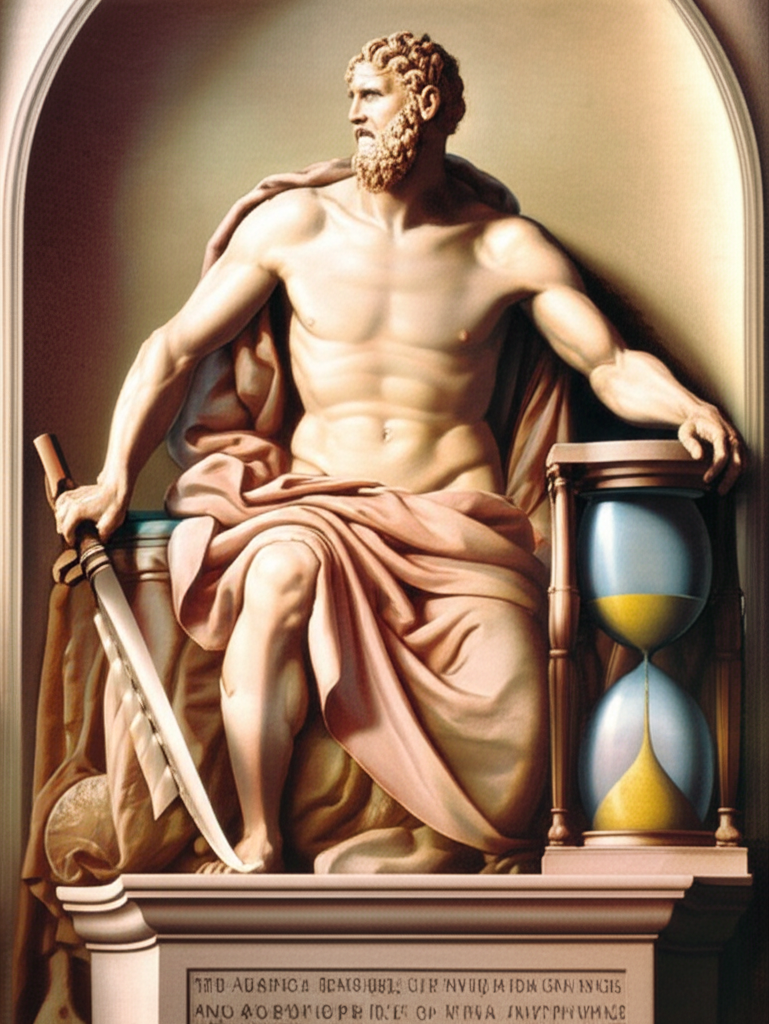 with an hourglass, juxtaposed with a modern, abstract representation of spacetime curvature, perhaps a glowing grid distorted by a sphere, symbolizing the convergence of ancient philosophical concepts with contemporary Physics.)
Modern Physics and Philosophical Echoes
The 20th century brought a seismic shift with Albert Einstein's theories of relativity, fundamentally altering our understanding of Space and Time.
- Special Relativity: Einstein demonstrated that space and time are not absolute but relative to the observer's motion. The faster an object moves, the slower Time passes for it relative to a stationary observer, and its length contracts in the direction of motion. This revolutionary idea dissolved Newton's absolute framework, revealing that space and time are inextricably linked into a single entity: spacetime.
- General Relativity: Further, Einstein showed that this spacetime continuum is not merely a static background but a dynamic entity that can be warped and curved by mass and energy. Gravity, in this view, is not a force but a manifestation of this curvature. This perspective profoundly redefines the relationship between matter, energy, Space, and Time, making them active participants in the cosmic dance.
These modern theories of Physics continue to echo ancient philosophical debates. The relativity of space and time forces us to re-evaluate the nature of objective reality, questioning whether there is a single, universal "now" or "here." The implications extend to quantum mechanics, where the very definitions of position and duration become fuzzy at subatomic scales, challenging our intuitive grasp of how the universe is structured. The pursuit of a unified theory of quantum gravity, which seeks to reconcile general relativity with quantum mechanics, remains one of the greatest challenges in contemporary Physics, pushing the boundaries of both scientific and philosophical inquiry into the ultimate nature of Space and Time.
The Enduring Quest
From Aristotle's Physics to Einstein's relativity, the journey to comprehend Space and Time is a testament to humanity's relentless curiosity. These concepts, while fundamental to Physics, remain fertile ground for philosophical exploration. The Quantity we measure in laboratories and observatories tells us much, yet the qualitative experience and metaphysical implications of Space and Time continue to inspire wonder and debate. As we push the frontiers of scientific knowledge, the philosophical questions posed by the Great Books of the Western World remain as relevant as ever, reminding us that the deepest truths often lie at the intersection of empirical observation and profound contemplation.
YouTube Video Suggestions:
-
📹 Related Video: ARISTOTLE ON: The Nicomachean Ethics
Video by: The School of Life
💡 Want different videos? Search YouTube for: "'Great Books Western World Aristotle Physics Time Motion'"
-
📹 Related Video: KANT ON: What is Enlightenment?
Video by: The School of Life
💡 Want different videos? Search YouTube for: "'Einstein's Relativity philosophical implications spacetime'"