

The Unfolding Tapestry: A Philosophical Inquiry into the Physics of Space and Time
Summary: From the ancient Greek philosophers who grappled with the nature of existence to the groundbreaking theories of modern physics, our understanding of Space and Time has undergone profound transformations. This article delves into the historical evolution of these fundamental concepts, examining how they transitioned from mere backdrops for events to dynamic, interwoven components of the cosmos. We explore the philosophical implications of these shifts, particularly concerning the quantity and reality of these dimensions, drawing insights from the intellectual heritage preserved in the Great Books of the Western World to illuminate our contemporary scientific worldview.
I. The Eternal Questions: What is Space? What is Time?
For millennia, humanity has gazed upon the cosmos, contemplating its vastness and the relentless march of moments. What exactly is the arena in which all existence unfolds? Is Space an empty void, a mere container waiting to be filled, or is it a substantive entity with its own properties? And what of Time? Is it a flowing river, an illusion, or a fundamental dimension of reality? These are not merely scientific questions; they are deeply philosophical inquiries that strike at the very heart of our being. The journey to answer them has been a grand intellectual adventure, one that has consistently blurred the lines between physics and metaphysics.
II. From Aristotelian Place to Newtonian Absolutes: Early Conceptions
The earliest systematic attempts to define Space and Time often emerged from observations of the natural world and the human experience.
A. Aristotle's Relational Universe
In the classical world, figures like Aristotle, whose ideas permeate the Great Books of the Western World, conceived of place not as an empty vacuum but as the innermost boundary of a containing body. For him, a true void was impossible. Time, similarly, was not an independent entity but rather the quantity of motion with respect to "before" and "after." It was inherently relational, tied to change and movement. Without change, there could be no Time. This perspective championed a universe where Space and Time were emergent properties of matter and events, not fundamental, pre-existing frameworks.
B. Newton's Absolute Framework
Centuries later, the scientific revolution, spearheaded by Isaac Newton, radically redefined these notions. Newton's Principia Mathematica posited the existence of:
- Absolute Space: An unmoving, invisible, and infinite container, existing independently of any matter within it. It was the ultimate, unchangeable stage upon which all physical events played out.
- Absolute Time: A universal, uniform flow, progressing independently of any observer or event. It was a cosmic clock, ticking away identically for everyone, everywhere.
This Newtonian framework, while incredibly successful in explaining celestial mechanics and earthly physics, introduced a profound philosophical shift. Space and Time became fundamental, substantial entities, their quantity measurable and consistent, forming the bedrock of reality.
III. Einstein's Revolution: The Fabric of Spacetime
The 20th century brought a seismic shift in our understanding, challenging the intuitive absolutes of Newton and ushering in the era of modern physics. Albert Einstein's theories of relativity fundamentally reshaped our perception of Space and Time.
A. Special Relativity: The Intertwining of Space and Time
Einstein's Special Theory of Relativity (1905) demonstrated that Space and Time are not independent, absolute quantities but are relative to the observer's motion. The faster an object moves, the more its Time dilates and its Space contracts relative to a stationary observer. This led to the revolutionary concept of spacetime – a unified, four-dimensional fabric where the three dimensions of Space and the one dimension of Time are inextricably linked.
- Key Implications:
- Relativity of Simultaneity: Events simultaneous for one observer may not be for another.
- Time Dilation: Time passes differently for observers in relative motion.
- Length Contraction: Distances appear shorter in the direction of motion.
B. General Relativity: Gravity as Curvature
Building upon special relativity, Einstein's General Theory of Relativity (1915) presented an even more astonishing revelation: gravity is not a force acting across Space, but rather a manifestation of the curvature of spacetime itself. Massive objects, like stars and planets, warp the fabric of spacetime around them, and this curvature dictates the paths of other objects, including light.
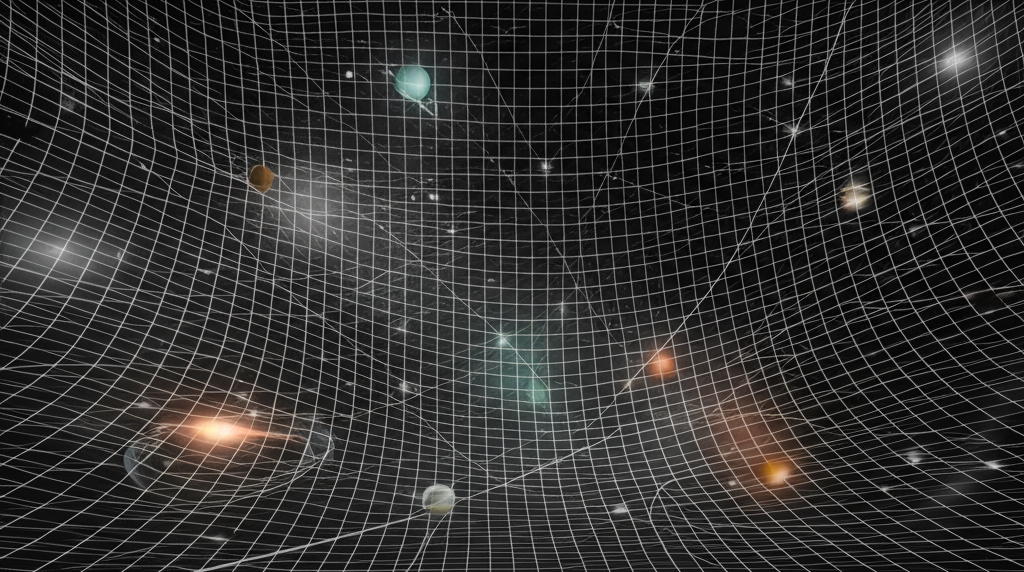
This profound insight transformed Space and Time from passive backdrops into active participants in the cosmic drama. They are dynamic, malleable, and intrinsically linked to matter and energy. The quantity of matter dictates the quantity of curvature, directly influencing the flow of Time and the geometry of Space.
IV. Philosophical Reverberations: The Nature of Reality
The insights from modern physics have not only advanced our scientific understanding but have also reignited and deepened ancient philosophical debates about the true nature of Space and Time.
A. Substantivalism vs. Relationalism Revisited
Einstein's spacetime continuum brings back echoes of the substantivalist debate (Newton's absolute Space and Time being real entities) versus relationalism (Leibniz's view that Space and Time are merely relations between objects and events). Is spacetime a fundamental "thing" that exists independently, or is it merely a description of the relationships between events? The very quantity of spacetime's curvature depends on the presence of matter, suggesting a deep relationality, yet spacetime itself seems to possess properties that can exist in the absence of matter (e.g., gravitational waves propagating through empty Space).
B. The Arrow of Time and the Block Universe
Modern physics often presents a "block universe" view, where all moments in Time – past, present, and future – exist simultaneously as part of the four-dimensional spacetime block. This challenges our intuitive experience of Time as a flowing "present" moving from a fixed past towards an open future.
- Key Philosophical Questions:
- Is the "flow" of Time an illusion, a product of human consciousness?
- Does the future already "exist" in some sense?
- What gives Time its direction (the "arrow of Time") if all moments are equally real?
C. The Quantum Realm: Further Mysteries
As we venture into quantum physics, the very concepts of Space and Time become even more enigmatic. At the Planck scale, Space and Time may not be continuous but granular, quantized into discrete units. This raises questions about the ultimate nature of reality, hinting that our familiar macroscopic Space and Time might be emergent phenomena rather than fundamental constituents.
V. Conclusion: The Ever-Expanding Horizon of Understanding
From Aristotle's relational definitions to Newton's absolute framework, and finally to Einstein's dynamic spacetime, our understanding of Space and Time has been a continuous journey of philosophical and scientific discovery. The physics of these fundamental dimensions continues to challenge our most basic intuitions, pushing the boundaries of what we consider real.
The Great Books of the Western World remind us that these questions are not new, but their answers are constantly evolving with our scientific progress. As we continue to probe the universe, the interplay between physics and philosophy remains crucial, ensuring that we not only understand how the cosmos works but also what it means for our place within it. The quantity of our knowledge expands, but the mystery of Space and Time endures, inviting endless contemplation.
YouTube Video Suggestions:
-
📹 Related Video: ARISTOTLE ON: The Nicomachean Ethics
Video by: The School of Life
💡 Want different videos? Search YouTube for: ""PBS Spacetime What is Time""
2. ## 📹 Related Video: KANT ON: What is Enlightenment?
Video by: The School of Life
💡 Want different videos? Search YouTube for: ""Brian Greene Fabric of the Cosmos Spacetime explained""