

The Physics of Space and Time: A Philosophical Inquiry
The very fabric of our existence, the stage upon which all events unfold, is woven from the enigmatic threads of Space and Time. For millennia, these fundamental concepts have captivated philosophers and scientists alike, their true nature remaining a profound mystery that continually redefines our understanding of reality. This article delves into the intricate relationship between physics and philosophy in discerning the essence of space and time, exploring how humanity's quest to quantify and comprehend these dimensions has evolved from ancient metaphysics to the groundbreaking theories of modern science, challenging our most deeply held intuitions about quantity and existence itself.
I. Ancient Contemplations: The Dawn of Spatial and Temporal Thought
Long before the advent of modern physics, the philosophers of antiquity grappled with the fundamental nature of space and time. Their inquiries, richly documented within the Great Books of the Western World, laid the groundwork for all subsequent scientific and philosophical exploration.
A. Defining Space: From Void to Place
The Greeks were acutely aware of the problem of space. Is it an empty container, a void, or is its existence contingent upon the objects it contains?
- Plato's Chora: In his Timaeus, Plato speaks of the chora—a receptacle or matrix, a kind of formless, indeterminate space that provides room for the material world to manifest. It is a concept that defies easy definition, being neither fully existent nor entirely non-existent, a kind of third genus alongside Forms and sensible things.
- Aristotle's Place: Aristotle, in his Physics, rejected the notion of empty space. For him, place (topos) was not an independent void but rather the innermost boundary of a surrounding body. An object's place is defined by what immediately encloses it. This relational view profoundly influenced Western thought for centuries, emphasizing the interconnectedness of objects and their environment.
B. The Elusiveness of Time: Motion and Measurement
Time proved even more elusive. How does one quantify something that is perpetually flowing, never truly present?
- Aristotle's "Number of Motion": Aristotle famously defined time as "the number of motion in respect of 'before' and 'after'." This definition links time intrinsically to change and movement, suggesting it is not an independent entity but a measure of processes. Here, the concept of quantity becomes central, as time is understood through counting discrete moments or intervals of motion.
- Zeno's Paradoxes: The pre-Socratic philosopher Zeno of Elea presented paradoxes (such as Achilles and the Tortoise, or the Arrow) that highlighted the profound philosophical difficulties in conceptualizing the infinite divisibility of space and time, and the nature of motion itself. These paradoxes questioned the very possibility of motion if space and time are infinitely divisible, underscoring the deep tension between our intuitive experience and logical deduction.
II. The Newtonian Cosmos: Absolute Space and Absolute Time
The scientific revolution, culminating in the work of Sir Isaac Newton, ushered in a radically new understanding of physics, space, and time. Newton's mechanistic universe, detailed in his Principia Mathematica, established a framework that would dominate scientific thought for over two centuries.
A. The Absolute Framework
Newton posited the existence of absolute space and absolute time.
- Absolute Space: This was conceived as a uniform, infinite, and immutable container, existing independently of any objects within it. It was, in essence, God's sensorium, a fixed backdrop against which all motion could be precisely measured.
- Absolute Time: Flowing uniformly and independently of any external reference, absolute time was a universal clock, ticking away at the same rate for everyone, everywhere. It was a pure duration, uninfluenced by events.
B. The Primacy of Quantity
Newtonian physics elevated the concept of quantity to its highest plane. Every phenomenon, every interaction, could be reduced to measurable quantities: mass, velocity, force, distance, and duration. This emphasis on precise measurement and mathematical description became the hallmark of scientific inquiry, allowing for unprecedented predictive power regarding the motion of celestial bodies and terrestrial objects.
Classical vs. Relativistic Views of Space and Time:
| Feature | Newtonian (Classical) View | Einsteinian (Relativistic) View |
|---|---|---|
| Space | Absolute, fixed, independent container. | Dynamic, interwoven with time (space-time), warped by mass/energy. |
| Time | Absolute, flows uniformly for all observers. | Relative, rate depends on observer's motion and gravitational field. |
| Relationship | Separate entities. | Inseparable continuum (space-time). |
| Gravity | A force acting between objects. | A manifestation of space-time curvature. |
| Quantity | Absolute measurements possible. | Measurements are frame-dependent. |
III. Einstein's Revolution: The Relativistic Continuum
The early 20th century witnessed a paradigm shift with Albert Einstein's theories of relativity, fundamentally altering our understanding of space, time, and their relationship to physics. His work challenged the very bedrock of Newtonian mechanics and introduced a universe far more dynamic and interconnected than previously imagined.
A. Space-Time: A Unified Fabric
Einstein's Special Theory of Relativity (1905) demonstrated that space and time are not independent entities but are interwoven into a single, four-dimensional continuum known as space-time. The measurements of distance and duration are not absolute but depend on the relative motion of the observer. Concepts like time dilation (moving clocks run slower) and length contraction (moving objects appear shorter) became startling consequences of this new framework. The quantity of time and space became relative, not absolute.
B. Gravity as Geometry
With the General Theory of Relativity (1915), Einstein further revolutionized our understanding by showing that mass and energy warp the fabric of space-time. What we perceive as gravity is not a mysterious force pulling objects together, but rather the curvature of space-time itself, guiding objects along geodesics—the shortest paths in this curved geometry. The presence of matter tells space-time how to curve, and space-time tells matter how to move. This profound connection between matter and the geometry of existence underscores the deep philosophical implications of modern physics.
IV. Philosophical Implications: Reality Reimagined
The journey from Aristotle's place to Einstein's space-time continuum has not merely been a scientific progression; it has been a continuous philosophical dialogue on the nature of reality.
- The Nature of Reality: If space and time are relative and dynamic, what does this imply about an objective reality? Is there a "block universe" where all moments—past, present, and future—are equally real, or does only the present truly exist? This question resonates with ancient debates on eternal forms versus transient phenomena.
- Causality and Determinism: Relativity's implications for causality are profound. The concept of simultaneity is relative, meaning events that are simultaneous for one observer may not be for another. This challenges our intuitive, linear understanding of cause and effect, and fuels discussions on determinism and free will.
- The Enduring Role of Quantity: Despite the shift from absolute to relative, the concept of quantity remains central to physics. From measuring the speed of light to quantifying the curvature of space-time, the scientific endeavor is fundamentally about assigning precise numerical values to phenomena. This continuous refinement of measurement not only advances our scientific understanding but also forces us to re-evaluate the philosophical underpinnings of what it means to measure, and what these measurements truly tell us about the world.
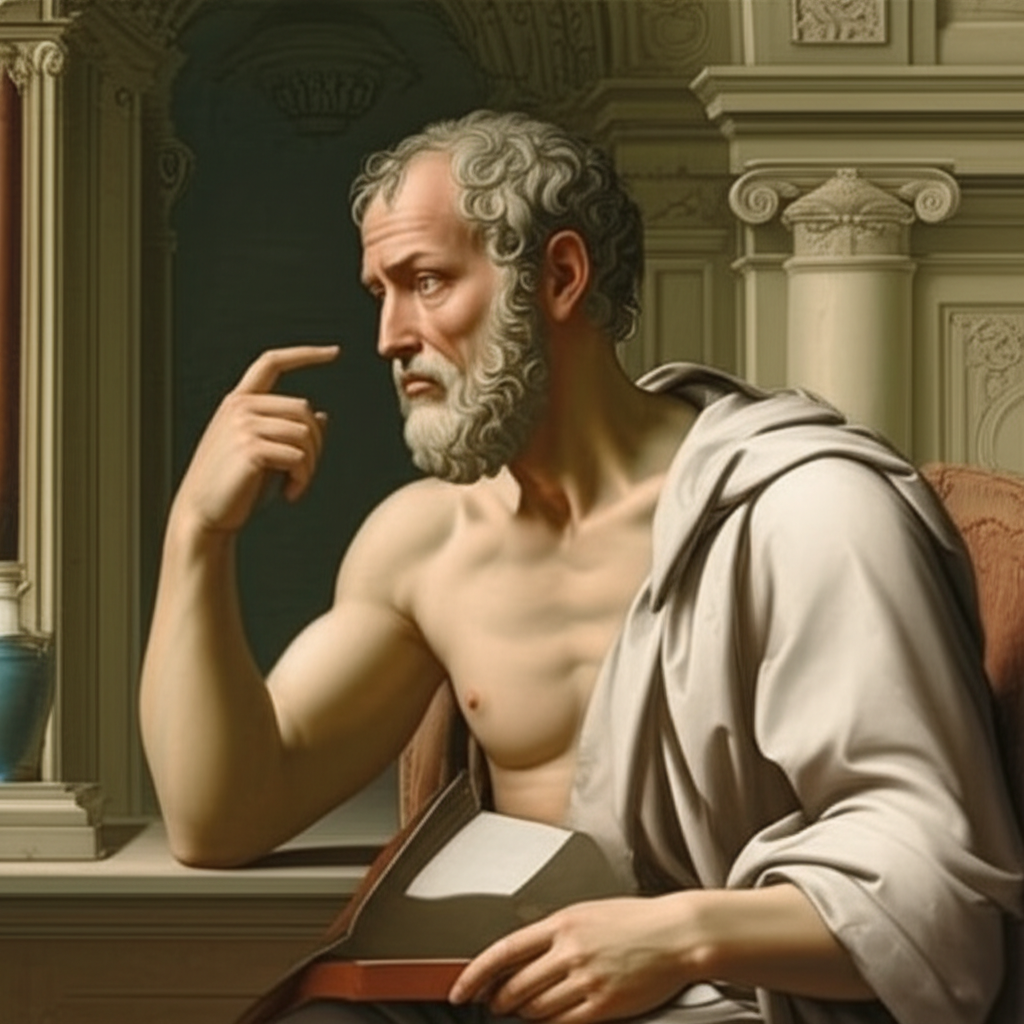 gazing upwards at a starry night sky. The stars are subtly connected by faint, glowing lines that represent the warping and interconnectedness of space-time, with a discernible gravitational lens effect around a central bright star, blending ancient contemplation with modern astrophysical concepts.)
Conclusion: The Unending Dialogue
The physics of space and time offers more than just scientific theories; it provides a fertile ground for profound philosophical inquiry. From the ancient Greeks pondering the nature of place and the flow of time, through Newton's absolute universe, to Einstein's dynamic space-time continuum, humanity's understanding has continually evolved. Each scientific advance has not only answered old questions but has also posed new ones, deepening our appreciation for the intricate relationship between the measurable quantity of the universe and the philosophical quest for meaning. As we continue to probe the cosmos, the dialogue between physics and philosophy will undoubtedly continue to illuminate the mysteries of existence, reminding us that the very stage of our being is as complex and wondrous as the drama that unfolds upon it.
📹 Related Video: KANT ON: What is Enlightenment?
Video by: The School of Life
💡 Want different videos? Search YouTube for: ""General Relativity Explained Philosophically""
📹 Related Video: What is Philosophy?
Video by: The School of Life
💡 Want different videos? Search YouTube for: ""What is Time? Philosophy and Physics Perspectives""