

The Enduring Enigma: Navigating the Physics of Space and Time
The concepts of Space and Time are not merely backdrops against which the drama of existence unfolds; they are active participants, fundamental constituents, and perhaps the most profound mysteries that both physics and philosophy have grappled with since antiquity. This article delves into how our understanding of these foundational elements has evolved, from the classical insights of the Great Books of the Western World to the revolutionary paradigms of modern science, highlighting the intrinsic connection between their physical description and their philosophical interpretation. We will explore how these concepts, often taken for granted, are in fact dynamic and complex, shaping our very perception of reality and challenging our notions of quantity and measurement.
From Absolute Stages to Dynamic Fabric: A Historical Journey
Our journey into the physics of Space and Time is a testament to humanity's relentless quest for understanding. What began as intuitive perceptions has transformed into a sophisticated scientific and philosophical inquiry, perpetually pushing the boundaries of what we thought possible.
The Classical Cosmos: Aristotle's Place and the Measure of Motion
For much of Western thought, influenced profoundly by figures like Aristotle, Space was not an empty void but rather a collection of places—the immediate boundary of a containing body. There was no "space" independent of objects; rather, objects defined space. Time, similarly, was not an independent flow but "the number of motion with respect to before and after." In this view, Time is a quantity derived from change, inseparable from the events it measures. This relational understanding, where Space and Time are defined by the objects and events within them, laid the groundwork for centuries of philosophical and scientific thought, emphasizing observation and the tangible world. The Great Books provide ample evidence of this perspective, where the cosmos is a plenum, and motion is the key to understanding temporal succession.
Newton's Grand Stage: Absolute Space and Absolute Time
The scientific revolution, spearheaded by Isaac Newton, dramatically altered this classical picture. Newton posited the existence of Absolute Space and Absolute Time. Absolute Space, he argued, "in its own nature, without relation to anything external, remains always similar and immovable." It was an infinite, immutable container, existing independently of any matter within it. Absolute Time, likewise, "in its own nature, without relation to anything external, flows equably and without relation to anything external." For Newton, Space and Time were the unchanging, objective framework within which all physical phenomena occurred. This absolute framework provided the necessary foundation for his laws of motion and universal gravitation, allowing physics to describe the universe with unprecedented precision. The quantity of space and time became measurable constants, forming the bedrock of classical mechanics.
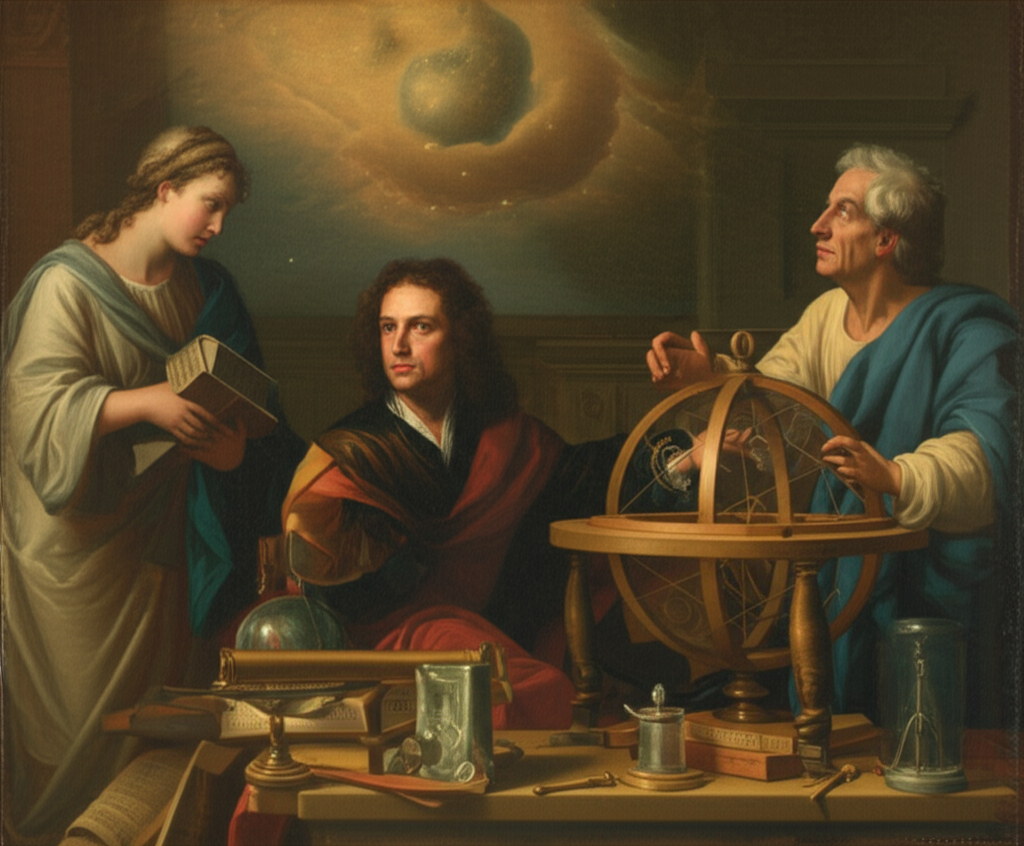 standing behind him, one pointing to a clock and the other to a geometric diagram, symbolizing the intertwining of absolute time, space, and human reason.)
Einstein's Revolution: Space-Time and Relativity
The 20th century brought another seismic shift with Albert Einstein's theories of relativity. Special Relativity (1905) shattered the Newtonian absolutes, demonstrating that Space and Time are not independent entities but are interwoven into a single, four-dimensional fabric called space-time. The measurement of both Space and Time becomes relative to the observer's motion. Concepts like time dilation and length contraction showed that what one observer perceives as a fixed quantity of time or space can be different for another moving relative to them.
General Relativity (1915) took this even further, revealing that space-time is not merely a passive background but a dynamic participant in the universe. Mass and energy warp the fabric of space-time, and this curvature is what we perceive as gravity. Planets orbit the sun not because of a mysterious force pulling them, but because they are following the curves in space-time created by the sun's immense mass. This revolutionary understanding fundamentally redefined the subject matter of physics, transforming Space and Time from inert containers into an active, malleable component of reality, whose quantity and structure are influenced by matter and energy.
Key Concepts in the Physics of Space and Time
To fully grasp the contemporary understanding, it's useful to delineate some core ideas:
- Relativity of Simultaneity: Events that appear simultaneous to one observer may not be simultaneous to another observer in relative motion. This directly challenges the intuitive notion of a universal "now."
- Time Dilation: Time passes more slowly for an object in motion relative to a stationary observer. This effect is subtle at everyday speeds but becomes significant at velocities approaching the speed of light.
- Length Contraction: The length of an object measured by an observer moving relative to the object is shorter than its length measured by an observer at rest with respect to the object.
- Gravitational Lensing: The bending of light as it passes near a massive object, a direct consequence of space-time curvature predicted by General Relativity.
These phenomena are not mere theoretical constructs; they have been rigorously tested and confirmed through countless experiments, from atomic clocks on airplanes to observations of distant galaxies.
Philosophical Ramifications and the Nature of Quantity
The evolution of our understanding of Space and Time has profound implications beyond the realm of physics. Philosophers have long debated whether Space and Time are real entities, properties of objects, or merely conceptual frameworks imposed by the human mind (as Kant might suggest).
| Philosophical Stance | Description | Connection to Physics |
|---|---|---|
| Substantivalism | Space and Time exist independently of objects and events, like an empty stage. | Aligns with Newtonian absolute Space and Time. |
| Relationalism | Space and Time are merely relations between objects and events, not independent entities. | Echoes Aristotle's view; finds some resonance with the dynamic, interconnected nature of space-time in relativity. |
| Idealism | Space and Time are subjective forms of intuition, inherent to the human mind, not objective reality. | Challenges the very premise of physics describing an external reality, raising questions about the ultimate nature of quantity. |
The concept of quantity itself becomes more nuanced. In classical physics, quantity often implied a fixed, measurable attribute independent of the observer. However, relativity demonstrates that the quantity of a spatial interval or a temporal duration can vary depending on the observer's frame of reference. This forces us to reconsider what it means for something to be "real" or "objective." Are the fundamental quantities of the universe inherent, or are they partially constructed through our interaction with them?
The ongoing quest for a unified theory of physics, such as quantum gravity, promises even deeper insights into the nature of Space and Time. It is likely that at the quantum scale, our familiar notions of continuous space-time may break down, giving way to something far more granular and exotic.
Conclusion: An Unfinished Symphony
Our journey through the physics of Space and Time reveals a narrative of constant re-evaluation and profound discovery. From the relational views of antiquity to Newton's absolute stage, and finally to Einstein's dynamic, interwoven space-time fabric, each epoch has redefined our understanding of these fundamental constituents of reality. The interplay between philosophical inquiry and scientific exploration continues to push the boundaries, challenging our intuition and expanding our comprehension of the universe. The precise quantity and nature of Space and Time remain an unfinished symphony, with new movements yet to be composed by the relentless pursuit of knowledge.
📹 Related Video: ARISTOTLE ON: The Nicomachean Ethics
Video by: The School of Life
💡 Want different videos? Search YouTube for: ""General Relativity Explained Visually""
📹 Related Video: KANT ON: What is Enlightenment?
Video by: The School of Life
💡 Want different videos? Search YouTube for: ""What is Time? Does it Flow?""