

The Enduring Enigma: A Philosophical Look at the Physics of Space and Time
The concepts of Space and Time are not merely backdrops against which the drama of existence unfolds; they are active participants, fundamental constituents of reality that have captivated philosophers and scientists alike for millennia. This article delves into the Physics of these elusive quantities, tracing our understanding from ancient philosophical musings to the profound insights of modern science, and exploring how these scientific advancements continually reshape our philosophical landscape. We examine how physics attempts to measure, define, and ultimately comprehend the very fabric of our universe, challenging our intuitive grasp of what it means to be, and to be when.
From Ancient Cosmos to Newtonian Absolute: The Evolution of Space and Time
The journey to understand Space and Time is as old as human thought itself. For the ancient Greeks, represented in the Great Books of the Western World, figures like Aristotle grappled with these concepts not as empty voids or independent dimensions, but as properties intrinsically linked to matter and motion. In his Physics, Aristotle conceived of space (or "place") as the innermost boundary of a surrounding body, and time as "the number of motion in respect of 'before' and 'after'". These were not abstract containers, but relational aspects of the physical world.
Centuries later, the scientific revolution ushered in a radically different perspective. Isaac Newton, whose Principia Mathematica stands as a monumental achievement, posited the existence of absolute Space and absolute Time. For Newton, Space was an infinite, immutable, and invisible container, independent of any matter within it, providing a fixed reference frame for all motion. Similarly, Time flowed uniformly, eternally, and independently of any observer or event. These were bedrock quantities of the universe, unassailable and universally applicable, forming the unshakeable foundation of classical Physics. This Newtonian paradigm, intuitive and highly successful in describing the observable universe, dominated scientific thought for over two centuries, solidifying the idea of Space and Time as distinct, fundamental, and unchanging entities.
Physics Redefined: Einstein's Relativistic Universe
The 20th century brought a seismic shift in our understanding, fundamentally altering the Newtonian framework. Albert Einstein's theories of Special and General Relativity shattered the notion of absolute Space and Time, revealing them to be far more intricate and interconnected than previously imagined.
Special Relativity (1905):
- Relativity of Simultaneity: Events simultaneous for one observer may not be simultaneous for another, if they are in relative motion.
- Time Dilation: Time passes more slowly for objects moving at high speeds relative to a stationary observer.
- Length Contraction: The length of an object appears to contract in the direction of its motion when observed from a different reference frame.
- Spacetime: The most profound insight was the unification of Space and Time into a single, four-dimensional continuum called spacetime. They are not separate entities but different facets of the same reality, inseparable and interlinked. The speed of light (c) became the universal constant, dictating the relationship between spatial and temporal dimensions.
General Relativity (1915):
- Gravity as Spacetime Curvature: Einstein proposed that gravity is not a force acting at a distance, as Newton believed, but rather a manifestation of the curvature of spacetime itself, caused by the presence of mass and energy. Massive objects warp the fabric of spacetime around them, and other objects (including light) follow these curves.
- Dynamic Quantity: This theory transformed Space and Time from passive backgrounds into active, dynamic participants in the universe's mechanics. They are no longer static, absolute quantities but are influenced by, and in turn influence, the matter and energy within them.
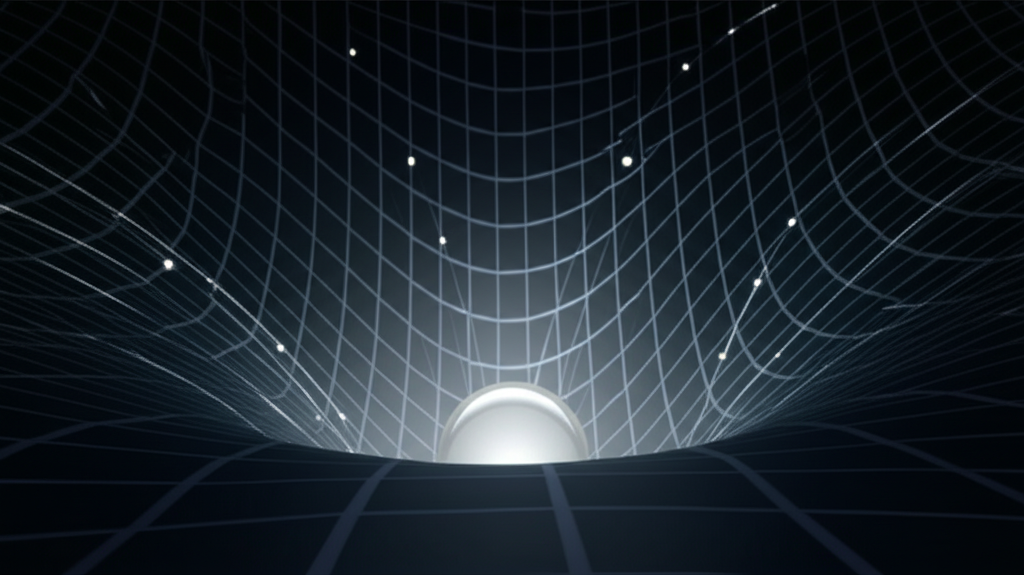
This revolutionary Physics forced philosophers and scientists alike to reconsider foundational questions about reality, causality, and the very nature of existence. The quantity of time, for instance, became observer-dependent, a notion that challenges our deepest intuitions.
The Quantum Realm: When Space and Time Get Weird
While relativity describes the universe on grand scales, quantum mechanics governs the subatomic world, and here too, our conventional notions of Space and Time face profound challenges. At the Planck scale (the smallest theoretical units of length and time), the smooth, continuous fabric of spacetime described by general relativity is expected to break down.
- Quantum Foam: Some theories suggest that at these incredibly tiny scales, spacetime might not be smooth but rather a chaotic "quantum foam," fluctuating wildly.
- Non-Commutative Geometry: Other theoretical frameworks propose that Space and Time might not even be fundamental at the quantum level, but rather emergent properties arising from deeper, more abstract structures.
- Uncertainty: The inherent uncertainty principle of quantum mechanics also hints at fundamental limits to how precisely we can measure certain quantities, including potentially the position and momentum within spacetime simultaneously.
The quest to reconcile general relativity with quantum mechanics – to formulate a theory of quantum gravity – remains one of the greatest challenges in modern Physics, and its resolution promises to further revolutionize our understanding of Space and Time.
The Philosophical Quantity: Measuring the Unmeasurable
The scientific evolution of Space and Time has profound philosophical implications. If Time is relative, does a universal "now" exist? If Space is curved, what does "straight" even mean on a cosmic scale? The very quantity of these concepts, once thought self-evident, now appears complex and observer-dependent.
- Determinism vs. Free Will: The nature of Time as a dimension, potentially traversable in theory (though not practically), raises questions about the linearity of events and the implications for free will.
- The Nature of Reality: Do Space and Time exist independently of our minds (realism), or are they merely constructs of our perception (idealism), as Kant once argued, albeit under a different scientific paradigm?
- The Beginning and End: Modern cosmology, rooted in general relativity, speaks of a beginning of Time (the Big Bang) and potential ends (heat death, Big Crunch). This brings scientific rigor to ancient theological and philosophical debates about creation and eschatology.
The ongoing dialogue between Physics and philosophy is crucial. While Physics provides the empirical data and mathematical models to describe Space and Time, philosophy grapples with the existential and epistemological consequences, pushing us to ask what these quantities truly mean for our understanding of ourselves and our place in the cosmos.
Further Exploration:
-
📹 Related Video: PLATO ON: The Allegory of the Cave
Video by: The School of Life
💡 Want different videos? Search YouTube for: ""Philosophical Implications of Einstein's Relativity""
-
📹 Related Video: What is Philosophy?
Video by: The School of Life
💡 Want different videos? Search YouTube for: ""What is Time? Philosophy and Physics""
Concluding Reflections: The Continuing Quest
From Aristotle's relational definitions to Newton's absolute container, and finally to Einstein's dynamic, interwoven spacetime, our understanding of Space and Time has undergone radical transformations. Modern Physics has shown us that these fundamental quantities are not passive stages, but active participants, shaped by and shaping the universe. As we venture further into the quantum realm and the mysteries of cosmic origins, the dialogue between scientific inquiry and philosophical contemplation will undoubtedly continue to evolve, pushing the boundaries of what we can know about the very fabric of existence. The quest to fully grasp "The Physics of Space and Time" remains one of humanity's most profound and enduring intellectual adventures.